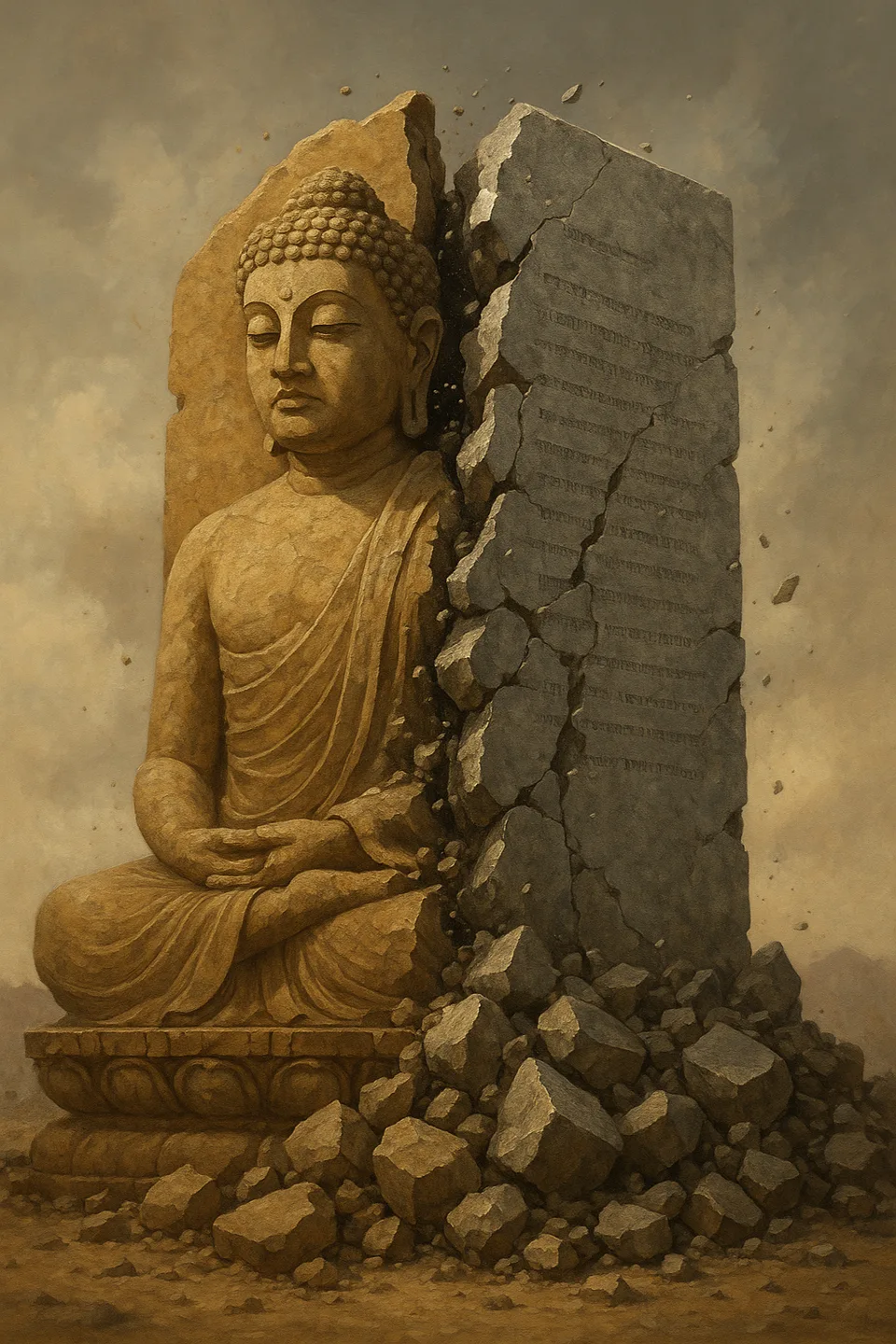
If you hand a stick of dynamite to a Taliban fighter in 2001 and tell him there’s a 1,500-year-old Buddhist statue smiling peacefully in a cliff face, you’ll hear the same justification you’d hear from a guy in Georgia in 2022 backing a truck up to the Guidestones at four in the morning: God told me to.
Different accents, different scriptures, same demolition job.
We like to think the distance between rural Afghanistan and rural Georgia is measured in oceans and cultures, but on the map of human behavior, they’re right next door. The costumes change—flowing robes or camouflage, headscarves or baseball caps—but the script is identical. Step one: decide your holy book is the only map of reality. Step two: see anything outside its borders as dangerous. Step three: destroy it, whether it’s carved in stone, written on a page, or living in your neighbor’s house.
Fundamentalism’s PR team likes to spin this as “defending truth,” but in practice it’s more like “erasing anything that reminds me the world is bigger than my story.” The Taliban did it with the Bamiyan Buddhas. ISIS did it with Assyrian artifacts. The Spanish Inquisition did it with books and people in equal measure. The Puritans did it with “heathen” ceremonies. The Catholic Church in the Dark Ages burned manuscripts and flattened temples so thoroughly you’d think God Himself was allergic to architecture.
The Georgia Guidestones may not have been ancient—they went up in 1980—but the reasons for blowing them up rhyme perfectly with those older acts. They dared to speak in universal terms about humanity, to suggest our sacred duty might be to live in balance with nature rather than conquering it. For the true believer who’s certain God gave man dominion over everything, that’s blasphemy with a capital B.
It’s easy to get distracted by the aesthetics—sandstone Buddhas versus polished granite slabs—but the real common thread isn’t the material, it’s the mindset. Absolute certainty turns the brain into a gated community where no new ideas are allowed to move in. History that doesn’t match the homeowner’s association rules is bulldozed. Art that doesn’t affirm the bylaws is banned. People who don’t fit the covenant get exiled or worse.
In Mirror Theory terms, what fundamentalists destroy is never the actual threat—it’s the reflection of their own insecurity. A statue of the Buddha isn’t dangerous in itself, but it’s a reminder that another way of living and thinking has persisted for centuries without their God at the center. The Georgia Guidestones weren’t going to topple Christianity, but they whispered the heresy that humanity’s purpose might not be infinite growth. These are mirrors they cannot look into without seeing the cracks in their own glass.
History is an endless loop of this same impulse. From the Library of Alexandria to pagan temples in Europe, from Reformation mobs tearing down Catholic icons to modern extremists with truck bombs—the names change, the zeal stays the same. And here’s the cosmic joke: the more they destroy, the more mythic the thing becomes. The Buddhas live on in photographs and memory as symbols of resilience. The Guidestones are now legend, freed from geography and given immortality in story.
That’s why the parallels between a Taliban fighter and a Guidestone bomber aren’t an insult to either culture—they’re a diagnosis of the same human flaw. Two books, one disease. Both convinced the cure is purity, and both terrified of the messiness of a plural world.
And here’s the hard truth: the messiness is the point. That friction between worldviews, that uncomfortable coexistence of myths and meanings—it’s the only thing that keeps the knives sheathed and the monuments standing. The moment we decide one story must erase all the others, we’re already holding the match. The only real defense against fundamentalism isn’t to swap one holy book for another—it’s to refuse the idea that any book gets to be the only one.