About two months ago I was watching pups for one of my best friends. They were out of town, so I stayed at their house with their two dogs—the kind of dogs you can’t help but love if you spend more than ten minutes with them. There’s a special kind of joy in living inside someone else’s routines for a bit: familiar couch dents, different light through the windows, the soft chaos of paws on hardwood at 2 a.m.
What made it even better was the rhythm of it. I’d keep their dogs at their home while they were away, then drive back and spend time with my own dogs off and on during the day. It felt like living in two overlapping worlds—two sets of food bowls, two sets of little rituals, two kinds of comfort. A small, sweet loop of responsibility and affection.
My friend is also a gaming addict, a lot like me, and he decided to take his Xbox with him on his trip. Under normal circumstances, I’d simply bring my own—but I’ve got an eight-year-old gamer at home now, and the Xbox has become less “mine” and more “a critical household organ.” Removing it would cause immediate system failure. So I did the responsible thing and left it.
Which dropped me straight into what I can only describe as gaming despair: that twitchy void where you have time to play, the desire to disappear into something, and none of your usual portals available. In that state, I did what any modern person does when deprived of their preferred vice—I found a substitute that looked harmless.
A little browser game called Cookie Clicker.
On the surface it’s ridiculous in the purest way. You click a cookie. You get a cookie. You use cookies to buy things that make more cookies so you can buy more things that make more cookies so you can… you get it. At first it feels like a joke you’re in on—a satire of productivity, a parody of capitalism, an idle game for idle moments. Click. Cookie. Click. Cookie.
But then the escalation starts.
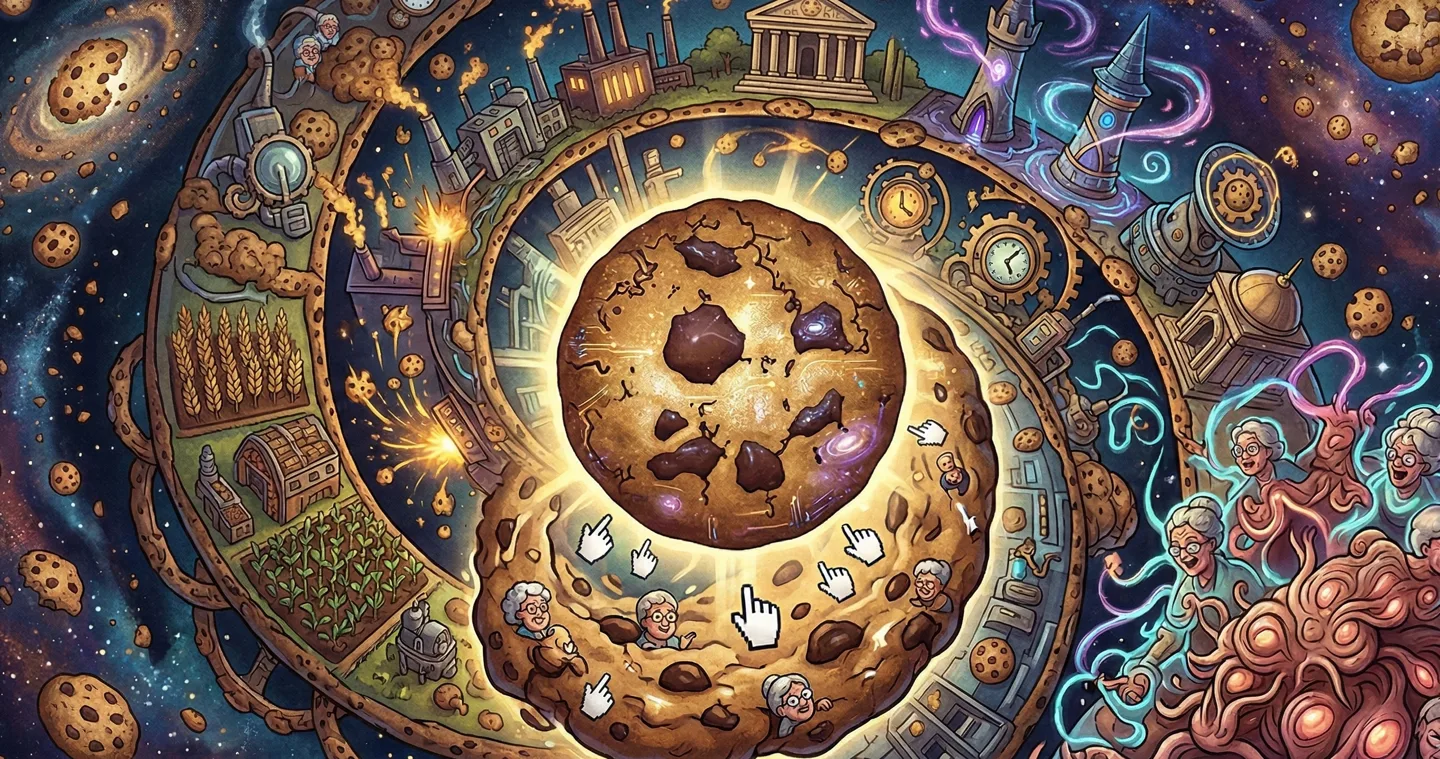
You buy a cursor. Then a grandma. Then more grandmas. Then farms. Factories. Banks. Temples. Wizard towers. Time machines. Antimatter condensers. Eventually you’re purchasing multiple versions of yourself, whose only purpose is to generate more cookies per second inside a universe where cookies are no longer food—they’re infrastructure. They’re physics. They’re cosmology. They’re the fabric of reality.
The game reveals itself like a magician pulling scarves from their sleeve. Just when you think you’ve seen the joke, it produces another layer. Just when you think you’ve reached the ceiling, you discover there’s an attic. It keeps expanding in a way that feels both hilarious and faintly unsettling, like it’s teaching you something while pretending it’s not.
And then comes the moment where the game’s sweetness curdles into something stranger. The comforting grandma energy goes… eldritch. The tone shifts. What started as cozy and domestic becomes fleshy and hive-minded and cosmic. The game takes the most harmless symbol it has and reveals the shadow inside it, like it’s quietly reminding you: nothing stays simple once you look closely enough.
Then one day you look up—two months later—and realize you’re reading guides, learning optimization strategies, planning build orders, timing upgrades, managing systems, min/maxing production like you’re running a small interdimensional economy. I am currently earning 3 sexdecillion cookies a second. That sentence should not be possible, and yet here we are.
Here’s the part that really got me: the “me” doing this isn’t the same person who started. The early player is all impulse—click, reward, click, reward. The later player is a different psychological creature: patient, strategic, systems-minded, weirdly calm about astronomical numbers. Somewhere along the way, the game didn’t just scale up the cookies. It scaled up the player. It quietly replaced the person at the keyboard with a newer model who can tolerate a larger universe.
Now I’m back at my friend’s house again for another week of dog watching, living inside that same borrowed routine of bowls, leashes, and joyful chaos, still doing the back-and-forth to check in on my own dogs during the day. I’m still playing Cookie Clicker—because of course I am—and last night, somewhere between a dog doing laps around the living room and me checking my cookie production like it’s a stock ticker, I had a thought that stopped me in my tracks.
This is how life works.
Not the cookie part. (Although… who knows.) The layers part.
Because Cookie Clicker is a deceptively simple interface sitting on top of an absurd amount of depth—depth that doesn’t appear all at once. It appears in stages. It appears after you’ve adapted to the previous stage. It appears right when you’ve mastered what you thought was the game.
At the beginning, you can’t even imagine wizard towers and time machines because your world is made of clicks. Your imagination is limited by your current scale, by what you’ve already seen. The cookie universe feels flat and understandable and kind of cute—just a tiny loop of effort and reward.
Then the game expands. The numbers inflate. The logic evolves. New mechanics arrive. And what once felt like “the whole thing” becomes a baby version of itself, like your first understanding was a sandbox designed to train your hands and seduce your attention before the real complexity showed up.
Life does this too.
We start with the simplest layer of existence we can perceive: get through the day, find comfort, avoid pain, seek pleasure, learn the rules. For a while, that’s the whole map. The world feels like something you can figure out if you’re smart enough, disciplined enough, lucky enough. You build your little cookie factory, optimize your daily clicks, try to win.
Then—if you’re paying attention, or if you’re forced by experience—something shifts. A new layer opens. Maybe it’s love. Or loss. Or parenthood. Or grief. Or wonder. Or the sudden realization that the assumptions you’ve been leaning on don’t actually hold. A new mechanic appears, and you understand there’s a game happening under the game you thought you were playing. You can’t unsee it.
Life keeps offering what feels like a complete worldview and then quietly revealing it was only a tutorial. You finally get stable and think, Okay. I understand. And then something happens and you realize you didn’t understand anything—you just got comfortable. You reach what feels like mastery, and reality whispers: new content unlocked.
The deeper levels don’t just require more knowledge. They require a different you. And that’s the part that’s both humbling and strangely hopeful: you can’t always force understanding, but you can become someone who can hold it. The same event that would have shattered an earlier self becomes, for a later self, difficult but survivable—maybe even illuminating. Reality doesn’t just reveal itself. It trains the perceiver.
And that shift isn’t graceful. It isn’t a clean upgrade. It’s often confusing and humbling. It can feel like losing the plot, like discovering the “rules” you relied on were never universal—they were provisional. But if you stick with it, something else emerges: a respect for the hidden complexity of things, and a quiet suspicion that every time you declare, This is it. This is reality, you’re just standing at the edge of another unopened menu.
So yes—Cookie Clicker is absurd. A universe made of cookies. Grandmas industrialized. Your own clones generating baked goods at the speed of cosmic expansion. But it’s also, accidentally, a parable: a silly mirror for the way reality unfolds, one awakening at a time.
The deeper joke—the one I can’t shake—is that you don’t beat Cookie Clicker. You just keep unlocking more Cookie Clicker. You don’t solve life either. You just keep unlocking more life.
And maybe the point isn’t to reach the final upgrade. Maybe the point is to notice the moment the next layer reveals itself and respond without panic, without needing to control it.
Ah. New content.
Then click once more—not because you’re sure it matters, but because it’s what you do when you’re alive. You participate. You learn. You expand. You let the universe keep surprising you.