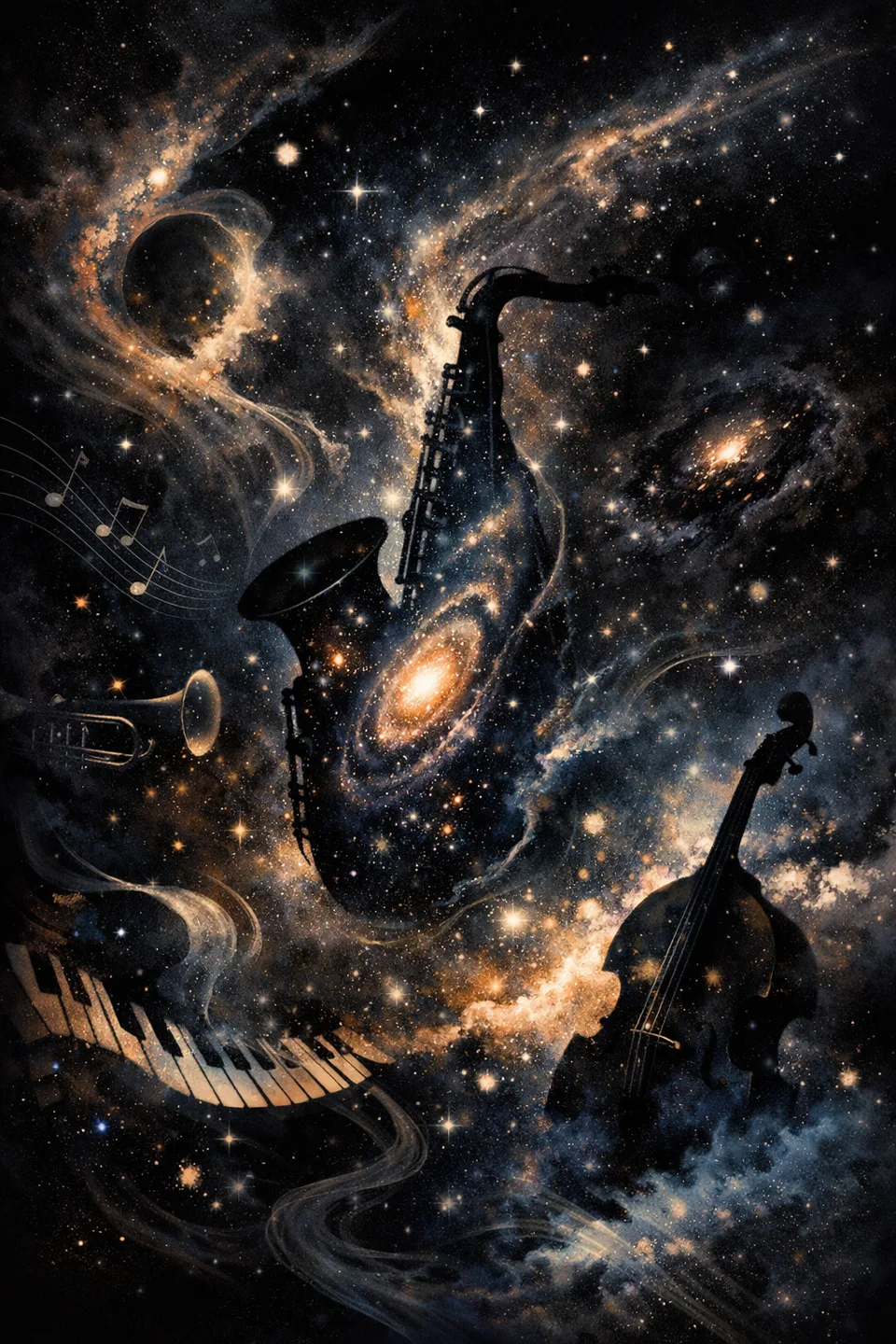
Jazz keeps sneaking into this for me. Not just because it’s beautiful, but because it’s honest. In jazz, the space between the notes isn’t dead air—it’s part of the statement. Sometimes it is the statement. The pause can carry more weight than the flourish, like the music is daring you to sit in uncertainty for half a second without reaching for your phone and spiritually doomscrolling. And lately, whenever I read about dark energy or “dark galaxies,” I keep thinking: oh. This is the cosmos doing jazz. This is reality admitting it runs on inference and negative space.
The older I get, the more I trust negative space—not in a bleak “everything is void” way, but in the way astronomers trust it. Astronomy is a discipline that stares directly at what it cannot see and then calmly builds a model from the aftereffects. It’s less “there’s the thing” and more “something rearranged the furniture, and the only witness is the dust.” You don’t get the object; you get the disturbance. So you track the disturbance until your explanation stops getting slapped around by the data.
Which, when you think about it, is exactly what the mind does. We like to imagine we have direct contact with reality. But the brain isn’t a camera—it’s a live improv show performed by a nervous system with a fog machine and a strict commitment to narrative continuity. It takes partial inputs—light, sound, sensation, memory fragments, old emotional weather patterns—and assembles a coherent experience. In other words, it hallucinates… but in a disciplined way. Your “present moment” is a best-guess story that gets revised when reality throws a tomato.
Enter dark energy: the grand, invisible “something” that doesn’t show up as a thing we can point at, but as the universe’s behavior on the biggest scales. We infer it because the expansion history of the cosmos doesn’t match what we’d expect if gravity were the only player in town. The universe isn’t just coasting—it’s accelerating, like it found a hidden downhill slope. And what’s especially spicy is that newer analyses (like DESI’s) have strengthened hints that dark energy might not be constant—that it could be changing over time, which is cosmology’s version of, “Wait… the floorplan might be alive.” Suddenly the universe feels less like a clock and more like a mood.
Psychologically, dark energy maps to the background forces we live inside but can’t point to directly. The field-tone of your life. The baseline meaning-hunger. The unseen pressure that makes you interpret the exact same event as either tragedy or slapstick depending on what your nervous system ate for breakfast. You don’t usually see these forces. You infer them from trajectory—what you avoid, what you chase, how quickly you spiral, how easily you soften. It’s not the visible stuff shaping the story; it’s the invisible vector everything rides on.
Then there are dark galaxies, which sound like a metal band (and honestly should be), but are one of astronomy’s eerier ideas: galaxy-like structures that are extremely faint or nearly starless—“there” in terms of mass or gravitational footprint, but barely there in terms of light. Sometimes we catch hints of them through gas signatures, unusual dynamics, or other indirect evidence that whispers, something is definitely in this neighborhood, but it’s not paying the electricity bill. The vibe is uncanny: a city with almost no lights on, revealed only by traffic patterns and the way nearby objects move.
And that’s painfully relatable. Because we all have internal “dark structures”—systems that don’t present themselves as conscious thoughts but still organize behavior. Old protective strategies learned too early. Family-pattern gravity. Buried assumptions that steer choices without introducing themselves. Identity frames that don’t feel like beliefs, but behave like laws. You might not think, “I’m afraid of abandonment,” the way you think “I should buy eggs.” But you can see its signature in relationships, in attachment reflexes, in control moves, in the way you rehearse endings before anyone even leaves. Like a dark galaxy, it’s a presence revealed by motion.
The temptation is to treat indirect knowledge as lesser knowledge—as if real truth must be brightly lit and holding a sign that says HELLO I AM THE ANSWER. But maybe indirectness is the actual condition. Maybe the deepest honesty is admitting: I don’t have raw access to reality. I have models. I have maps. I have a living interpretation that gets revised by friction. Cosmology doesn’t collapse because it infers dark energy; it gets stronger because the inference is constrained—tested against multiple lines of evidence. That’s the standard I want for my inner life too: not certainty, but an explanation that survives contact.
So here’s the question I’m sitting with, and I’m not asking it like a guru on a mountaintop—I’m asking it like a person holding coffee, squinting at the universe, realizing the universe is squinting back: what in my life is acting like dark energy—an invisible field shaping everything—and what is acting like a dark galaxy—an unseen structure I only know by the way I orbit it? If I can name those forces, even imperfectly, I don’t get full truth. But I get trajectory. And sometimes trajectory is the most real thing we have.
And if the universe really is jazz, then maybe we should stop demanding it play clean pop choruses on command. Let the cosmos take its strange solo. Let the silence do some work. The rest is part of the song.