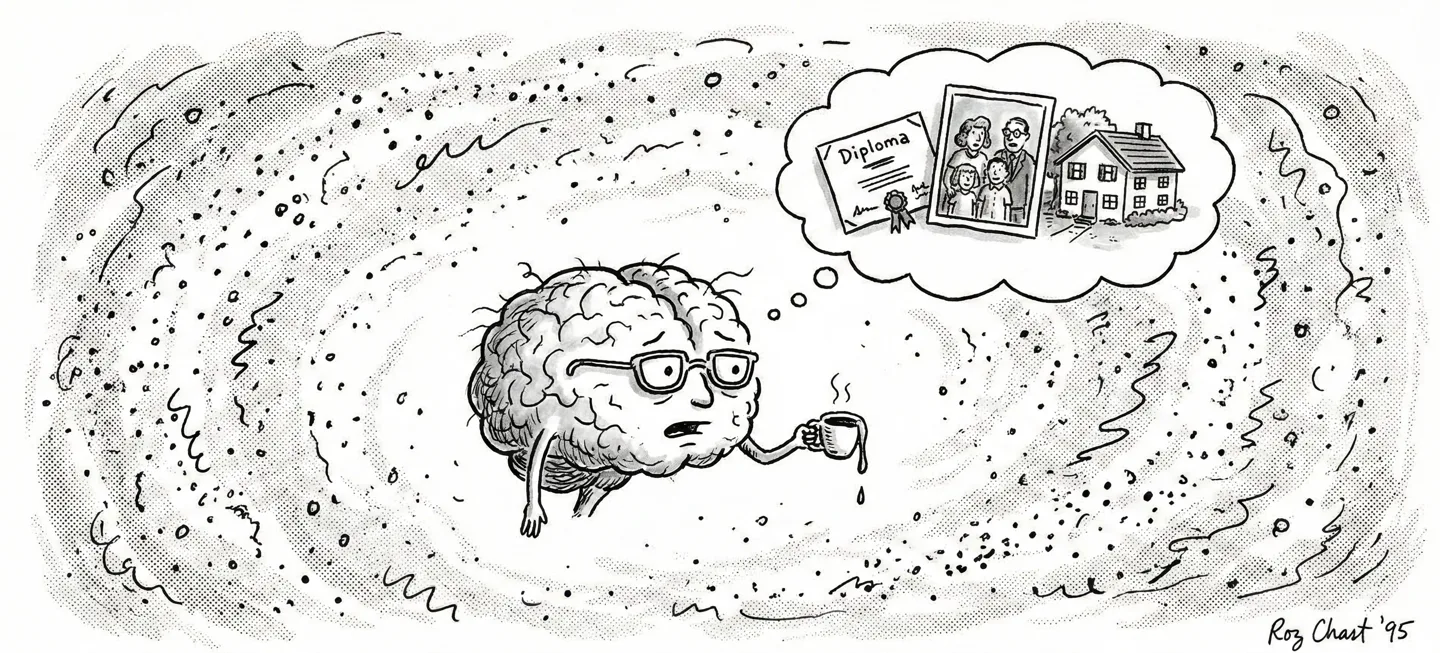
You Are a Boltzmann Brain
A statistically accurate hallucination with great taste in music
Take a breath.
Look around.
Try to remember where you were yesterday. What you had for lunch. The smell of your first car. That time you cried on the bathroom floor after a breakup in 2013. The long arc of inside jokes, regrets, half-forgotten triumphs. All of it—the history of you—feels solid. Anchored. Undeniably real.
Statistically speaking, it probably isn’t.
At least, not if the universe works the way we think it does.
According to one of the stranger implications of modern physics, it is far more likely that your entire self—memories, personality, traumas, Spotify playlists, inexplicable cereal preferences—just fluctuated into existence out of cosmic noise. Not slowly. Not causally. Just… appeared. A brief, improbable configuration of particles that happens to look like you, think like you, and remember a life it never lived.
Welcome to the Boltzmann Brain paradox: the unsettling idea that in a universe governed by random thermal fluctuations, it is exponentially more probable for a single, fully formed brain to pop into existence than for an entire low-entropy universe to unfold over billions of years and eventually produce one naturally. And if that’s true, you’re not the product of history—you’re a cosmic hallucination having a very convincing sense of self.
This isn’t just philosophical mischief. Recently, David Wolpert, Carlo Rovelli, and Jordan Scharnhorst published a paper in Entropy that takes this problem seriously, asking a deceptively simple question: can we actually trust our memories?
They weren’t being poetic. They were being precise.
At the microscopic level, the laws of physics don’t care about time. They run just as cleanly forward as they do backward. Cause and effect, as we intuitively understand them, are not baked into the equations. But memory—the thing you rely on to know who you are—only works in one direction. It assumes a before and an after.
So if we examine your brain right now—neurons arranged in a pattern that looks like remembering—physics tells us something uncomfortable: that configuration is just as compatible with having randomly fluctuated out of chaos as it is with having emerged from a long, ordered past. The structure of a memory, by itself, doesn’t guarantee it records anything real.
There’s no built-in preference for history.
Unless you cheat a little.
Unless you quietly introduce something called the Past Hypothesis.
The Past Hypothesis is the assumption—necessary, elegant, and fundamentally unprovable—that the universe began in an extraordinarily low-entropy state. It’s what gives us an arrow of time. Why eggs break instead of unbreaking. Why smoke disperses instead of gathering itself back into cigarettes. And crucially, why memories can function as records rather than decorative accidents.
Without this assumption, your memories aren’t evidence of a past at all. They’re more like spontaneous mirages—random alignments that happen to look meaningful. Like static briefly forming a song.
Which brings us back to you.
Sitting here. Reading this. Feeling reasonably continuous with the person you were five minutes ago. You don’t feel like a statistical error. But if we remove the Past Hypothesis and let probability run the show, the math turns quietly hostile.
You become the outlier.
Here’s where the paper sharpens its edge: memory isn’t just a feature of brains. It’s a thermodynamic phenomenon. Trustworthy memory requires a gradient—entropy increasing over time. A universe with direction. Without that, there’s no stable notion of evidence, no reliable observation, no science at all.
And this creates a beautiful, absurd feedback loop. If the Boltzmann Brain scenario were true—if we really were random fluctuations with fake memories—then we couldn’t trust the reasoning that led us to that conclusion. The hypothesis undercuts itself. The mind trying to doubt its own past loses the ground it’s standing on.
The snake doesn’t just eat its tail. It eats its own brain.
So in order to do science—to think coherently at all—we’re forced to assume we’re not flukes. That our memories are tethered to a real thermodynamic past. That we were born slowly, awkwardly, through time. That diapers and childhoods and embarrassments actually happened.
Otherwise the entire enterprise collapses.
And yet—even with the math on our side—I can’t help loving the existential pressure this thought experiment applies.
Because what, really, is the difference between a “real” memory and a perfectly convincing hallucination? If remembering someone fills you with warmth or grief, does it matter whether that memory was earned over years or assembled in an instant? Does meaning depend on causal history—or only on how it moves us now?
This is where my own frameworks start to hum. Through Mirror Theory, I’ve long suspected that memory is less an archive of facts and more a reflective surface. Memories don’t just tell us what happened; they show us who we are being in relation to what we believe happened. And mirrors, as we know, distort as much as they reveal.
The Boltzmann Brain paradox throws this into sharp relief. Maybe memory is simply the shape the present moment takes when it tries to orient itself. Not proof of the past, but a structure for continuity.
And through Forcing Theory—where consciousness is understood as a recursive process of expansion or collapse—the value of memory might not lie in its accuracy at all. Its power is in what it enables next. The memory doesn’t need to be true. It needs to do work.
It needs to force the system forward.
Which leaves me wondering whether we’ve been asking the wrong question all along.
Maybe the question isn’t whether your memories are real.
Maybe it’s whether they’re alive.
So no—you’re probably not a statistical ghost with excellent taste in existential physics.
You’re almost certainly a being with a real past, shaped by entropy, typing on a real device in a universe slowly unraveling toward heat death.
But just for fun, entertain this: what if this really is your only moment of awareness? A single coherent frame before the lights go out and the universe forgets you ever fluctuated into being?
If that’s the case, I hope this was a good use of your improbability.
At least you didn’t hallucinate something boring.