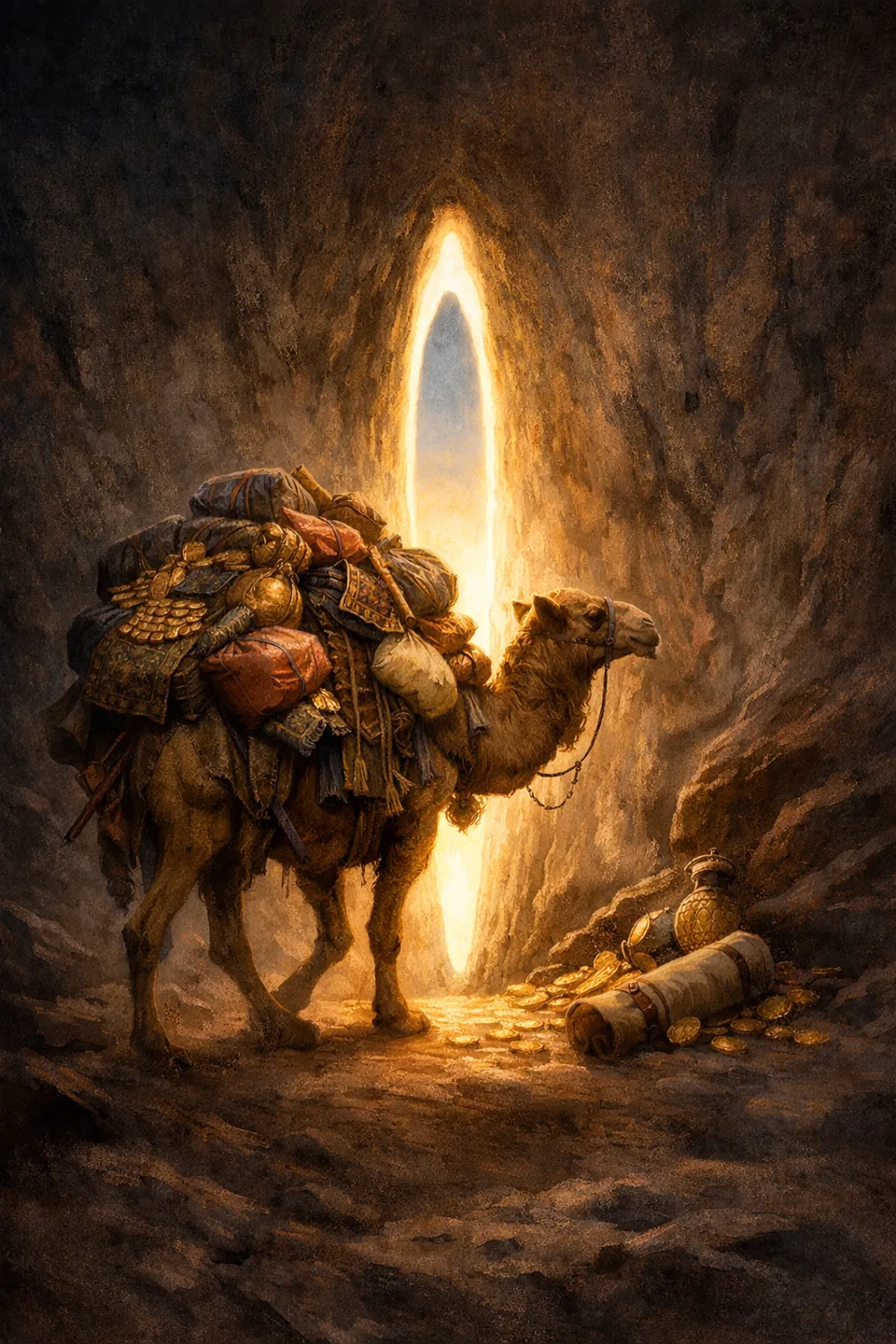
Growing up inside fundamentalist Christianity, the words of Jesus were taken literally, absolutely, as if they had been carved into the structure of reality itself. When I first encountered the line about it being easier for a camel to go through the eye of a needle than for a rich man to enter the kingdom of heaven, I remember being genuinely confused. I believed the Bible to be the literal word of God and heaven to be a real, physical destination—somewhere beyond this life, waiting like a reward at the end of a long moral obstacle course. In that framework, the saying felt baffling. Rich people went to church. Some of them were generous. Some of them seemed good. Why would wealth, specifically, be such an insurmountable problem?
Only much later did the confusion dissolve—not because the saying softened, but because it sharpened. What once felt like an impossible moral rule revealed itself as something closer to a koan. The image was never meant to be practical. It was meant to destabilize. A camel is not merely large; it is burdened. It carries supplies, tools, possessions—everything required to survive long journeys. It is a perfect symbol for a self weighed down by accumulation: money, identity, security, certainty. And the eye of the needle is not a loophole to be historically reinterpreted or explained away. It is an aperture. A narrowing. A demand for reduction. The gateway into what Jesus called the kingdom of heaven, which I no longer understand as a future location, but as a present state of being—awareness unencumbered by excess.
The rich man cannot enter not because he is being punished, but because he cannot fit. Wealth is not just a quantity of money; it is a way of orienting to the world. It trains attention outward, toward preservation and growth. It encourages the belief that satisfaction lies one acquisition away, that safety is something to be engineered and defended. Money becomes a master not because it is evil, but because it is insatiable. It always asks for more focus, more protection, more future planning. And the cost of that attention is interior space. Presence does not expand under accumulation. It narrows.
I’ve come to realize that my own life, largely spent scraping by financially, placed me in a different relationship with want. Not an easy one, and certainly not one I would romanticize, but a clarifying one. When you don’t have much, want stops being abstract. It becomes intimate. You either fight it endlessly or you learn to sit with it. Over time, I did the latter. I stopped treating want as an enemy to defeat and began listening to what it was actually asking for. In that strange friendship, something shifted. Want no longer felt like a void to be filled, but a signal—an invitation to notice how little was actually required to feel alive, present, enough.
This is where the saying finally made sense. Jesus was not condemning wealth as a moral failure. He was describing a structural incompatibility. The kingdom he spoke of is not something you earn later by being good now. It is something you enter by letting go. And letting go is precisely what wealth makes unnecessary. The more insulated you are from uncertainty, the less reason you have to look inward. The more buffered your life becomes, the easier it is to mistake comfort for peace and distraction for fulfillment.
I don’t say this from a position of moral superiority. If my life had unfolded differently—if comfort and abundance had arrived early—I’m not sure I would have learned how to release my grip. Scarcity forced the issue. It stripped away illusions faster than philosophy ever could. It taught me that satisfaction is not something you accumulate but something you allow. That presence emerges not when everything is secured, but when you stop trying to secure everything.
The eye of the needle is not a threat. It is an invitation. But it requires shedding. You cannot pass through it carrying your identity, your status, your plans for who you think you’re supposed to become. You cannot pass through it while clutching the belief that more will finally be enough. The camel cannot fit. But something else can. Something lighter. Something quieter. Something already here, waiting patiently for the moment you set the burden down.