In March 2020, millions of workers inadvertently gained something precious — autonomy. No longer tethered to fluorescent-lit cubicles, they rebuilt their lives around their actual needs rather than their employers’ demands. They thrived. Productivity soared. Work-life balance improved. Mental health strengthened.
Now, companies want it all back.
This mandate to return to the office carries a familiar echo. It resembles the control dynamics of an abusive relationship, where autonomy is systematically stripped away under the guise of care, necessity, or “what’s best for you.” Though workplace dynamics and personal relationships differ in severity and context, both rely on mechanisms of control that erode autonomy and distort reality. These parallels are unsettling but necessary to confront, revealing fundamental truths about modern workplace power dynamics.
The Dependency Trap
In abusive relationships, control begins with fostering dependency. The abuser dominates finances, social connections, or daily schedules, making autonomy difficult to achieve. Similarly, many workplaces are reclaiming control by insisting that productivity hinges on proximity to the office — despite overwhelming evidence to the contrary.
Workplace dependency is no accident — it was built into the system. In the mid-20th century, U.S. employers tied healthcare benefits to jobs, solidifying a cycle where workers couldn’t risk leaving their roles. Over decades, office culture reinforced these dynamics, conflating proximity with loyalty and productivity.
The pandemic disrupted this cycle, forcing an unprecedented experiment in remote work. Employees didn’t just adapt — they excelled. Studies showed remote work increased productivity by 13% (Stanford University, 2022), while Prodoscore revealed a staggering 47% increase in worker output during the early pandemic period. Workers reclaimed their time and energy, integrating work into their lives more healthily.
Yet employers persist with a clear message: “You need us. And to thrive, you need to be here.”
But who is this need truly serving?
The Manipulation of Truth: “It’s For Your Own Good”
In abusive relationships, control is justified through manipulation: “You’ll thank me for this later,” or, “I only do this because I care.” This is the logic of gaslighting, where reality is distorted until compliance feels inevitable.
The workplace equivalent manifests in persistent claims about the “essential” nature of office presence. Research consistently undermines every argument for mandatory office return. Studies show remote workers report lower stress levels and better mental health outcomes. Microsoft’s analysis revealed that collaboration didn’t collapse but evolved, with digital tools enabling seamless teamwork across distances. Meanwhile, GitLab’s comprehensive report demonstrated that asynchronous communication fosters deeper focus and creativity.
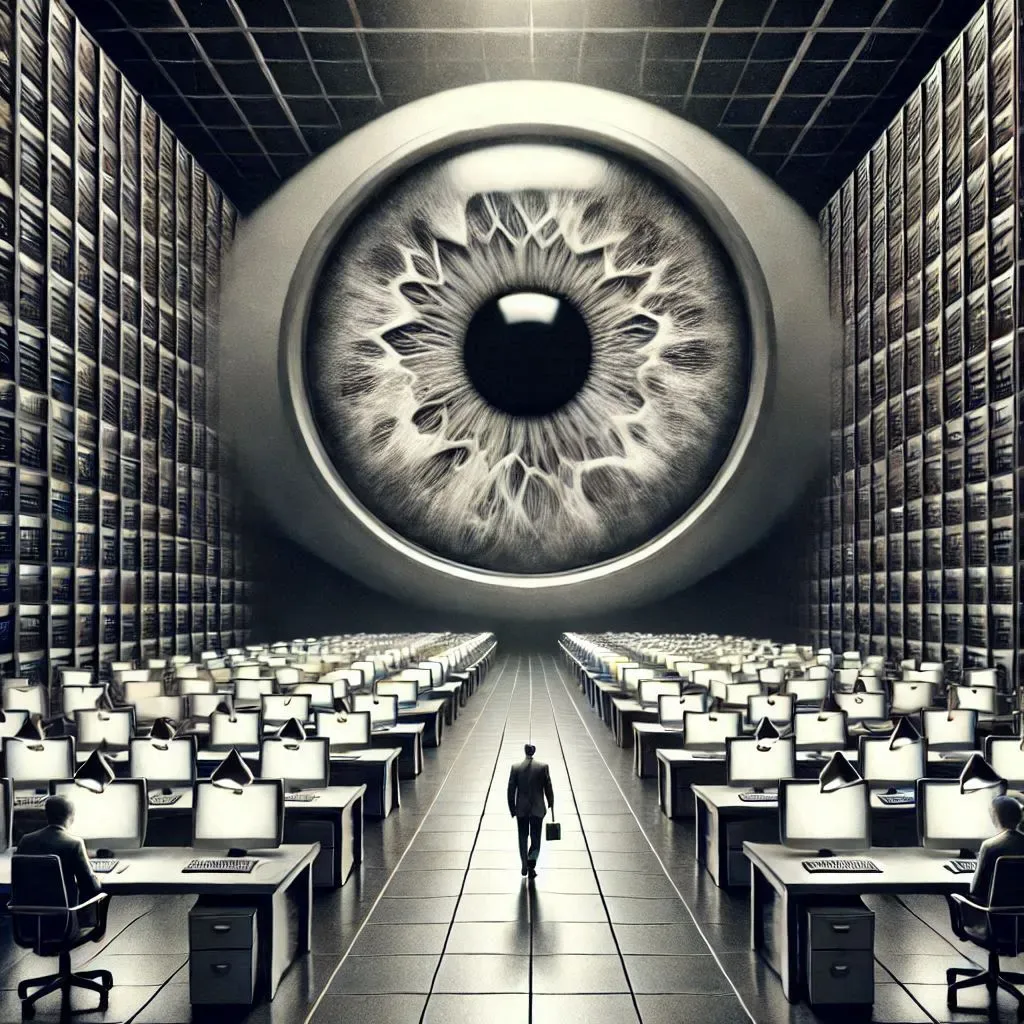
The insistence on office mandates isn’t about collaboration — it’s about surveillance. During remote work, employers deployed invasive monitoring software — tracking keystrokes, taking random screenshots, and monitoring “productivity metrics.” A 2023 ExpressVPN survey revealed that 78% of employers use monitoring software on remote workers. Yet these digital panopticons weren’t enough. Physical presence offers something surveillance software can’t replicate: the visceral power of being watched.
The office enables what sociologist Michel Foucault called “disciplinary power” — control through observation and normalization. Workers internalize the watching eyes of managers, adjusting their behavior, appearance, and even thoughts to meet expected norms. Surveillance extends beyond software to the architecture of the office itself: glass walls, open layouts, and casual “drop-ins” are all tools of subtle observation. The message is clear: you are always being watched, always being evaluated, always being judged.
The Illusion of Freedom
Like an abuser who dictates the smallest details of daily life, workplaces now impose mandates that micromanage existence: rigid schedules, daily commutes, and obligatory physical presence. This isn’t about productivity — it’s about power.
Capitalism thrives on dependency, structuring society so that workers’ survival hinges on compliance. Remote work briefly disrupted this power dynamic, granting workers autonomy over their time and environment. Mandates to return to the office represent not just a desire for productivity but a reassertion of control — an attempt to restore the status quo.
Surveillance reinforces this dependency. Workers aren’t just watched — they’re conditioned to equate visibility with value. Open office layouts and mandatory in-person presence compel workers to perform not only tasks but the appearance of productivity, creating a cognitive and emotional burden.
The Cost of Conformity
The erasure of individual needs in workplace mandates mirrors how abusive relationships suppress individuality. Parents who finally found sustainable childcare solutions through flexible schedules now face impossible choices. Disabled workers who discovered genuine workplace accessibility through remote work confront renewed barriers. Health concerns are dismissed as inconvenient truths in the rush to restore “normalcy.”
The psychological toll of constant surveillance manifests in what researchers call “digital presenteeism” — the pressure to appear busy and available at all times. Office mandates add physical presenteeism to the burden. Workers must now perform productivity through both digital metrics and physical presence, doubling the cognitive load of being watched. The result is a workforce exhausted not just by work itself, but by the perpetual performance of working.
The False Promise of Reciprocity
In an abusive dynamic, there’s often talk of “mutual benefit,” but the reality is starkly one-sided. The workplace version of this manipulation is equally transparent. Companies tout the “value” of in-person work while ignoring the real costs — both financial and emotional — borne entirely by employees.
According to Bloomberg (2023), the average worker spends $5,000–$10,000 annually on commuting and office-related expenses. Meanwhile, employers who saved millions by reducing their office footprint during remote work rarely share these savings with their workforce. The benefits flow upward; the burdens trickle down.
Breaking Free: The Revolution Has Already Begun
Yet something remarkable is happening. Workers are refusing to accept this regression. Fully remote companies like GitLab and Automattic demonstrate daily that thriving without a physical office isn’t just possible — it’s preferable. The gig economy offers escape routes for those seeking autonomy. Even traditional companies face unprecedented pushback from employees who have tasted freedom and refuse to surrender it.
Some companies are actively rejecting surveillance culture. Buffer, for example, abandoned traditional monitoring metrics in favor of results-based evaluation. GitLab’s remote-first culture explicitly prohibits surveillance software, focusing instead on documented outcomes. These companies prove that trust and autonomy aren’t just moral choices — they’re competitive advantages in attracting and retaining talent.
The Future We Choose
Rejecting office mandates means rejecting the surveillance infrastructure that underlies modern work. It means demanding evaluation based on results rather than visibility, worth measured by output rather than observation. The question isn’t just why we’d return to the office. It’s why we continue to accept workplaces that strip us of autonomy, gaslight us into compliance, and tether our worth to constant observation.
Freedom isn’t negotiable. It’s time to reclaim it
This Substack is reader-supported. To receive new posts and support my work, consider becoming a free or paid subscriber.