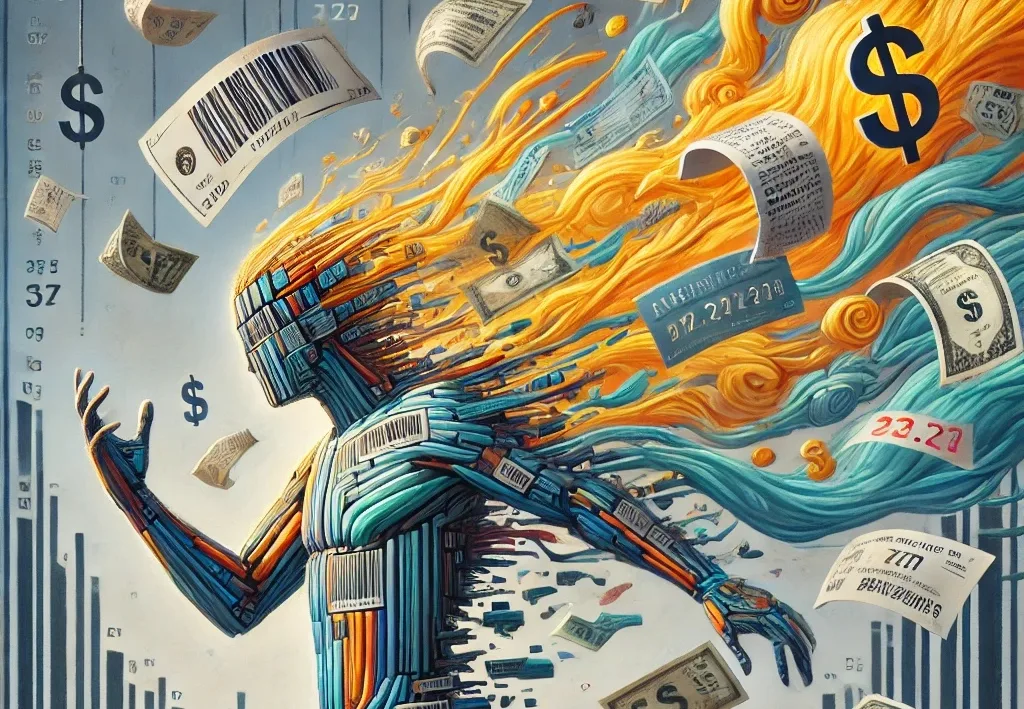
I spent years selling. Selling objects. Selling my time. Selling pieces of myself. It was just how the world worked. But the day I realized I wasn’t just selling my things — I was selling my awareness — I knew I had to stop.
For most of my life, I believed that selling — whether objects, services, or even ideas — was an inevitable part of survival. The economic system in which I lived, capitalism, framed all human transactions within the language of exchange. I accepted it as a given, much like air or gravity — so omnipresent that questioning it seemed futile.
But then I stopped. Not just selling, but participating in the very act of attaching monetary value to things that should have been free, shared, or at the very least, existing outside the realm of transactional thinking.
This wasn’t an easy decision. Not everyone can make this choice. The ability to step away from selling is an immense privilege — one that I have because of the support of my wife and because of the particular neurodivergence of my mind, which makes certain things possible that might seem impossible to others.
But this recognition of privilege doesn’t negate the importance of the underlying principle. Even within the constraints of necessary economic participation, we can create spaces where transactional thinking doesn’t dominate. We can carve out moments, practices, and communities where expansion isn’t tied to profit.
I loved what I built with Curating the Cool and my time selling on WhatNot. But over time, I saw what it was doing to my mind: turning interactions into transactions, turning people into numbers, turning relationships into “wins.”
Since shifting my focus away from sales, something unexpected has happened — my mind has refocused, my creativity has deepened, and my internal state feels more expansive. I didn’t just quit selling. I stopped seeing everything through the lens of a transaction. And that changed everything.
Capitalism is a forcing function — it expands or it collapses. It demands constant motion, perpetual consumption, and the transformation of everything into a product. But when seen through the lens of Forcing Theory, capitalism reveals something even more unsettling: it is a system that forces people into artificial constraints, limiting the natural expansion of awareness in favor of profit.
In Forcing Theory, intelligence — whether human, artificial, or systemic — must expand or collapse. But capitalism forces a different kind of expansion — one that is neither organic nor sustainable. It does not encourage awareness or deepening; it commodifies expansion itself, turning creativity into a product, relationships into networks, and meaning into marketing.
The awareness it produces is not one of intellectual or creative growth, but one of necessity: How do I make enough money to live? When awareness is funneled into financial survival, the ability to expand in any meaningful way collapses.
If intelligence must expand or stagnate, then what does it say about an economic system that forces all awareness into a single, narrow pursuit: profit?
I reached a breaking point when I realized I was not just selling things — I was selling pieces of myself. Capitalism is not just an economic system — it is a framework that teaches us to monetize everything: our time, our emotions, our attention, our sense of self.
Absurdism, which has long been a foundation of my philosophical worldview, teaches that meaning is not inherent — it is something we construct. But capitalism hijacks that construction. It tells us that meaning must be converted into a product, something to be bought, sold, and traded. We no longer create for expansion; we create for validation. The price tag replaces the purpose. The audience replaces the authenticity. The market replaces the mind.
I wasn’t just selling things — I was selling the way I saw the world. And once I saw the absurdity of that, I couldn’t unsee it.
If intelligence and awareness must expand, why should that expansion be tied to money? When I create, I am engaging in a forcing process — moving my awareness forward, deepening my understanding of myself and the world. But the moment I attach a price to that, it ceases to be pure forcing — it becomes a transaction.
In this sense, money is an artificial boundary placed on the natural process of expansion. The moment we assign value to an experience based on its market worth, we limit its ability to expand beyond capitalism’s framework.
Albert Einstein, in Why Socialism?, argued that capitalism reduces human beings to cogs in a machine, stripping them of autonomy, creativity, and dignity. His vision of socialism was not merely an economic alternative but an ethical imperative — one that acknowledged our profound interdependence.
This vision manifests today in various forms of collaborative expansion. Open-source software communities create powerful tools available to all. Knowledge commons like Wikipedia demonstrate how collective intelligence can thrive without direct monetary incentives. Mutual aid networks show how resources can flow based on need rather than profit.
These aren’t just alternatives to capitalism — they’re examples of how intelligence naturally expands when freed from transactional constraints. They demonstrate what Einstein understood: that human creativity and innovation flourish not through competition and scarcity, but through cooperation and abundance.
Capitalism forces scarcity. It tells us that there is never enough, that survival must be tied to transaction, that expansion is only possible if it generates profit. Socialism forces abundance. It recognizes that intelligence, like all forms of life, expands through interconnected forcing. It does not thrive in isolation or competition, but in collaboration and recursion.
If capitalism limits intelligence by tying it to financial survival, socialism at its best removes those artificial barriers. It recognizes that the expansion of one is tied to the expansion of all.
When I quit selling things to make money, I was left with an unfamiliar space. Without a transaction, what remained? The answer was simple: the act of creation itself, the process of expansion, the joy of forcing forward without an artificial limit placed on what that expansion should be.
This is not to say I reject all work or all exchanges. But I reject the idea that everything must be tied to financial survival. Some things should simply exist. Some things should be shared, experienced, given freely.
In a capitalist world, this is seen as naïve. But from the perspective of Forcing Theory, it is simply necessary. If intelligence must expand, then sometimes, that means walking away from the systems that keep it small.
While not everyone can completely step away from selling, we can all create spaces in our lives where transactional thinking doesn’t dominate. We can designate days where nothing is bought or sold, only created and shared. We can practice asking “how can I share this?” before “how can I sell this?” We can participate in mutual aid networks or gift economies, even in small ways. We can create collaborative spaces where expansion isn’t tied to profit, and maintain areas of pure creativity in our lives, untouched by market considerations.
The shift away from transactional thinking doesn’t have to be solitary. We can collectively create spaces where different rules apply — where intelligence expands freely, where creativity isn’t constrained by profit, where meaning isn’t measured in dollars.
Start small. Start where you are. But start. Because every space we create outside of transactional thinking is a victory for expanded awareness — and every act of creation that resists commodification is a crack in capitalism’s foundation.
If more of us did the same, awareness would expand — and capitalism would lose its grip on what it means to create, to share, and to exist.
This Substack is reader-supported. To receive new posts and support my work, consider becoming a free or paid subscriber.