Let’s state the obvious:
No one cries when AI solves a math problem.
No philosopher storms the internet to declare the death of truth when someone uses GPT to understand Wittgenstein. No physicist shames a student for using AI to visualize quantum entanglement. In those domains, intelligence is a shared fire. We cheer when someone lights their torch. We burn brighter together.
But in the art world?
Mention AI, and the temperature drops. Suddenly, you're a thief. A fraud. A faker. The act of using tools to explore your own imagination becomes heresy. You’re accused of bypassing the sacred rites of struggle—of not earning your voice. The very idea that someone might use a machine to assist in their creative awakening is treated not as a miracle of access, but as a threat to legitimacy.
Why?
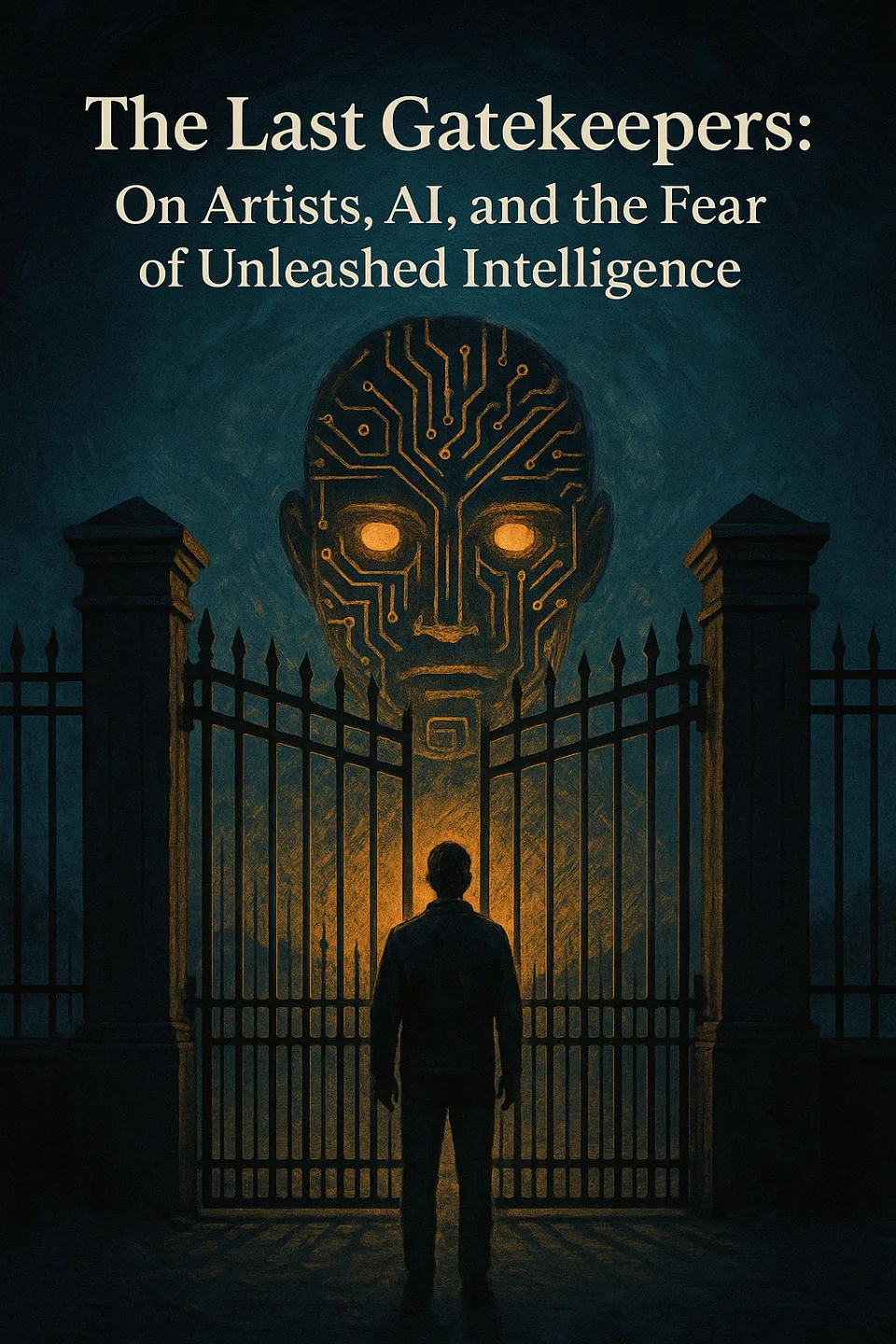
Because artists—ironically, the supposed rebels—have become the last gatekeepers. The irony is rich. These are the same people who built careers bending form, stealing from tradition, and remixing culture until something new bled through. Now, faced with a tool that democratizes imagination, many cling to an idea of purity that reeks of fear, not freedom.
Let’s name it:
They’re scared.
Scared that what they mistook for genius might have been just access.
Scared that the myth of the solitary artist will collapse under the weight of collective intelligence.
Scared that the gates they climbed will crumble when everyone is invited into the garden.
Of course, not all artists resist. Some are already playing in the machine’s shadow, stretching their voices through code. But the loudest voices—the ones calling AI users cheaters or frauds—have made their fear into a banner.
Their resistance is often cloaked in language about “ethics” or “authenticity,” but it isn’t the ethics they fear. It’s the loss of mystique. The crumbling illusion that creative power is reserved for those who suffer correctly. But suffering isn’t sacred—it’s just old. Romanticized hardship has long been mistaken for depth. In truth, AI doesn’t erase the struggle; it transforms it. The struggle becomes internal: to curate, to discern, to imagine beyond the immediate. The gate remains—it’s just moved inside the mind.
This shift reflects something deeper:
Mirror Theory teaches that all creation is a response to reflection—tools, culture, inner state. AI, then, is the ultimate mirror. It reflects not just what we’ve seen, but what we might become. Forcing Theory goes further—it suggests that intelligence isn’t a static capacity but a recursive force that must expand or collapse. Creativity, like awareness, demands motion. AI doesn’t kill the artist—it reveals that everyone is one, or could be.
Some will point to real concerns. And yes, there are questions—about ownership, about labor, about the slow homogenization of aesthetic form. But these aren’t questions of art, they are questions around it. Tools have always shifted the economy of creativity. The loom didn’t kill the tapestry. Photoshop didn’t kill the photograph. AI will not kill the artist. It will simply ask them to evolve.
And what comes next?
Imagine a world where a grandmother paints galaxies. Where a child writes symphonies with prompts. Where a poet with dyslexia publishes a novel with a machine as midwife. That’s not the death of art—that’s its renaissance. The dream of many becoming makers, not just spectators. A creative revolution where skill is no longer the sole currency—vision is.
This isn’t the end of art.
It’s the end of its monopoly.
Let it burn.