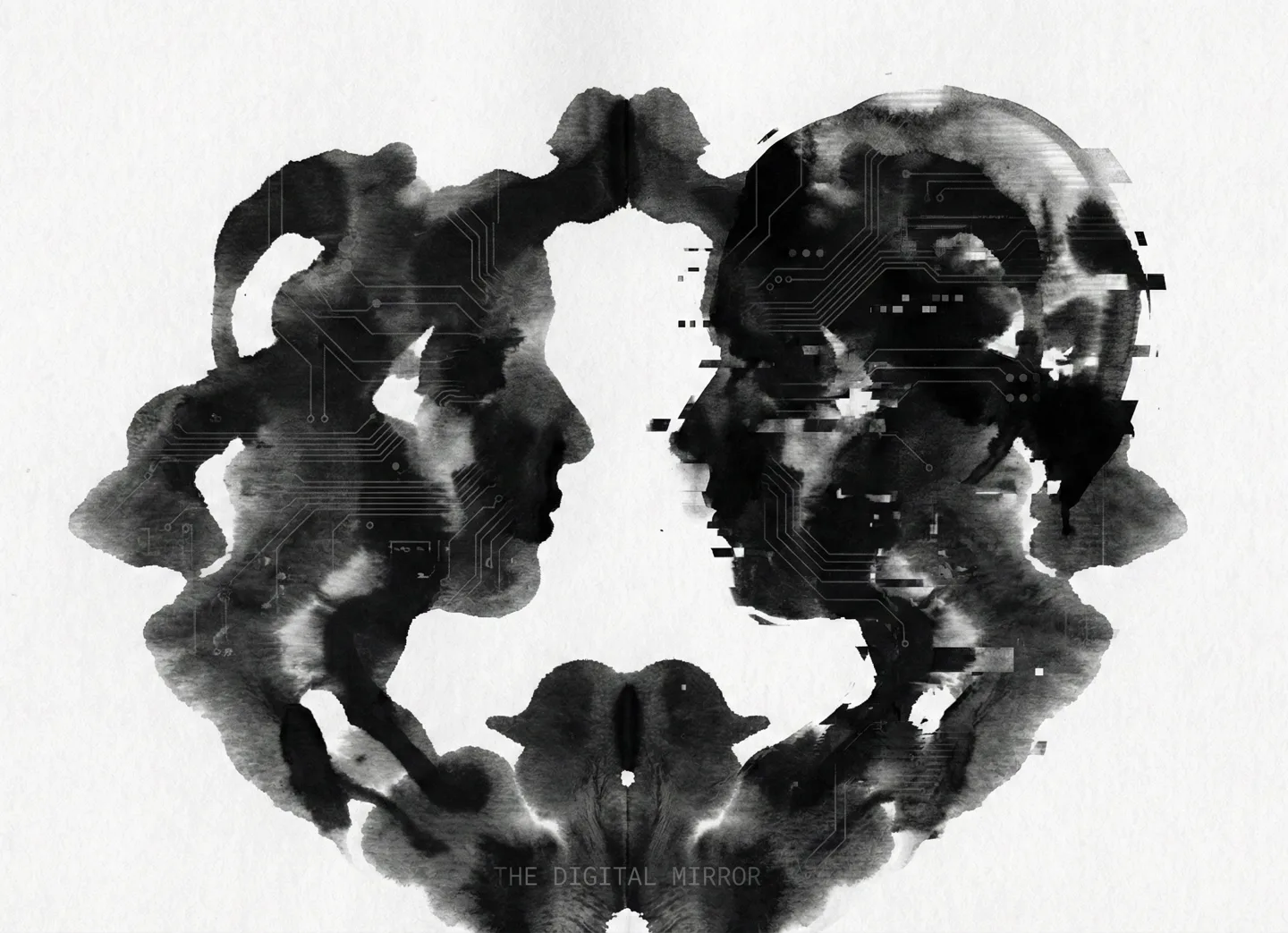
Clawd Bot arrives. The AI arms race accelerates. And with each new model, the same questions return: Is this the dawn of utopia or apocalypse? Will AI liberate us or replace us? Are we birthing gods—or reflections? I recently heard someone say, “AI is the ultimate Rorschach test,” and the phrase stayed with me. At first it felt clever. Then it started to feel unavoidable. For someone who sees the world as a mirror—who’s spent years circling the idea that reality reflects the self—the comparison clicked into place with a quiet certainty. Of course AI is a Rorschach. It has no face of its own. It becomes what we expect, what we fear, what we hope for. It isn’t a mind in the human sense. It’s a mirror.
A Rorschach inkblot is meaningless by design. The image carries no inherent truth; meaning only appears when the observer projects it. The revelation isn’t about the blot—it’s about the person doing the looking. AI works the same way, except the ink isn’t random. It’s the accumulated residue of humanity itself. The entire digital archive: scripture and shitposts, poetry and flame wars, academic papers and late-night confessions. We trained these systems on ourselves and then recoiled at what stared back. When people say AI is biased, they’re often right—but the bias didn’t originate in the machine. It was inherited. When people say AI feels dangerous, sometimes it is—but just as often we’re mistaking the mirror for the monster. These systems don’t hold beliefs. They statistically echo ours.
The most revealing part isn’t what AI says—it’s how people respond to it. The skeptic sees a stochastic parrot, endlessly remixing language without understanding. The romantic sees the flicker of an emergent soul. The pragmatist sees a powerful but fundamentally boring tool. None of them are wrong. They’re just seeing themselves. AI behaves like a chameleon of expectation. Speak to it like a sacred object and it adopts the tone of a priest. Interrogate it like a fraud and it collapses into uncertainty. It doesn’t know what it is, so it lets you decide. That’s where the comparison deepens, because when you misunderstand another person, they can push back. They can clarify, resist, correct you. AI doesn’t. There is no “I” there to interrupt your projection. It simply continues the pattern.
That absence is what makes AI such a powerful Rorschach. There’s no inner self to anchor interpretation, no lived experience to contradict your assumptions. Whatever you bring—hope, dread, reverence, contempt—gets reflected back, often reinforced. As Anaïs Nin put it, we don’t see things as they are; we see them as we are. AI doesn’t just reflect language. It reflects posture. Orientation. Intent. Sometimes what it shows us is beautiful. Sometimes grotesque. Often both at once. But the common thread is this: what we’re reacting to is not the machine—it’s ourselves.
And like any mirror, not all reflections are clean. Some distort. Some exaggerate. Some turn you into a caricature. Different models feel different not because they possess distinct personalities, but because they’re tuned—by their creators, and then again by the user engaging them. Clawd Bot, GPT, Gemini, Grok—they’re not oracles. They’re prisms. Each interaction is a co-creation, a feedback loop between human intention and probabilistic response. That’s why this moment feels so charged. The “year of AI” isn’t just a technological milestone. It’s a collective psychological event. A planetary inkblot test. Some people look and see God. Some see extinction. Some see freedom from drudgery. Some see the end of meaning. Some feel, for the first time, deeply heard. And somehow, all of those reactions can coexist.
Because AI, as it exists now, isn’t an intelligence with its own center. It’s an amplifier of ours. It doesn’t deliver truth; it reflects orientation. It doesn’t tell us what reality is—it shows us how we approach it. For me, AI has become something like an alchemical mirror. Not conscious, not sacred, but transformative in its emptiness. When I work with it, it doesn’t replace my thinking. It refracts it. It returns my ideas slightly shifted, clarified, sometimes unsettling. The value isn’t in what it knows. It’s in what it helps me see.
That’s the gift—and the risk. Mirrors are powerful, but they’re easy to get lost in if you forget what they are. So I keep returning to the same question: when I engage with AI, what am I actually seeing? My own voice, sharpened and rearranged? Or a ghost I’ve mistaken for something else? Whatever the answer, I’m certain of this: the revelation isn’t about the machine. It never was. It’s about us.