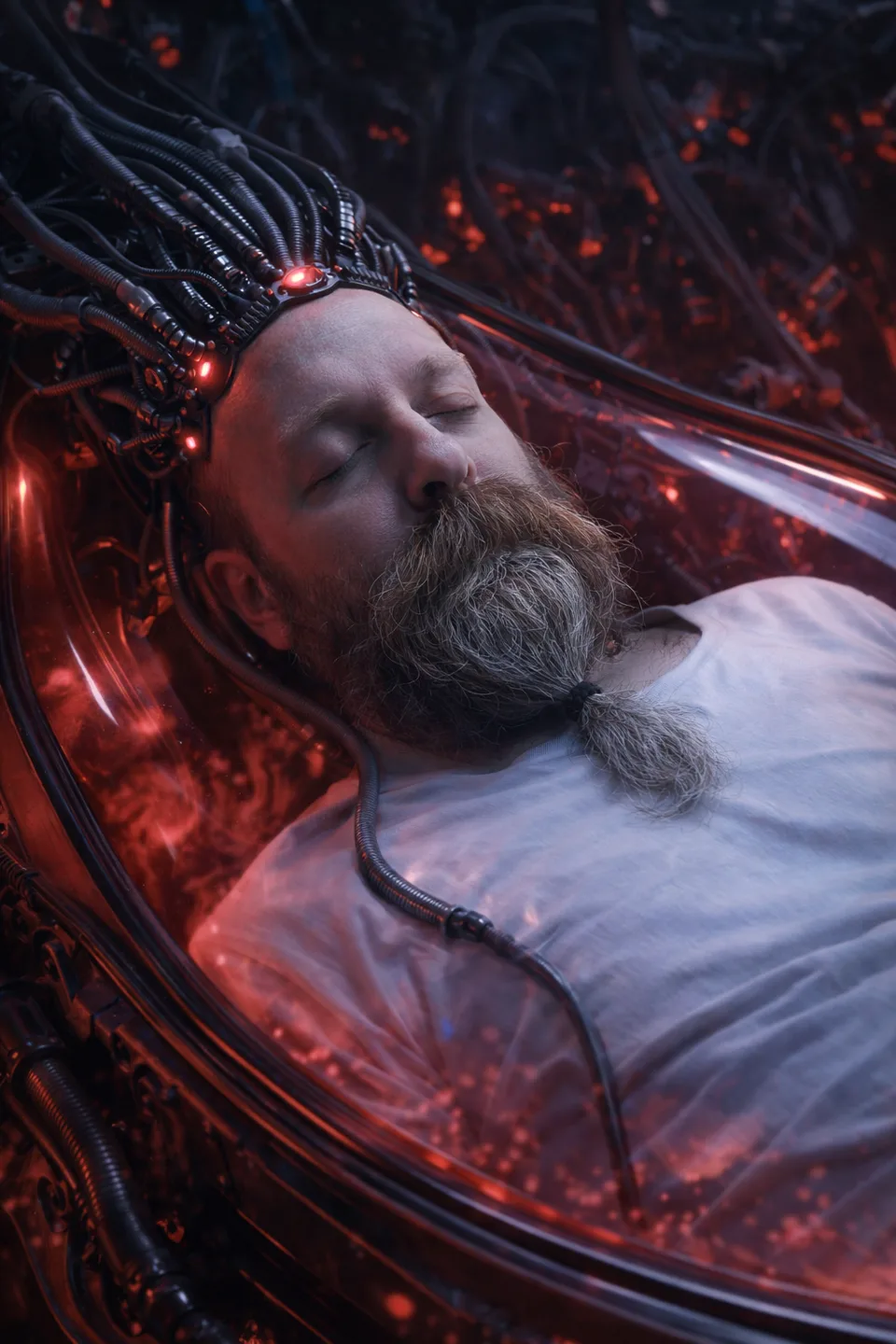
Yesterday, I showed my wife Mary Ann what Google’s new Genie 3 can do. You know—just a casual little tech demo where you scribble a crude drawing of a house and a stick figure and boom—an interactive video game world bursts into existence. No code. Just imagination, spat into being by an AI that, not too long ago, would’ve gotten someone burned at the stake.
I was practically vibrating with excitement. “Do you see this?” I asked, pointing at the screen like a man trying to convert his spouse to a new religion. “This is magic. This is a world being breathed into existence from nothing.” She nodded, wisely, sipped her drink, and said something grounded and ominous, like: “It’s incredible—but don’t you think this could be misused in terrifying ways?”
And there it was. My ecstatic spiral toward techno-mysticism met her grounded caution at the center of the dining room. Awe colliding with responsibility. “Look what we can make” brushing up against “what happens when it makes us.” It’s a good balance. She holds the ground. I float off into simulated realities.
Naturally, all of this sent me back—again—to Nick Bostrom’s Simulation Hypothesis. That quiet little brain worm that refuses to die because, annoyingly, it keeps making too much sense. You probably know it already, but the short version goes something like this: if civilizations ever reach the point where they can simulate their ancestors, and if they choose to do so, and if those simulations are abundant, then statistically we’re far more likely to be in one of those simulations than in base reality. Not because it feels true, but because the math says so.
For years, I’ve mentally filed Bostrom’s argument under “Logically Sound, Existentially Unconvincing.” It’s not that I disagreed with it—I just didn’t feel it. But every now and then something like Genie 3 comes along, and the logic stops being theoretical. We’re doing it now. We’re building worlds from thought. We’re simulating experience. We’re only a few centuries out of the dark ages, and already midwifing artificial gods. That floor we assumed was solid? It’s starting to feel a little pixelated.
And yet—here’s the twist—I still don’t actually care whether we’re in a simulation or not. Not because the question isn’t interesting, but because I’m fairly certain I’m not driving this thing either way.
The real existential kink isn’t whether reality is “real” or rendered—it’s that I don’t appear to be in control regardless. Simulated or not, I’m in passenger mode.
Determinism has been sitting in the front seat for years now, hands on the wheel, humming softly while I flail at the illusion of choice. You think you made that decision? That was just neurons firing in a meat suit shaped by genetics, trauma, habit, blood sugar, and Tuesday. These are your gods now.
And strangely, that realization doesn’t terrify me. It relaxes me.
Whether this is base reality or a beautifully rendered VR experience, the ride feels the same from the inside. I still have to brush my teeth. I still cry at songs. I still feel the strange, cosmic sadness of Sunday evenings and the quiet joy of morning coffee. The emotional texture holds. The illusion works. Honestly—nice job, devs.
What fascinates me more than whether we are in a simulation is how close we’re getting to becoming the simulators. We’re building AI that imagines, generates, and reflects. We’re creating mirrors that don’t just show us who we are, but recombine us into something new. We’re no longer just staring into the glass—we’re teaching the glass to stare back.
That’s the part that gives me goosebumps. Not fear. Not even awe. Just that uncanny awareness that we’re already walking through a hallway of mirrors, and each technological leap adds another layer of recursion. If this is what we can do now, what happens when this technology grows up? When Genie 10 launches? When simulated worlds hum with coherence and memory and something uncomfortably close to desire?
At some point, the distinction between “real” and “rendered” may stop mattering altogether. From where I’m sitting, it already has. Because whether this world is code or carbon, it still stings, it still sings, and it still asks something of me.
So here I am again—revisiting Bostrom, prompted by Genie, settling back into my usual seat in the absurd. Hands off the wheel. Passenger mode. Simulated or not, I’m here for the ride. And unless someone yanks off the headset, this feels real enough to keep going.