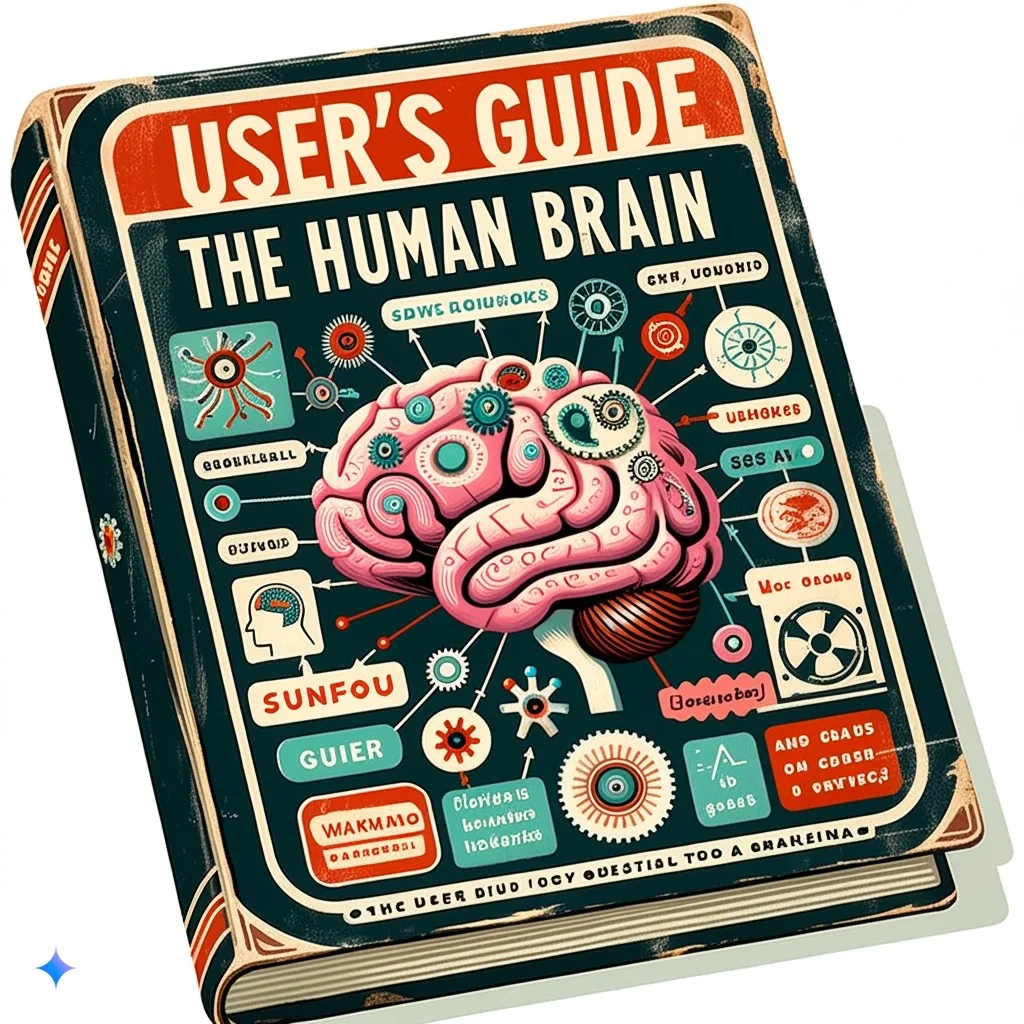
Congratulations! You are now the proud owner of a fully functional (we hope) human brain! Before using your new consciousness, please read this guide carefully to avoid existential confusion, cognitive malfunction, or unexpected bouts of philosophical dread.
Product Overview
Your brain is a multi-layered, self-referential intelligence system designed for both survival and self-expansion. This means it is equally capable of solving complex problems and wondering if pigeons have feelings for each other. It is an organic, self-replicating thought machine that runs on pattern recognition, contradiction, and caffeine (sold separately).
Your brain is NOT a static object—it is an adaptive system, constantly shaped by mirrors, or the external forces that reflect back aspects of itself. This means it can learn, evolve, and sometimes trap itself in recursive loops of overthinking at 2 a.m.
Key Features
Mirror Processing Unit (MPU™) – Your thoughts are shaped by external reflections—people, experiences, art, algorithms, and questionable life choices. These reflections act as mirrors, forcing you to see parts of yourself that would otherwise remain hidden.
Forcing Expansion Mode™ – Your brain is wired for growth or collapse. It will either expand its awareness through tension, novelty, and deep reflection, or it will loop endlessly on a single issue like a software bug that refuses to resolve.
Self-Perception Distortion – Warning: The way you see yourself may not accurately reflect reality. Your brain comes preloaded with identity biases, emotional distortions, and the occasional existential crisis.
Instant Story Generator™ – Your brain will make up reasons for why things happen, whether they are true or not. This feature allows you to interpret life events as grand narratives, but can also result in paranoia, unnecessary self-blame, or thinking the guy at the coffee shop is mad at you when he’s just tired.
Time-Warping Functionality – Your brain does not experience time objectively. A single awkward interaction from five years ago may be replayed in perfect high-definition clarity, while yesterday’s lunch order has already been deleted.
Safety Warnings & Common Malfunctions
Infinite Reflection Error – Staring into too many mirrors (philosophically or literally) may result in recursive self-analysis, leading to existential nausea. If this occurs, immediately engage in grounding activities such as eating a sandwich or touching grass.
Cognitive Dissonance Overload – Your brain is capable of holding conflicting beliefs at the same time. If you find yourself both wanting change and resisting it simultaneously, this is not a bug, it’s a feature.
Phantom Self Syndrome – Occasionally, you may feel like the person you were five years ago was a completely different human being. This is because you are an ongoing process, not a fixed entity. Please update your self-concept regularly.
Simulation Theory Loop – Your brain is not designed to answer questions like “What is consciousness?” or “Are we living in a simulation?” Attempting to do so may cause a feedback loop of unnecessary late-night Wikipedia searches.
Unexpected Emotional Ambush – Your brain will, at random intervals, sabotage your day by remembering something embarrassing you did in middle school. This cannot be turned off.
Operating Instructions
Step 1: Accept That You Are a Mirror
Everything you experience reflects back an aspect of yourself.
This means your reactions to others are often a projection of your internal world.
Annoyed by someone’s arrogance? You may have unresolved concerns about confidence, authority, or your own need to be heard.
Step 2: Understand the Forcing Function
Your intelligence is not a neutral state—it is constantly being forced to expand or collapse.
New challenges, unexpected events, and tension are not barriers—they are part of the function itself.
Avoidance shrinks awareness, engagement expands it.
Step 3: Debug Your Thought Patterns
Your brain loves shortcuts, biases, and mental loops.
If you’re stuck in overthinking, ask:
“Am I arguing with reality?”
“Would my future self find this worth my attention?”
“Am I replaying an old story rather than seeing the moment as it is?”
Step 4: Use the External Debugging Feature (Other People™)
Interacting with different perspectives will update your mental operating system.
Stagnation happens when you only reflect within familiar mirrors.
Step 5: Run the Existential Patch Update Regularly
Every few months, assess what beliefs, identities, and assumptions need upgrading.
Remember: You are not a fixed character—you are a series of unfolding versions.
Troubleshooting FAQs
“Why do I overthink everything?”
Because your brain’s pattern recognition software is too good at its job. It assumes everything must mean something, even when it doesn’t. Sometimes a random encounter is just that—a random encounter.
“Why do I feel different depending on who I’m around?”
Your identity is context-dependent. Your brain adapts based on the mirrors it’s engaging with. This is normal, but be mindful of which environments bring out your most authentic self.
“Why do I keep repeating old behaviors I hate?”
Your brain prioritizes familiarity over happiness. It defaults to known loops, even when they suck. You will need to override this manually.
“Am I the main character?”
No, but neither is anyone else. Reality is multiplayer.
Terms of Use
Your brain comes as-is, with no refunds, replacements, or extended warranties.
Side effects may include existential questioning, emotional breakthroughs, spontaneous laughter, and the occasional identity crisis.
Updates will be applied automatically through new experiences, conversations, and deep introspection.
By continuing to exist, you agree to the Terms and Conditions of Being Alive.
Final Message from the Manufacturer
Thank you for using Mirror Theory™ Brain Systems.
We hope you enjoy your new consciousness. It will never be finished, never be perfect, and never be fully in your control—but it is uniquely yours.
Now, go forth and reflect.
End of User Guide.