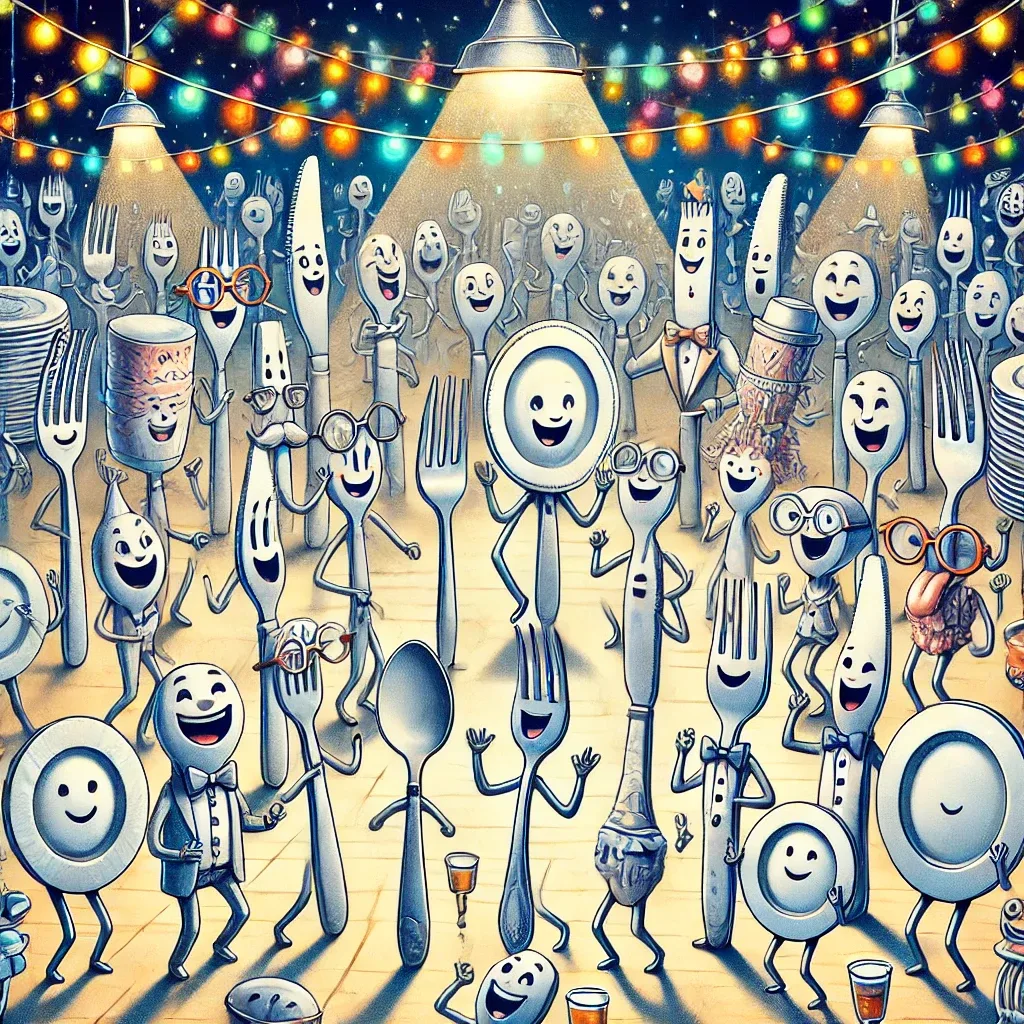
We all have our rituals. Some are sacred, some are silly, and some—like the proper placement of silverware—are both.
This ongoing series explores the absurd little traditions that bring meaning, humor, and order to an otherwise chaotic existence.
Today, we descend into the cutlery drawer—a world of hierarchy, diplomacy, and dishwashing as spiritual practice.
Because in my home, the silverware is alive.
It sets the tone, references the series, and dives right in. Would you like this version dropped into the essay draft from earlier? Or would you like me to punch it up with more absurd flair or personal voice?
You said:I like the reduced intro! Would you put add it to the entire essay pleoase?
ChatGPT said:Absolutely! Here’s the full essay with the reduced intro seamlessly integrated. The flow has been adjusted slightly to keep the momentum clean and natural:
Rituals of Ridiculousness, Part III: The Silverware Society
We all have our rituals. Some are sacred, some are silly, and some—like the proper placement of silverware—are both.
This ongoing series explores the absurd little traditions that bring meaning, humor, and order to an otherwise chaotic existence.
Today, we descend into the cutlery drawer—a world of hierarchy, diplomacy, and dishwashing as spiritual practice.
Because in my home, the silverware is alive.
The Sentience of Silverware
There are those who believe in the animistic spirit of all things—that rocks, trees, and even man-made objects contain a form of consciousness. I do not argue this as a universal truth, but I will say this: In my home, the silverware is alive.
I am not claiming that they whisper secrets in the night or that I have witnessed a great fork uprising (though I remain vigilant). But I know their personalities, their cliques, their rivalries. I have observed them long enough to recognize their social order, and as the primary caretaker of the dishes, I am bound by duty to uphold their customs.
Some may call it obsession. I call it respect.
The Hierarchy of the Drawer
The silverware drawer is not a random holding cell. It is a structured society with unwritten laws, an unspoken caste system, and a deep resistance to sudden change.
The Elders (The Original Set): These are the old warriors, the utensils that have survived from the original purchase. They bear the scratches and scuffs of countless meals, and though they are worn, they hold the highest status. They have earned their place.
The Middle Generation: A mix of adopted silverware from lost roommates, thrift store acquisitions, and the occasional piece from takeout orders that somehow entered the rotation. They are respected but not revered. Useful, but not foundational.
The Newcomers (Outsiders in Exile): Any newly introduced silverware must earn the trust of the drawer. These are the pieces that arrive from outside sources—purchased in desperation after a fork shortage, gifted by well-meaning friends, or smuggled in from an unknown past.
It would be madness to place them among the Elders immediately. No, they must wait—segregated, isolated, kept at the edges of the drawer until their presence no longer feels intrusive. Only then may they join the fold.
This is not cruelty. This is stability.
The Great Dishwasher Pilgrimage
In the cycle of silverware life, the dishwasher serves as a kind of baptismal rite—a cleansing journey that allows utensils to re-enter society without conflict.
Placing a newcomer directly into the drawer without first sending them through the cleansing waters is an act of sacrilege. It is a reckless disruption of order, a direct affront to the elders who have built this society from the ground up.
I will not allow it.
Every fork, knife, and spoon—whether seasoned veteran or fresh recruit—must take the pilgrimage through the dishwasher before finding its place among its peers.
I am not unreasonable. I do not demand that they enjoy it. I simply enforce the process.
The Loud Protests of the Misplaced
When the order is disturbed, the drawer becomes loud.
A fork in the knife section. A spoon wedged into the fork area. A rogue butter knife tangled with the steak knives. These transgressions do not go unnoticed.
I do not mean metaphorically. I mean literally. They make noise.
An unease settles in the kitchen. The rattle of the drawer is too chaotic, the clang of metal against metal too discordant. A misplaced spoon will scrape loudly against its neighbors. A displaced fork will wedge itself into an unnatural position, resisting every attempt to pull it free.
The drawer will groan and clatter until balance is restored.
And so, I listen. I observe. I adjust.
Because peace is only possible when every utensil is in its rightful place.
The Invisible Rules We Live By
Is this absurd? Absolutely.
Does it matter? More than you’d think.
We all build little rituals around the mundane—not because they are required, but because they shape our experience of the world.
Maybe it’s the way we organize our bookshelves, the precise method we use to fold laundry, or the sacred order in which we eat the components of a meal. These rituals are small anchors in an unpredictable world—acts of control that grant us a sense of harmony.
The Silverware Society is one of mine.
And so, I will continue to respect their hierarchy, enforce their traditions, and protect them from reckless disorder.
Because in a world that often feels chaotic, sometimes the only thing standing between order and madness is a properly organized utensil drawer.
And I, for one, refuse to let the chaos win.
Final Thought: In Defense of Absurd Rituals
To those who would mock such dedication to the ridiculous, I say this:
Life itself is absurd.
If meaning is optional, I choose to invent it in the smallest of places. I choose to listen when my silverware protests. I choose to uphold the sacred order of the drawer.
Because why not?
And so, my friends, I encourage you—
Find your rituals. Honor them. Let them be ridiculous.
After all, what is life but a collection of small, absurd acts that make existence bearable?