We once believed that the laws of chemistry were settled, etched into the scaffolding of the universe. Like children proud of our equations, we sketched out how matter behaves, what bonds with what, what dissolves, what freezes, what life must need to emerge. And then we looked toward Titan—Saturn’s largest moon, cold and distant and cloaked in haze—and the universe, ever patient, quietly dismantled our assumptions.
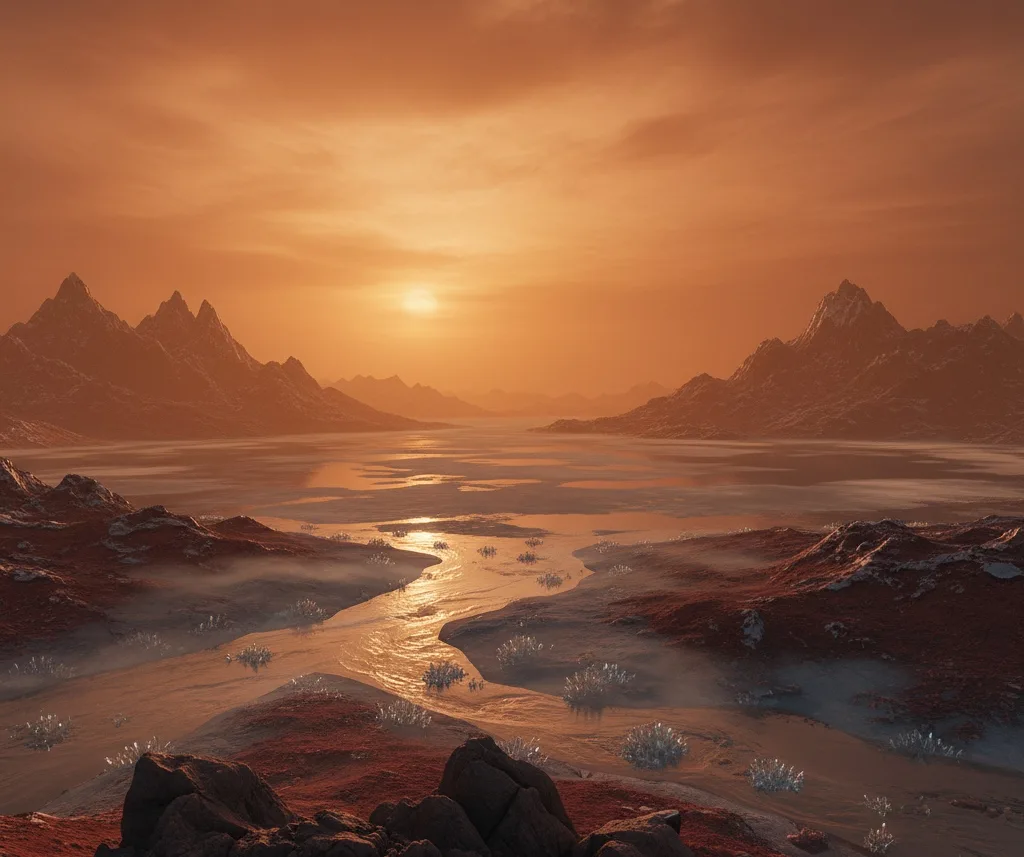
Titan doesn’t look like much at first glance. A frozen orb suspended in orbit, its atmosphere thick with nitrogen and methane, its surface awash in lakes not of water but liquid hydrocarbons. It is cold beyond imagining—almost 300 degrees below zero Fahrenheit—and yet, beneath that stillness, something astonishing is happening.
In recent years, Titan has started whispering secrets that we didn’t even know we were listening for. Scientists working with laboratory simulations and spectroscopic models have found that chemicals on Titan’s surface, under its pressure and temperature, behave in ways that violate the tidy boundaries we’ve always drawn. Molecules that should repel each other—polar and nonpolar compounds—are forming stable structures, co-crystals that defy the rules we teach in introductory chemistry. Hydrogen cyanide and methane, strange bedfellows by any Earth standard, are bonding in ice-like lattices. These aren’t the building blocks of life as we know it, not yet, but they are scaffolds of possibility.
And that’s the point. Not that Titan proves life elsewhere, but that it destabilizes the confidence with which we say we understand how things must work. It doesn’t take exotic lifeforms to remind us of our ignorance—it just takes molecules doing the “wrong” thing 800 million miles away.
The deeper we study Titan, the more it becomes a mirror. Not of alien biology, but of our own intellectual arrogance. For so long, science has carried with it an implicit assumption: that the universe plays by our rules. That our models are good enough. That we’re only a few revolutions away from a complete understanding. But what Titan teaches us is that our rules are local dialects in a language far more complex and cosmic. We assumed the same chemistry applies everywhere—but Titan shows us that environment reshapes behavior. That deep cold is not just absence but a new kind of laboratory. That what we consider “impossible” may just be “unfamiliar.”
And Titan is right next door. Cosmically speaking, it’s the moon next door. If such radical surprises are hiding in our own solar system, what waits in the far reaches of interstellar space? What chemistry spins beneath the frozen oceans of Europa, or in the atmospheres of exoplanets light-years away? How much are we not seeing—not because it’s distant, but because it doesn’t fit our assumptions?
We are, after all, pattern-seeking creatures. We crave the certainty of closed systems, of final answers, of neat definitions like “life,” “non-life,” “organic,” “inert.” But the cosmos is under no obligation to conform to the limits of our language. It keeps insisting on ambiguity, anomaly, exception. Titan doesn’t give us certainty. It gives us humility.
And maybe that’s more valuable.
We always say we want to find life out there. But maybe what we really need is to lose the illusion that we’ve already figured it all out. Because the most exciting discovery isn’t proof of alien biology. It’s proof that we are still at the very beginning of understanding what’s possible.
So let Titan keep unraveling us. Let it break our rules and stretch our imaginations. Let its frozen lakes and impossible molecules remind us that we are not masters of knowledge but apprentices of wonder. There are more truths in the universe than there are words in our books. And if we’re lucky—truly lucky—we’ll spend our brief time as a species discovering just how much we never knew.