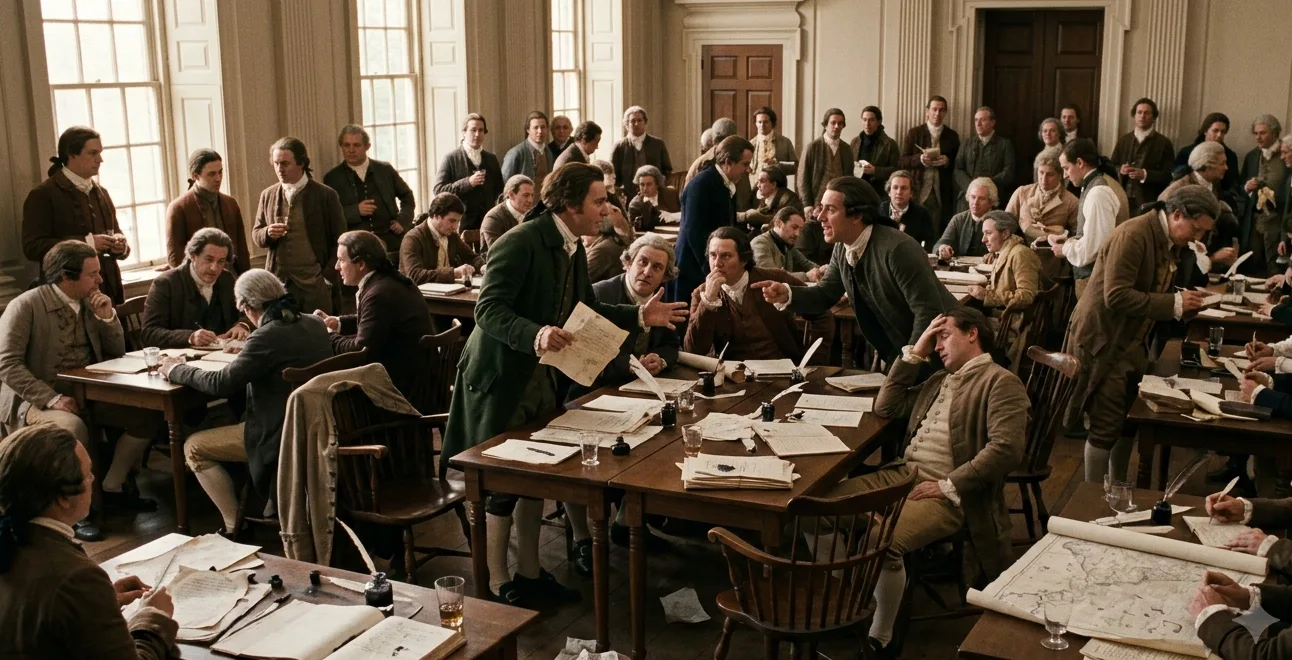
As I look back over history, it seems that humanity once looked toward the future for answers, while today people increasingly cling to the past. I find that extremely strange. When I talk to someone about the need to rethink our political systems or reconsider the goals of humanity, the conversation often stops before it begins. People defend systems created hundreds of years ago as though those systems emerged fully formed from reality itself, rather than from groups of human beings working with the limited knowledge, assumptions, prejudices, and pressures of their time. I am not even asking people to agree with me about what should replace them. I am asking for something much more basic: that we publicly admit the possibility that something better could exist.
That admission should not be controversial. Our political systems were built by people. Our economic systems were built by people. Our religious and philosophical traditions were developed, interpreted, organized, and preserved by people. None of these systems descended from the sky in their final form. They were created under specific historical conditions by individuals who could only work with the information available to them. Yet we often speak about these inherited structures as though questioning them is irresponsible, while defending them is somehow neutral. The existing system is not neutral. It is simply the system that survived.
This is not an argument that the people of the past were stupid. Some of my greatest intellectual heroes lived hundreds or even thousands of years ago. Their minds were clearly capable of extraordinary insight. But intellectual capacity and access to knowledge are not the same thing. I refuse to believe that a small group of white men living hundreds of years ago could compete, in almost any serious intellectual arena, with a diverse group of trained modern specialists who have access to centuries of accumulated research, global communication, advanced modeling, and nearly every major intellectual tradition at their fingertips. That is not demeaning the past. It is recognizing the conditions under which the past operated.
The founders of the United States could not have understood modern economic theory because most of it did not exist. They could not have understood modern psychology, sociology, neuroscience, climate science, digital communication, globalized finance, mass media, nuclear weapons, artificial intelligence, or industrial-scale political lobbying. They could not have anticipated a country of hundreds of millions of people containing cultures, religions, languages, identities, and belief systems from across the planet. It was impossible for them to gather enough information to meaningfully understand the complexity of one hundred different cultures interacting within a single political system. These were people living in a world where distance dramatically restricted knowledge and where something as ordinary to us as olive oil could still be perceived as exotic. To imagine that their political architecture should remain permanently authoritative under radically different conditions is laughable.
Their limitations were not failures of intelligence. They were limitations of time, place, access, and perspective. A person can be brilliant and still be unable to account for realities they have never encountered. A group can contain exceptional thinkers and still remain collectively blind because its membership excludes most of humanity. Diversity is not merely a symbolic gesture or moral decoration. It is a form of knowledge. People shaped by different cultures, classes, genders, faiths, bodies, and forms of social power perceive different aspects of reality. When those experiences are excluded from the design process, the system is built around absences its creators may not even know exist.
We understand this principle in nearly every other complex field. We would not ask a small group of intelligent generalists to redesign an electrical grid, healthcare system, aviation network, or nuclear reactor without consulting trained specialists. We would bring together engineers, researchers, operators, ethicists, historians, affected communities, and people with competing theories. We would test assumptions, model consequences, identify blind spots, and revise the design when evidence showed it was failing. Yet when the subject is the political system governing all those other systems, we suddenly become reverent. Instead of asking what we can learn from centuries of outcomes, we spend our time arguing about what the founders really meant.
Even progressive political movements often fail to make the deeper argument. They may call for reforms or advocate for another established economic model, but they rarely state publicly that political systems are inventions and that human beings retain the authority to invent again. They critique the outcomes of the current system without fully challenging the assumption that our legitimate options must come from the past. The right carries the founders. Liberals carry institutional precedent. Socialists carry Marx. Religious movements carry ancient revelation. Philosophers carry their canons. Everyone arrives with a dead man as a permission slip.
What I want is a public conversation that begins before the usual ideological choices. What is a political system supposed to accomplish? What does a successful society look like? What conditions should every human being be guaranteed? How should we balance freedom, security, dignity, community, ecological survival, creativity, and technological development? Which decisions require expertise, which require democratic participation, and which should never be controlled by concentrated private power? How should a government represent future generations, people not yet born, or forms of life that cannot vote? These are not childish or utopian questions. They are the questions any serious civilization should be willing to ask itself.
The refusal to ask them seems connected to a broader inability to admit that the past was flawed. If we cannot acknowledge the difficulties and environments that shaped our current systems, growth becomes far less likely. We inherit the compromises but forget the conditions that produced them. We preserve the answers after losing sight of the original questions. Eventually the system stops appearing designed and begins appearing natural. We no longer experience it as one possible arrangement among many. We experience it as reality.
This is where I think leadership consistently fails us. I rarely hear a leader say, “I do not know the answer, but I would like us to work toward finding out.” To me, that is one of the most powerful positions a leader can take. It does not mean paralysis or incompetence. It means refusing to perform certainty where certainty does not exist. There is a profound difference between saying “I do not know what to do” and saying “I do not yet know the answer, but I know the current answer is insufficient, and I am willing to investigate honestly and publicly.”
A leader who claims to already possess the answer closes the field of inquiry. A leader who admits uncertainty can invite collective intelligence. They can bring together specialists, communities, critics, and people directly affected by the problem. They can say what we know, what we do not know, what we are testing, and how we will determine whether we were wrong. That is not weak leadership. It is epistemic courage. It turns leadership from a performance of authority into stewardship of a shared search.
I am not arguing that modern people would automatically create something better. We still carry fear, greed, tribalism, ego, bias, and the desire to dominate. Greater access to information has not automatically produced greater wisdom. Modern technology could help create more humane, responsive systems, or it could enable surveillance and control on a scale the founders could never have imagined. The possibility of improvement is not a guarantee of improvement. But uncertainty about the outcome is not a reason to prohibit the inquiry.
My position is not that we are inherently wiser than the people who came before us. It is that we possess more accumulated knowledge and therefore have less excuse for treating inherited systems as sacred. We have access to evidence they could not gather, cultures they could not study, voices they excluded, technologies they could not imagine, and centuries of experience showing us where their systems succeeded and where they failed. To refuse to reconsider their designs is not respect for history. It is an intentional rejection of learning.
The greatest irony is that the people we now treat as untouchable authorities became historically important because they were willing to question authority. The founders did not cling to the political system they inherited. Great philosophers did not become great by merely repeating their predecessors. Religious movements began as disruptions. Social transformations occurred because people refused to accept that the existing order was final. We celebrate yesterday’s heretics and distrust anyone willing to become one today.
The founders deserve historical respect, but they do not require permanent obedience. Their achievement was not that they discovered the final form of political organization. Their achievement was that they were willing to imagine and construct something under uncertain conditions. To genuinely honor that spirit would not mean preserving every part of their creation forever. It would mean continuing the work.
We inherited a draft, not reality.
We do not need to pretend we already know what the next system should be. We only need enough humility to recognize that the current one is neither natural nor final, and enough courage to begin asking what humanity might build with everything it has learned since. They were allowed to imagine.
So are we.