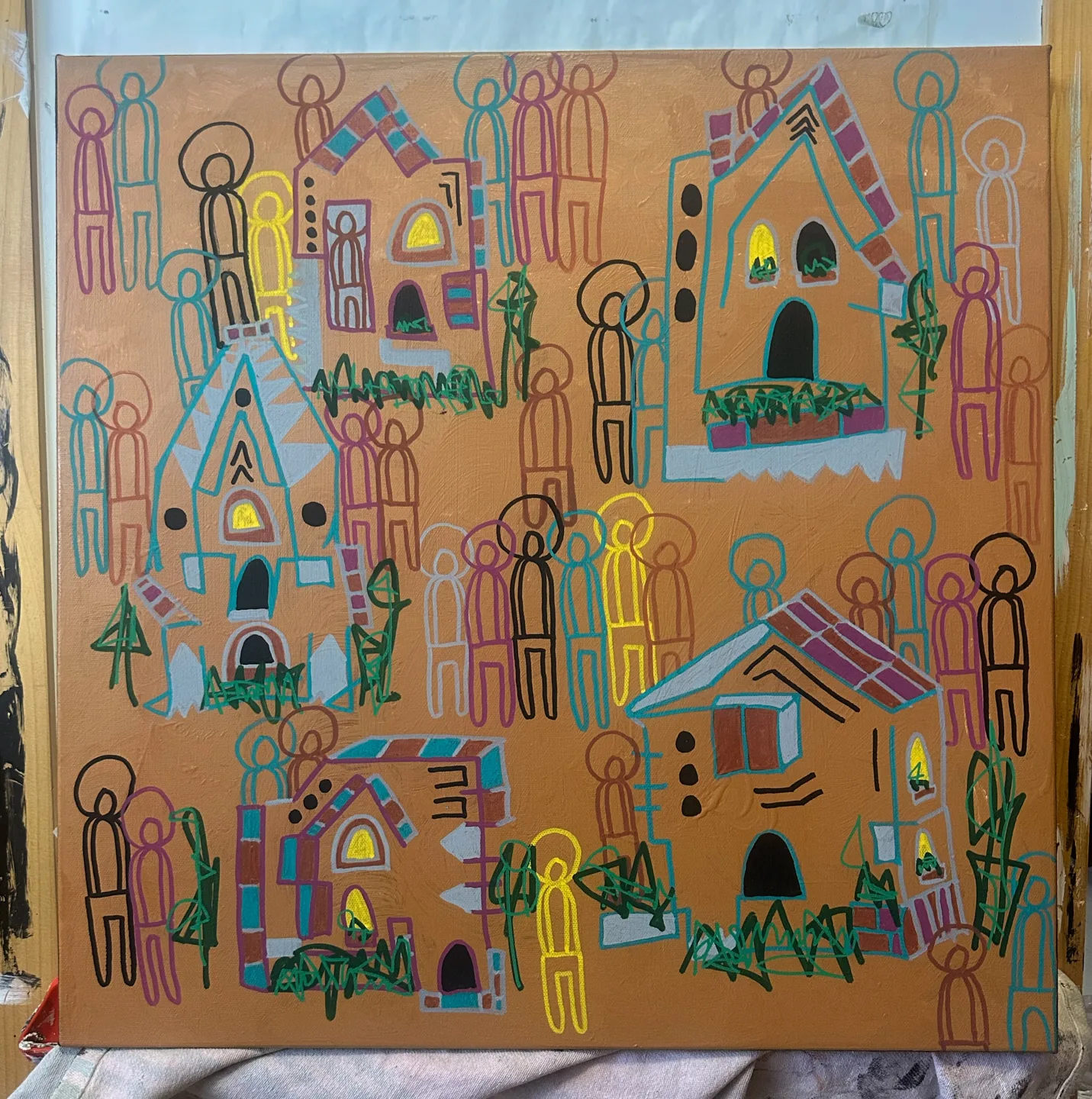
I’ve been thinking about process in art again. Not in a “this is right, that is wrong” kind of way, but more like realizing there are two entirely different conversations happening at once.
On one side, there are artists who find a process and lock in. Tape layered and peeled, paint dripped through motion, systems set in motion and allowed to unfold. The work that comes out of that can be incredible—each piece feeling unique even though the engine underneath stays the same. There’s a kind of beauty in that, like watching a system produce infinite variations of itself. It’s meditative in a way. The artist steps back, control loosens, and the process takes over. It becomes less about expression and more about allowing—letting physics, randomness, and repetition co-author the work.
That’s a real path. It’s just not mine.
Somewhere along the way, I realized I don’t want the system to run without me. I don’t want to set something in motion and then watch it resolve itself. I want friction. I want interruption. I want to argue with what’s happening on the canvas.
When I paint, it’s not about running a process and accepting the result. It’s about entering into something that keeps changing. I’ll layer something down, hate it, scrape it away, notice something new emerging, respond to that, and then ruin it again. It’s not clean, and it’s definitely not efficient, but it feels alive.
And somewhere inside that mess, something started showing up. A bird. A snake. Eyes. Strange little glyphs that feel like they mean something, even when I don’t fully understand what yet.
At first, I worried this was the beginning of a trap—that I’d found a “style” and would end up repeating it. But the opposite happened. These forms didn’t lock the work down; they opened it up. They weren’t outputs of a process—they were pieces of a language.
And language doesn’t get weaker when you reuse it. Imagine telling Shakespeare he only gets to use each letter once. Meaning doesn’t come from novelty alone; it comes from recombination, from context, from relationships shifting in real time.
That’s what I’m chasing now. Not a process that generates endless visual variation, but a set of symbols that can carry different meanings depending on how they interact, where they exist, and what surrounds them.
The bird isn’t fixed. The snake isn’t fixed. They change depending on their relationships—sometimes cooperating, sometimes conflicting, sometimes not making sense at all. And that’s the point. It means the system is still alive.
So the distinction, at least for me, isn’t really about process versus meaning. It’s about closed systems versus living ones. Some processes eventually stabilize. They become incredibly good at producing a certain kind of output, and there’s nothing inherently wrong with that.
But I’m more interested in systems that don’t quite settle. Systems that keep forcing something new into existence, even if it’s messy, even if it breaks what worked last time.
So I’ll keep using process. I’ll layer, scrape, wash, and rebuild. But not as a way to step away from the work. I’m there the whole time—pushing, responding, getting surprised.
Trying to speak a language I don’t fully understand yet, and seeing what answers back.