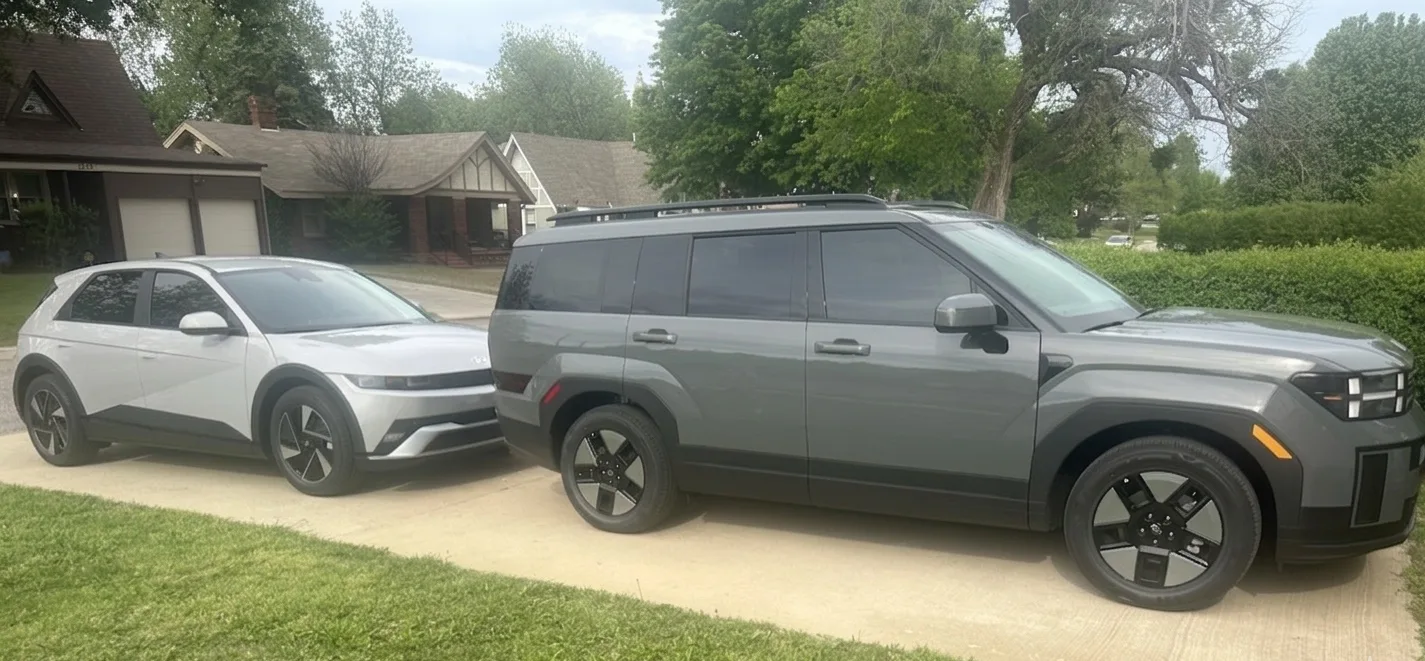
I love AI for big things: philosophy, consciousness, deep research rabbit holes, and strange recursive conversations about selfhood and reality. That’s usually where my mind goes. But over the last three weeks, my wife and I used Gemini for something far less glamorous and immediately more useful: figuring out how to trade our two vehicles without getting chewed up by the dealership process.
Honestly, this may be one of the most practical use cases for AI I’ve experienced yet. Because while AI can absolutely help you explore the nature of existence, it can also help you survive one of the least spiritually evolved institutions in modern life: the car dealership.
We had a complicated little puzzle. One vehicle was a leased 2024 Subaru Crosstrek with a bit of positive equity. The other was a 2022 Hyundai Tucson carrying some negative equity. We wanted to reset the whole garage, keep our monthly payment under a certain threshold, roll taxes and fees into the deal, and put zero dollars down out of pocket. In other words, we wanted the kind of clean, sensible outcome that dealership systems seem specifically designed to obscure.
Normally, this is where you walk into a showroom, sit under fluorescent lights for three hours, and let someone keep disappearing into “the back” to perform financial theater. This time, we did something different. Instead of showing up and asking what was possible, we used Gemini to figure out what needed to be possible before we ever set foot on a lot.
That shift changed everything. Rather than treating the dealership as the source of truth, we treated it as the final checkpoint. The real work happened beforehand. We used Gemini as a conversational strategist, running scenarios, testing vehicle combinations, and thinking through trade values, incentives, taxes, and deal structure. Because it could hold the whole mess in view at once, it reduced an enormous amount of cognitive drag.
That was the first big win. A process like this usually creates a low-grade fog. You’re trying to remember payoff amounts, trade estimates, lease terms, incentives, taxes, monthly targets, and whether a salesperson is actually helping or just rearranging the math. Gemini gave us a place to think clearly, structurally, and without pressure. At some point, the process stopped feeling like car shopping and started feeling like solving a puzzle.
Then came the real unlock. We realized this wasn’t just about finding two vehicles we liked. It was about finding the right combination of incentives and pricing structures to make the whole equation work. That led us to EV lease incentives. Once we saw how aggressive some of the electric vehicle lease programs were, the game changed. A high-incentive EV could absorb negative equity much more cleanly than a standard deal, which meant one side of the trade could do the heavy lifting and make the other side easier to keep sane.
That was the moment it all became legible. Not effortless, but understandable. And legibility is power.
My favorite part of the process was the email strategy. Anyone who has spent time in a dealership knows how much of the experience depends on momentum, discomfort, and decision fatigue. Sit there long enough, hear enough cycles of “good news” and “bad news,” and eventually you stop negotiating from clarity and start negotiating from exhaustion.
So instead of playing that game, we had Gemini help us shape a direct email to internet sales departments. The message was simple: here are the vehicles, here is the credit profile, here are the trade realities, here is the monthly target, here is the zero-down requirement, and here is the strategy we know exists. Run the numbers and let us know if you can do it.
That felt revolutionary. No pacing around the showroom. No vague promises. No “come on in and we’ll see what we can do.” No walking in blind and hoping a good outcome might happen to us. We were no longer asking the dealership to define reality for us. We were presenting a reality and asking who could meet it.
That’s probably the biggest practical gift AI gave us in this process: it removed so much of the wondering. Not all of it, of course. This is still car buying. Some amount of nonsense appears to be built into the ritual. But the usual haze was gone. We had already thought through the structure, tested the math, compared the options, and worked through the fit questions that actually mattered to our lives.
So when we finally went to the lot, the visit felt less like negotiation and more like physical verification. Does the cargo space work? Do the seats fold the right way? How does it feel in person? That’s a much better use of dealership time than sitting in an office while someone tries to make four different payment numbers sound like the same deal.
And that, to me, is the practical promise of AI. Not that it replaces thinking, but that it helps preserve it. It gives you a place to work through complexity before entering a high-friction environment designed to scramble your judgment. It acts less like a magical oracle and more like a calm, tireless thinking partner who doesn’t get flustered, doesn’t forget the constraints, and doesn’t get seduced by showroom lighting.
People often talk about AI in futuristic terms, and I understand why. It can feel eerie, profound, and occasionally world-bending. But one of the most useful things it has done for me lately was far more ordinary. It helped turn a stressful consumer ritual into a solvable problem. It helped us move from confusion to clarity, from haggling to structure, and from emotional pressure to actual leverage.
Maybe that’s part of the deeper lesson. The value of AI isn’t only that it can help us explore the big questions. It’s that it can help us deal more intelligently with the stupid stuff.
Which, depending on the day, may be even more important.