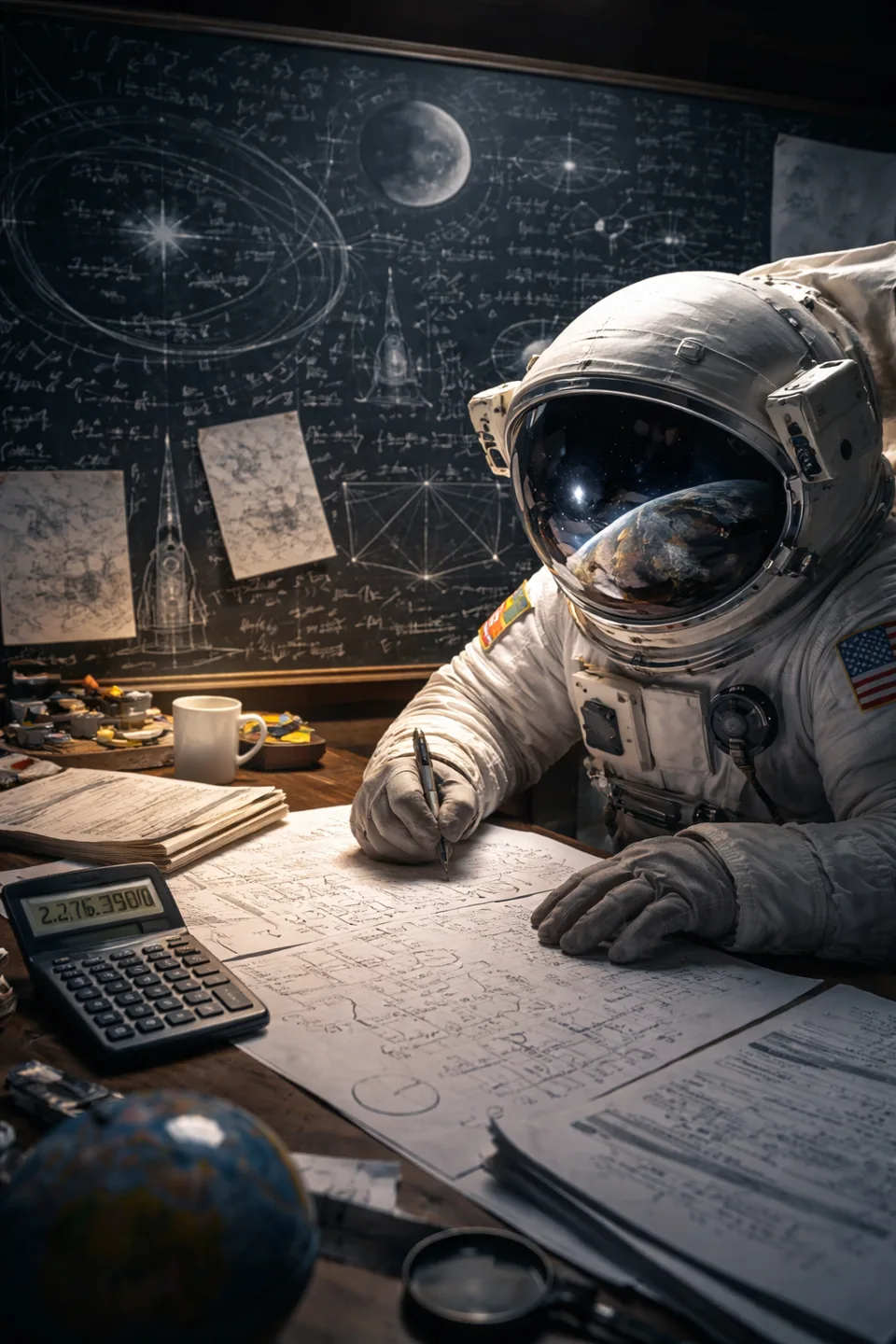
In the days since Artemis II returned, I’ve found myself strangely moved by the whole thing. Watching astronauts welcomed home, seeing the emotion on their faces, hearing the speeches, watching them return not just as symbols but as people — it has felt like a rare burst of hope in a world that often seems committed to ugliness and confusion. NASA says Artemis II splashed down on April 10, 2026, and the crew returned to Houston the next day to reunite with their families.
And, almost immediately, the other side showed up too: the people insisting it was fake, that NASA is a fraud, that space itself is some elaborate performance. I understand the pull more than I wish I did. When I was younger, I went through a conspiracy phase myself. Not because I was stupid, but because conspiracy thinking offers something strangely comforting. It makes a confusing world feel ordered. It turns complexity into plot. It replaces uncertainty with hidden intention.
The thought that ended all of that for me came when I was 19. It was not a debate about evidence. It was a number.
Or rather, too many numbers.
Apollo alone employed about 400,000 people at its height. NASA has repeated that figure in its historical material for years.
And that was just one program.
Today, the official space workforce is already enormous even before you start counting it historically. Space Foundation reported that the U.S. space sector reached 222,300 positions in 2023, including NASA and military roles. A 2025 BEA working paper estimated that the U.S. private-sector space economy employed more than 373,000 workers in 2023, while BEA also estimated 19,686 non-defense government space employees in 2022, with more than 16,000 of those from NASA. Europe’s upstream space industry alone was estimated at 62,659 full-time-equivalent jobs in 2023.
Then add the unofficial observers.
Not officials. Not insiders. Just people with telescopes, clubs, radios, cameras, data, and obsession. One industry summary, citing the International Astronomical Union, says there are about 10,000 professional astronomers worldwide and estimates the amateur astronomy community at 300,000 to 1.5 million people globally. Even an older estimate from Sky & Telescope put amateur astronomers at at least 200,000.
So when someone says “NASA is fake” or “space is a hoax,” what they are really asking me to believe is not that a few astronauts lied. They are asking me to believe that across the full history of space programs, millions of people would have had to lie, stay silent, or somehow fail to notice.
That realization hit me 28 years ago, and it has stayed useful ever since. The number was simply too large for the fantasy to survive. People love to imagine conspiracies as small, elegant, and controlled: a few powerful men in a room, a secret script, a hidden hand. But reality is rarely that neat, and the larger the claim, the larger the silence required to sustain it. At a certain point, the conspiracy does not collapse because of physics or astronomy or expertise. It collapses because of headcount.
That is still my favorite cheat code for breaking almost any scientific conspiracy: How many people would have to lie for this to be true? Usually, the answer is enough to set you free.
Some conspiracies die by evidence. The stupidest ones die by arithmetic.