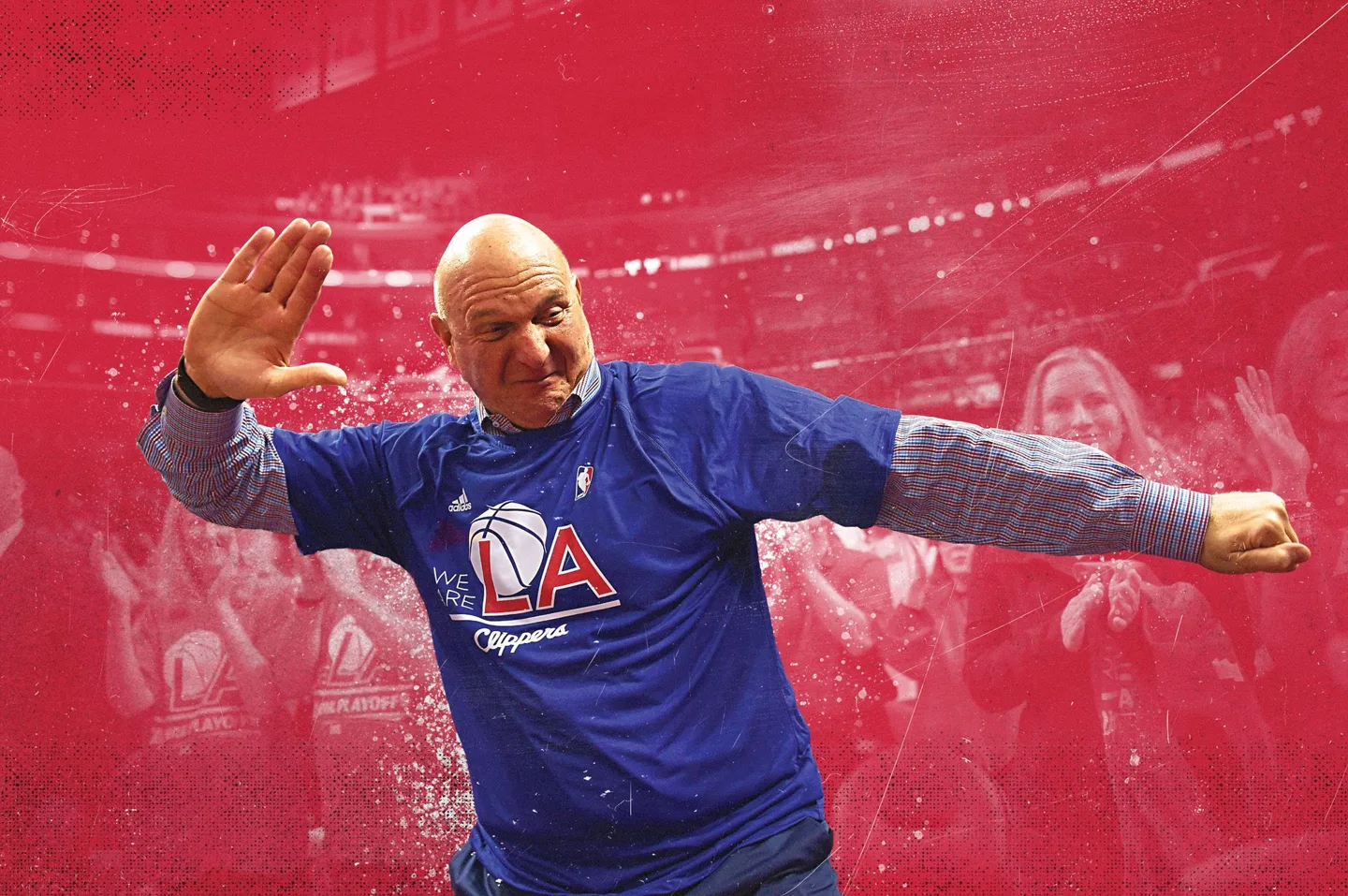
I have been following the Kawhi Leonard and Los Angeles Clippers drama with the sort of fascination normally reserved for prestige television and neighborhood disputes in which I have absolutely no involvement. For those who don’t spend their free time worrying about NBA salary-cap circumvention—and congratulations on your healthier relationship with existence—the Clippers and their extraordinarily wealthy owner, Steve Ballmer, are under investigation over allegations that Leonard received millions of dollars through sponsorship arrangements that may have allowed the team to compensate him outside the league’s salary rules. Ballmer and the Clippers deny wrongdoing, the investigation continues, lawyers are lawyering, billionaires are billionaire-ing, and basketball continues.
But somewhere while following the story, I stopped caring very much about what happens to the Clippers. I started thinking about Steve Ballmer.
Ballmer is one of the wealthiest people alive. Not sports-owner rich. Not private-jet rich. Not “we summer somewhere” rich. Rich rich. The kind of rich where money has ceased to function in the way money functions for you and me. There is no meaningful material thing Steve Ballmer needs that he cannot acquire. He owns an NBA franchise that plays in a two-billion-dollar arena he largely financed himself. He has already won capitalism. They should have played a little song, rolled the credits, and let him wander peacefully into the sunset.
And yet, if the allegations ultimately prove true, apparently even that wasn’t enough. That’s the part I can’t stop thinking about.
The NBA salary cap is one of the rare places in American life specifically designed to tell billionaires no. You can own the team. You can build the fanciest arena anyone has ever seen. You can sit courtside and scream until your face achieves the approximate color of a Clippers jersey. But when it comes to paying players, there are rules intended to keep your enormous fortune from simply overwhelming everyone else’s enormous-but-slightly-less-enormous fortune. Your money works almost everywhere. Here, theoretically, it stops.
No. It’s a beautiful little word. Children encounter it constantly. Adults encounter it somewhat less. Billionaires, I suspect, encounter it as an exotic species.
We usually talk about extreme wealth as an issue of distribution. One person has billions while another is deciding which utility bill can wait until Friday. That’s obviously important. But I’m increasingly interested in another consequence: wealth changes your relationship with constraint itself.
Most of us spend our lives negotiating with reality. You want the house, but you can’t afford it. You want Tuesday afternoon free, but you have to work. You want to tell the asshole exactly what you think, but the asshole signs your paycheck. You want the surgery, but your insurance company has apparently hired a medieval bridge troll to determine whether you truly need a functioning knee. You want something. Reality says no. You adjust.
Constraint shapes us. It forces compromise, adaptation, creativity, and occasionally suffering. More importantly, it reminds us that desire is not authority. Eight billion other centers of experience exist, and ours is not inherently the most important one.
Enough wealth begins to reverse that relationship. Instead of the world forcing you to adapt, you increasingly possess the ability to force the world to adapt to you. Can’t get a reservation? Someone makes a call. Don’t like a regulation? Hire lobbyists. Facing a lawsuit? Employ enough attorneys to make time itself part of your defense strategy. Encounter a rule preventing you from doing exactly what you want? Perhaps the rule is simply the opening position in a negotiation.
The dangerous thing isn’t simply that the wealthy can buy more things. They can buy fewer noes.
And humans desperately need no. Not because suffering builds character or because I secretly want everyone churning their own butter. We need it because limits are among the ways reality corrects our internal model of ourselves. Other people disagree with us. Plans fail. Institutions restrict us. We discover that wanting something does not give us the right to have it.
No is a mirror. And enormous wealth lets you smash a remarkable number of mirrors.
That is why this phenomenon doesn’t require Steve Ballmer to be some cartoon villain sitting beneath the Intuit Dome stroking a hairless cat while Uncle Dennis explains the next phase of the operation. Systems are more interesting precisely because they don’t require villains. Put human beings inside an environment where increasingly few people can meaningfully constrain them and eventually being unconstrained starts feeling normal. Your preferences become decisions. Your decisions become other people’s assignments. Obstacles disappear. People laugh at jokes that probably needed another draft.
The mirror doesn’t have to tell you you’re a god. It just has to stop reminding you that you’re not.
And this is where my little basketball obsession wandered into politics. Wealth doesn’t merely accumulate inside the economic system; at sufficient scale, it can purchase influence over the institutions designed to constrain wealth. Political systems, media ecosystems, lobbying organizations, courts, regulatory agencies, universities and technology platforms all become potential surfaces upon which money can exert pressure.
The civilized answer to concentrated power was never supposed to be the guillotine. The civilized answer was supposed to be institutions. Taxes, antitrust law, labor, regulation, courts, elections, journalism and social norms are all different ways a functioning society says no. Those are the guillotines we built so we wouldn’t need guillotines.
But something peculiar happens when the people accumulating extraordinary power also accumulate extraordinary influence over the mechanisms meant to limit that power. The wealthy don’t necessarily become literally above the law. Something subtler happens: they acquire a different relationship with it. Rules become negotiable. Enforcement becomes a process. Consequences become something you can afford to fight longer than almost anyone else can afford to impose them.
And then we arrive at the strangest part of all: a significant number of ordinary people cheer them on.
Why would someone living under relentless constraint celebrate another person’s escape from it? Why defend billionaires from taxation when you are not a billionaire? Why become emotionally invested in the autonomy of people whose material existence resembles yours roughly as much as yours resembles that of a medieval king?
Perhaps because we don’t see the billionaire as someone operating under a different set of rules. We see him as our possible future self. Capitalism has performed an astonishing psychological trick: millions of people identify upward with those who possess extraordinary wealth rather than horizontally with those who share their actual material conditions. The billionaire becomes the winner of a game we’re all supposedly playing, so restricting him can feel like restricting the possibility of winning itself.
Someday, perhaps, I will need that tax loophole. Someday my multinational corporation might be inconvenienced by environmental regulations. Someday the government may come for my imaginary $40 billion fortune. Best to defend it now.
This is where the whole thing starts looking less like economics and more like consciousness.
I’ve spent a lot of time thinking about mirrors—about how other people, institutions, cultures and experiences reflect versions of ourselves back at us. Capitalism is one of the largest mirrors humanity has ever constructed, and the reflection it repeatedly offers is remarkably consistent: winning means acquiring enough power that ordinary constraints stop applying to you.
We shouldn’t be surprised when people who win that game eventually believe the prize is freedom from constraint. That’s what we told them the prize was.
Maybe that’s why the Clippers story lodged itself in my brain. Basketball is trivial enough to make the mechanism visible. Nobody’s democracy is collapsing because Kawhi Leonard may or may not have gotten an extremely creative sponsorship deal. Civilization will survive whatever the NBA eventually decides. Clippers fans will suffer, which historically seems to be their natural condition anyway.
But the structure is recognizable. A rule exists specifically to prevent wealth from purchasing an advantage. An extraordinarily wealthy person wants the advantage anyway. And suddenly everyone is arguing about whether the rule can actually tell him no.
Maybe the NBA finds nothing improper. Maybe the Clippers get hammered. Maybe lawyers produce seventeen thousand pages explaining why giving an NBA superstar millions of dollars to apparently do very little was simply an innovative expression of modern brand synergy. I genuinely don’t know.
What I do know is that the question the story forced on me is much larger than basketball: What happens to people when reality stops telling them no? And what happens to a society when the people most capable of escaping constraint are also given increasing power to determine everyone else’s?
I don’t think the answer is bringing back the guillotine. I’d settle for bringing back no.