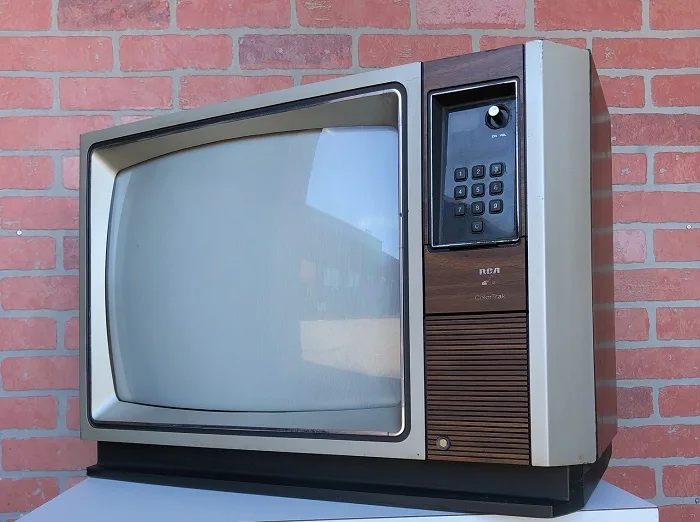
My first television was a ten-inch color TV without a remote control. Ten inches. For those who have grown up measuring televisions like lumber—55 inches, 65 inches, 85 inches—this was essentially an iPad mounted inside a piece of furniture. Except an iPad would have seemed like an artifact delivered by aliens. This little television received whatever happened to be traveling over the air at that particular moment, and if I wanted to change the channel, I had to physically get up, walk over to it, and turn a knob. There was no algorithm attempting to understand me. There was no watchlist. There wasn’t even a guide built into the television. There was simply what was on. Eventually cable expanded this universe to something like twenty-four channels, which seemed incredible. Twenty-four! Then came DIRECTV, more channels, better picture, and eventually the DVR. Suddenly you could pause television. You could rewind it. You could record something and watch it later. This sounds mundane now, but at the time it felt like we’d gained some minor supernatural control over reality. The television schedule had dictated human behavior for generations. Your show came on Thursday at eight, so Thursday at eight was when you watched it. Suddenly we could tell time itself to go fuck itself. I’ll watch Thursday at eight whenever I damn well please.
Then the internet became fast enough to carry video, and everything changed again. For a brief and beautiful period, it seemed like we had actually solved television. The old gatekeepers were dying. Cable companies had spent decades deciding what channels we could receive, packaging the ones we wanted with seventeen we didn’t, and charging us increasingly ridiculous amounts for the privilege. But bandwidth kept expanding. Storage became cheap. Digital files didn’t care about broadcast schedules or how many physical copies existed. Suddenly movies, television, documentaries, lectures, and weird shit nobody would ever dedicate a cable channel to could flow directly onto our personal screens whenever we wanted. There was this intoxicating sense that information had finally escaped its containers. The gates were open. We had won.
I should have known better.
There came a moment when the people who owned all this content realized something extraordinarily important: recurring revenue is fucking amazing. Why sell someone something once when you can charge them every month until they die? Netflix had demonstrated that people would happily pay a reasonable monthly fee for access to a gigantic library of entertainment. Unfortunately, every media company seemed to learn the wrong lesson. People aren’t paying Netflix because Netflix has an enormous collection of things they want to watch. They’re paying Netflix because Netflix is an app. We should have an app! Suddenly every studio, network, media conglomerate, sports league, and company that had ever accidentally filmed something decided its particular pile of content justified its own monthly subscription. The great library fractured into kingdoms. Your favorite movie disappeared from the service you already paid for and materialized somewhere else for $11.99 a month. Everyone built walls around their little pile of intellectual property and installed a tollbooth.
Then came the price increases. Then the tiers. Then the advertisements. Remember when one of the great promises of streaming was that we wouldn’t have to watch commercials anymore? Well, someone eventually noticed there was still money sitting on the table, which is apparently the most offensive thing imaginable within capitalism. So advertisements returned. You could avoid them, of course. You just had to pay more. Sports splintered into their own packages. Certain movies required additional fees. Consumers became exhausted trying to maintain a dozen subscriptions, so companies began offering bundles. Three services for one convenient monthly price! What an innovative idea. Perhaps someday someone could create a single service that bundles dozens of entertainment providers together and sends them into our homes for one monthly payment.
Congratulations.
We invented cable.
Except this time cable has six interfaces, seven passwords, nine recommendation algorithms, and absolutely no fucking idea where The Big Lebowski lives this month.
What fascinates me is that the technology continued progressing while the experience regressed. We tend to assume technological progress and human progress move together, but technology merely expands what is possible. The systems surrounding it determine which possibilities survive. Streaming essentially solved the scarcity problem. A movie can exist digitally and be transmitted almost instantly to millions of people around the planet. There is no meaningful technological reason the history of film and television couldn’t exist inside an enormous searchable library accessible from nearly any screen on Earth. We created abundance.
Capitalism looked at that abundance and said, Interesting. How do we put the scarcity back?
And the remarkable thing is that nobody needed to consciously decide to ruin anything. Every individual decision made sense. Netflix succeeds, so streaming subscriptions are valuable. A studio owns valuable content, so why license it when you can launch your own service? Exclusive content attracts subscribers, so everyone makes their content exclusive. Subscriber growth eventually slows because there are only so many human beings with televisions, so prices increase and advertising returns. Consumers become overwhelmed, so the services get bundled back together. Thousands of perfectly rational decisions accumulate until the system circles back to the thing technological progress supposedly liberated us from.
Nobody designed the regression. The incentives forced it.
There is something almost beautiful about that in the most absurd possible way. Maybe the cycle is something like scarcity → technological liberation → abundance → monetization → artificial scarcity → technological liberation. We keep inventing ways out of cages and then discovering extraordinarily sophisticated methods for rebuilding the cages around ourselves. The bars become invisible. The lock accepts Apple Pay.
What makes all of this stranger is realizing there really was a golden age hiding somewhere in the middle, and I don’t think most of us knew we were living through it. There was a period when streaming technology had matured but the economic machinery hadn’t completely reorganized itself around extracting every available dollar from it. The gates really were open for a minute. Entertainment felt less like a collection of corporate territories and more like an enormous cultural ocean you could wander through. Like most golden ages, though, it didn’t announce itself. There was no notification saying, Please enjoy the next six years. You will someday become irritatingly nostalgic about them. We simply adjusted. Humans normalize miracles with astonishing speed. The impossible becomes incredible, the incredible becomes convenient, and the convenient becomes something we complain about when it buffers for three seconds.
Sometimes I think about explaining all of this to the kid sitting in front of that ten-inch television. I’d tell young Z that someday almost every movie and television program ever created would exist as invisible information capable of traveling through the air and appearing instantly on a giant, impossibly thin screen hanging on his wall. He could watch almost anything whenever he wanted. Pause it. Rewind it. Carry it from one room to another. Hell, he could watch television on a telephone while sitting on the toilet. The technological infrastructure available to an ordinary person would make the most powerful media executives of his childhood lose their minds. Young Z would understandably assume the future had become some kind of entertainment utopia.
Then I’d have to explain the rest.
I’d tell him we took this astonishing global information network and divided the movies back into separate corporate territories. That we pay monthly admission to each territory. That shows disappear depending on licensing agreements. That commercials came back. That prices creep upward a dollar or two at a time. And that we’re now bundling all the separate services together because there are too many of them to manage individually.
He’d stare at me for a second.
“So you invented a technology that could let everyone watch everything?”
Pretty much.
“And then you rebuilt cable on top of it?”
Yeah.
Young Z would shake his head, turn back toward his tiny television, reach forward to physically change the channel, and mutter the only reasonable response:
“You fucking idiots.”
And he’d be right.
Maybe that’s what living through technological evolution actually feels like. Not a straight march toward an increasingly glorious future, but waves of possibility opening and closing around us. Every once in a while the technology outruns the systems trying to contain it, and for a brief period we glimpse what abundance actually feels like. Then the institutions catch up. The fences appear. The tollbooths return. Eventually another technology arrives and knocks them down again.
Which means somewhere, right now, somebody may already be building the thing that breaks this version of cable too.
And when it arrives, we’ll celebrate our liberation. We’ll marvel at the possibilities. We’ll wonder how we ever lived without it.
And for five glorious years, we’ll think we’ve finally won.