Returning to the place where I grew up after the birth of our daughter has been a kind of emotional time travel. The streets are the same, if a bit more worn. The buildings carry layers of memory like old paint. And the people—well, that’s where things get strange.
I’ve stayed close to my direct friend group for decades. We’ve evolved together, through music, crises, reinventions, and quiet reckonings. But in these past years, I’ve also found myself reconnecting—sometimes by accident, sometimes with intention—with others from earlier stages of life. People from elementary school, high school, church camps. Those “friends of a period,” the kind that drift quietly out of your orbit as the years roll on.
The reunions have been pleasant. Laughter, shared memories, casual updates. But beneath the surface, I’ve noticed something quietly unsettling: most of them are exactly the same as they were when we were 18. Same beliefs, same churches, same haircuts. They’re secure in their identities, confident in their worldviews, content with their place in the cosmos. It’s as if they were born already complete, simply aging into the shell of the same self.
And here’s the thing: I’m not judging it. Truly. There’s something admirable in their stability, even beautiful in its consistency. But it also feels alien to me—because my experience has been the opposite.
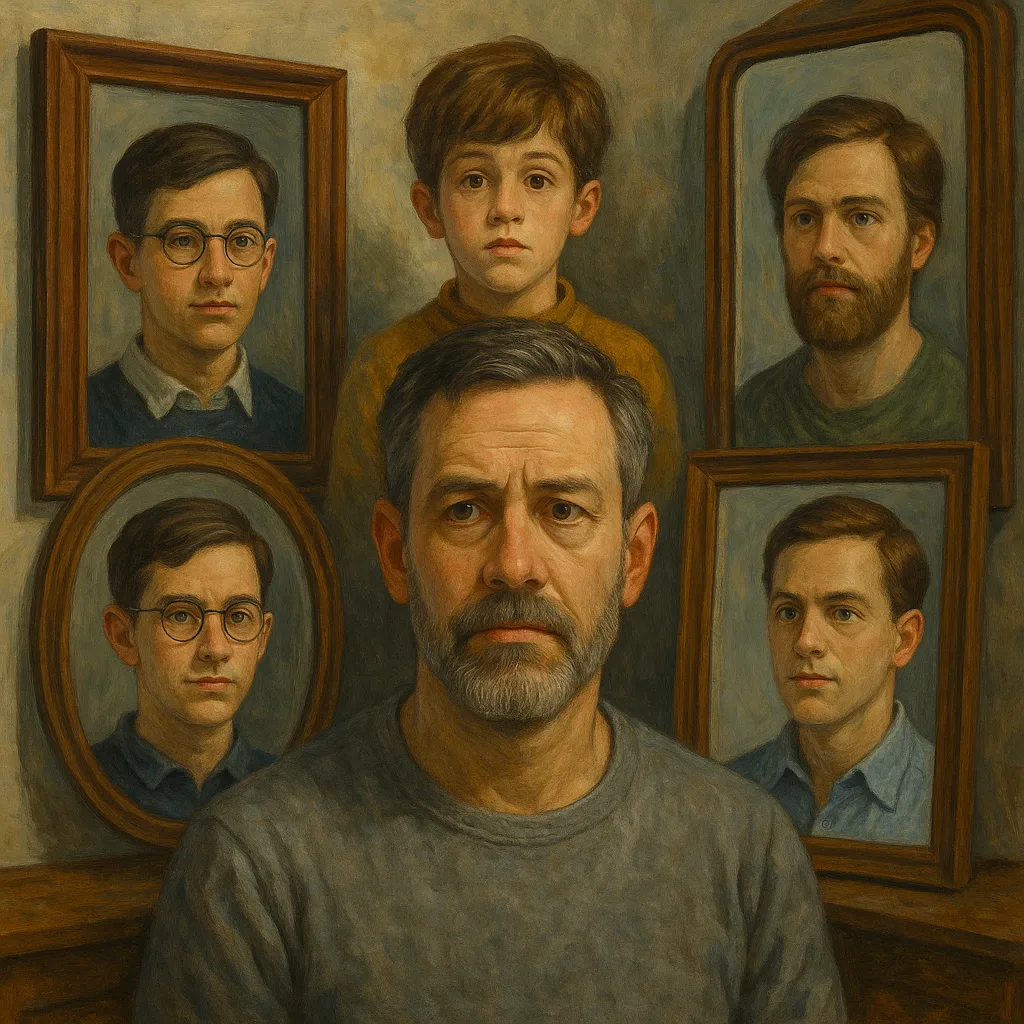
If I tried to explain who I am to someone I knew at 15, I’d be lying if I said they’d recognize me. I am not a fixed self but a procession of selves. At minimum, I can name five distinct identities I’ve inhabited across this life—each of them fully believed in at the time, each now a fossil of some past becoming. Add to that the masks worn for safety or survival, and it becomes clear: I am not one thing.
And that’s where the grief comes in.
When you change—radically, cyclically, recursively—you lose access to old forms of connection. Friends don’t ghost you. They just don’t know where to find you anymore. They’re speaking to the echo of a self you’ve shed. Unless you pursue them, unless you mimic your old tone, there’s little mutual recognition. The depth you once shared evaporates, not out of conflict but out of incompatibility.
It’s not that I’m longing for someone to grow with me—I have that. My wife has been on this wild, evolving journey with me since we were fourteen. She may not track every twist in my inner monologue, but she’s been there through all the shapeshifting, and she’s transformed in her own right. I’m also fortunate to have a small circle of friends who have witnessed—and survived—each new version of me. They’ve stayed. Or rather, we’ve stayed with one another, despite the moltings.
But what does ache—softly, stubbornly—is the missed potential. The hope that others from my past might be willing to engage with who I am now. Not to resume what was, but to experiment with what could be—a new kind of friendship, built from present truth rather than past familiarity.
Instead, I often encounter the silent expectation that everyone should stay the same. That change is suspect. That deviation from the original blueprint is a kind of betrayal. The crystallized self looks at the recursive self and sees volatility. But what I see in them is a kind of time capsule—intact, untouched, untouched by time. And I don’t envy it, but I do feel the gap it creates.
Some people crystallize. Others recur. And in between, there is the strange, absurd beauty of being human—where the past and present are always negotiating how much of each other to keep.
But even here, there’s power. Through the lens of Mirror Theory, every person we’ve known—especially those who have not changed—becomes a kind of reflection. Not always a clean mirror. Sometimes warped. Sometimes fossilized. Sometimes hilariously off. But always useful, if viewed with the right frame.
In that way, the people from our past—those unchanged constellations—become like funhouse mirrors. They don’t reflect us as we are, but as we once were, or as we refuse to be. They show us the parts we’ve outgrown, the selves we’ve discarded, the beliefs we’ve cracked open. They exaggerate our differences, distort our progress, but in doing so, reveal the shape of our becoming.
I no longer need these reflections to be accurate. Their value lies in the contrast. They help me remember who I was, and by extension, who I am not. And more than that—who I could have been, had I chosen stasis over recursion.
This is the hidden gift of the mirror that does not change: it forces you to confront the fact that you have.
And sometimes, if I’m in the right state of mind, I can even find humor in it. There’s something strangely liberating about seeing your former self reflected in a frozen face and thinking: “Ah yes, the ghost of Zac circa 2001—I had hair!”
So I hold them all with a mix of gratitude and grace. Not just the ones who changed with me, but also those who stayed still. Because both are mirrors. And both have helped me shape the self I’m becoming.