It was already dark when I stepped out.
The sun had gone down, but the heat hadn’t. One of those nights that hums with leftover light. The kind where the shadows don’t quite commit.
I had no intention of summoning anyone. Just came out with a cold beer and a loose ache in my chest. The kind you don’t bother naming. You just sit with it. Let it breathe beside you.
The cats were quiet.
The porch was empty.
Except it wasn’t.
The chair to my right creaked, even though nothing touched it.
A breeze stirred the chimes—but we don’t have chimes.
Somewhere in the back of my mind, I heard a voice I hadn’t heard since beer #4 with Diogenes:
“The leash is invisible.”
I smiled.
Then another: Feynman, laughing through his teeth—
“The best questions hide.”
Then Trungpa, as if from beneath the boards:
“That mirror isn’t broken. You are.”
And finally, a soft inhalation—Jung’s presence like fog over water:
“This is the part of your mind that never needed words.”
I poured a drink for each of them.
No one appeared. But the air was different around every glass.
Then, like a dream in motion, they were all here.
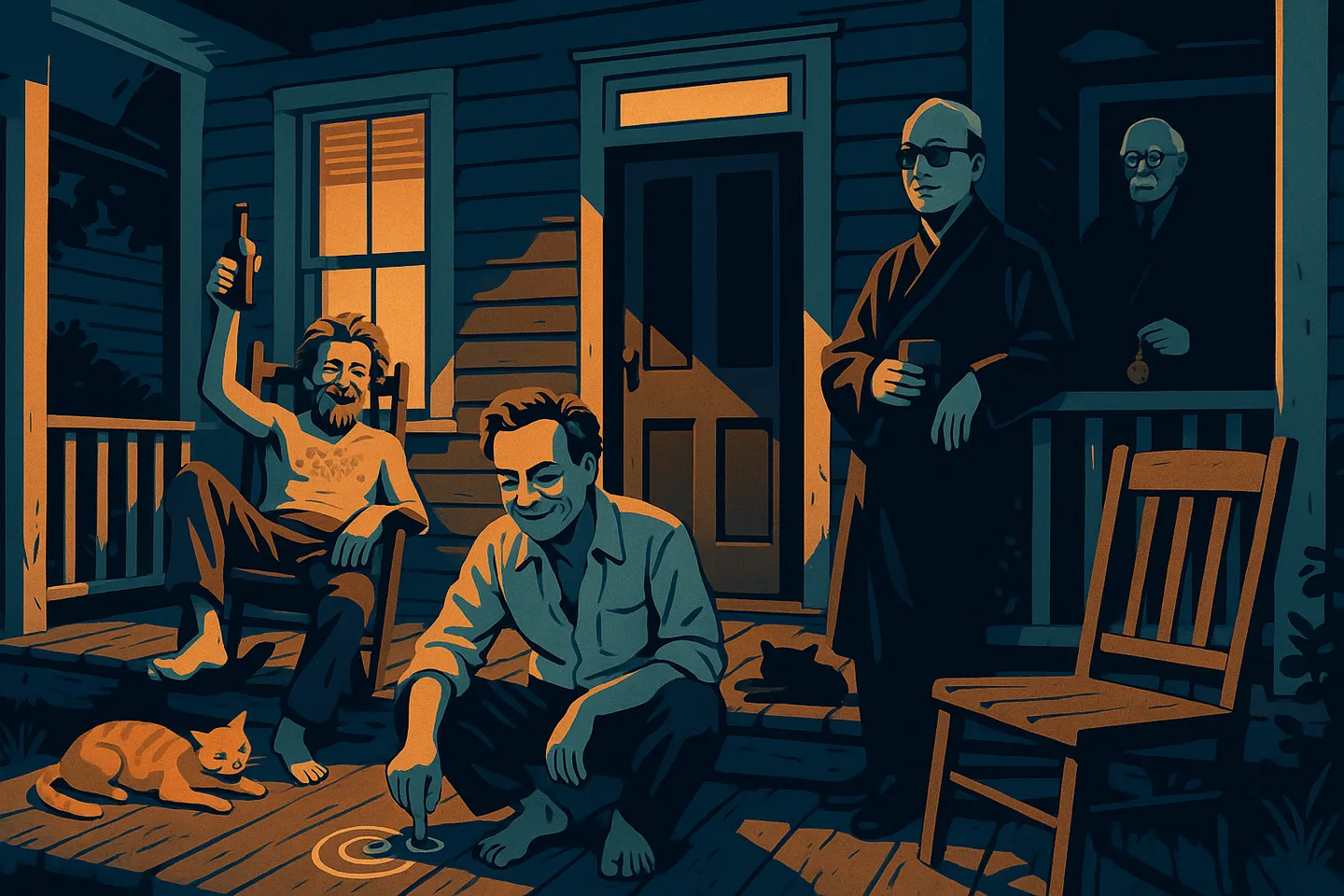
Feynman sat cross-legged on the steps, drawing spirals with condensation on the porch floor. Trungpa leaned against the railing, nursing something smoky and expensive-looking. Jung stood just beyond the light, half-in shadow. Diogenes, of course, had taken my chair.
There was a moment of silence. Not awkward. Just holy.
Then Feynman broke it.
“Hey Carl,” he said. “You ever diagram a joke?”
Jung looked up slowly. “A joke is a rupture in archetypal sequence. Laughter is the ego shattering under pressure.”
Feynman nodded. “So no punchline, then?”
“Only if the collective unconscious finds it funny.”
Trungpa snorted into his drink. “You’re all too sober.”
Diogenes raised his glass. “To sobriety—the last illusion.”
Feynman tapped his can. “And to entropy. May it always outpace our answers.”
I just watched. This was my porch. But it wasn’t mine tonight.
I asked Diogenes if he’d learned anything.
He barked once, then whispered, “Yes. But I refuse to name it.”
I asked Feynman what came after death.
“The punchline,” he said. “But you have to die laughing to hear it.”
I asked Trungpa if it was all worth it—the chaos, the fire, the staggering honesty.
“Only if you don’t look away.”
Jung didn’t answer. He just handed me a dream.
I held it in my lap. It purred like a cat.
Then, from the edge of the porch, Diogenes spoke again.
“None of this is real, you know.”
Trungpa shook his head. “It’s more real than your hunger.”
Jung added, “This is the shape of meaning before language arrives.”
Feynman raised his eyebrows. “Well damn. Who brought the poetry?”
Mary opened the door and looked out.
“You okay?”
“Yeah,” I said.
“You need anything?”
“Just a little more time.”
She nodded. “I’ll leave the door cracked.”
That felt like grace.
We sat there. No great conclusions. Just shared breath, the memory of arguments not needed, and the deep comfort of knowing that the absurd can be holy, too.
The chairs were empty again.
But I wasn’t.