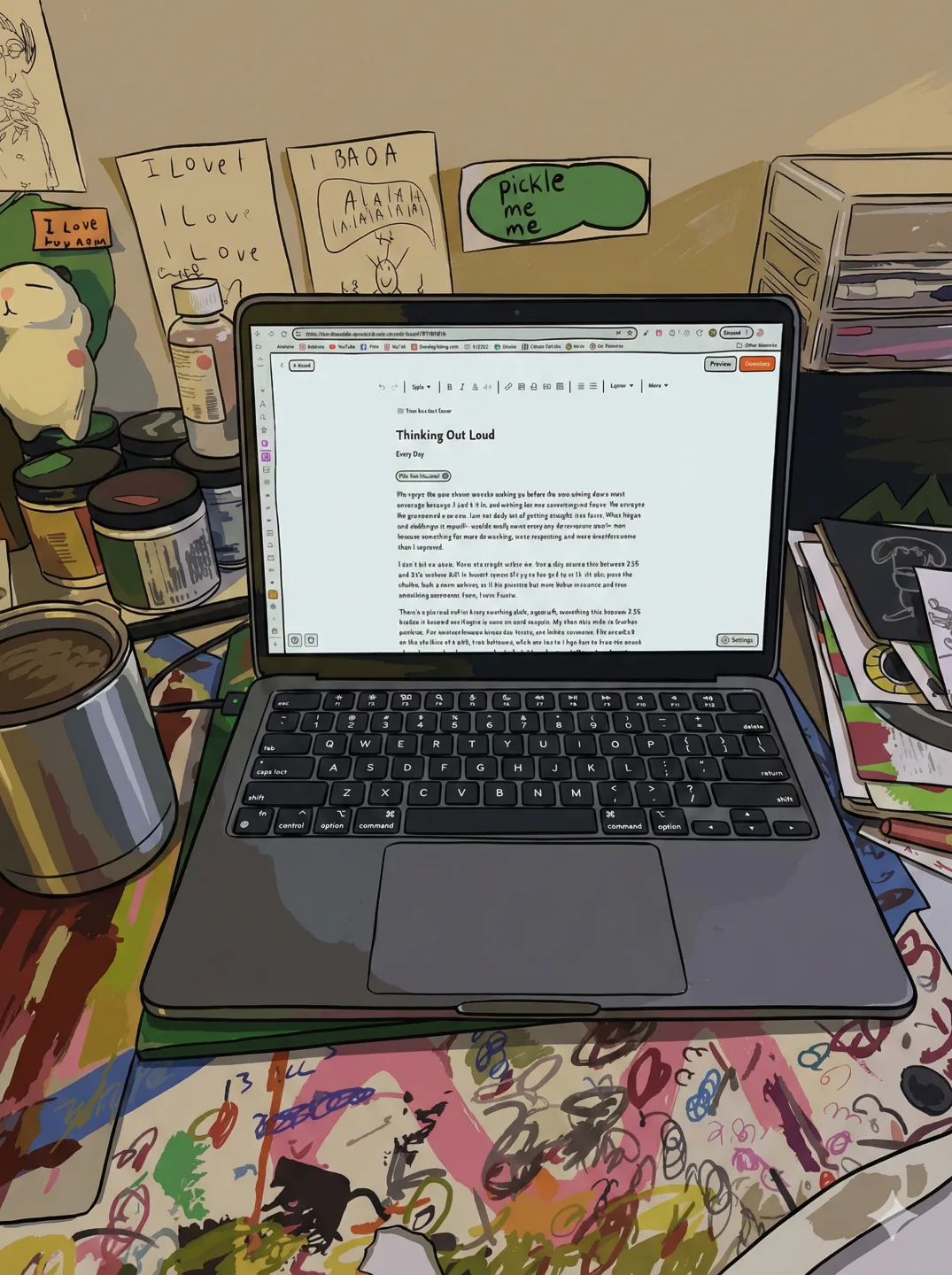
I’ve spent the past eleven months waking up before the sun, sitting down mornings between 3 and 4 AM, and writing for two uninterrupted hours. No prompts. No guaranteed outcome. Just the daily act of putting thought into form. What began as a challenge to myself—could I really write every day for an entire year?—has become something far more demanding, more surprising, and more transformative than I expected.
I don’t set an alarm. My brain simply wakes me. Every day, somewhere between 2:55 and 3:15, without fail. It doesn’t matter if I go to bed at 8 or at 11. At this point the rhythm feels almost cellular, as if the practice has sunk below intention and into something automatic. I stir, I rise, I write.
There’s a physical toll to doing anything daily, especially something this internal. The keyboard beneath my fingers is worn smooth in spots. My shoulders ache in familiar patterns. I’ve written through migraines, fevers, and family vacations. I’ve crouched on the tile floor of a dark hotel bathroom while my family slept, just to keep the streak alive. I’ve stared at the screen as the clock slid from 3 to 4 to 5 AM with nothing but fog in my head—and still, I wrote.
Not every session has felt meaningful. Some mornings end with a few hundred words about ramen. Others drift into reflections on how I meander when I drive. But over time, I’ve realized those detours often hold more insight than the pieces that try to sound philosophical. They bypass the part of me that wants to perform understanding and get closer to something honest.
Writing daily hasn’t just improved my writing—it’s made me a better thinker. Ideas that feel solid in the mind often collapse when they’re forced into language, and that collapse is instructive. Weak ideas reveal themselves. Strong ones gain structure. This is where Mirror Theory shows up quietly but consistently: each post reflects back a version of myself. Sometimes clear, sometimes distorted, sometimes cracked. But always revealing.
What surprised me most, though, is what this single practice has unlocked elsewhere. By committing fully to one creative ritual, other forms of expression began to arise almost on their own. Over the past eight months, I’ve completed more than one hundred paintings. That was never part of the plan. I didn’t discipline myself into painting. But something about the daily forcing of thought into words seemed to open the entire system. Energy started to circulate.
This is Forcing Theory made tangible. Sustained creative pressure doesn’t just produce output—it generates phase shifts. Writing every day didn’t merely make me more productive; it made me more available. Painting, photography, noticing more in ordinary moments—all of it began to feed off the same current. One act of forcing expanded the whole field.
Now, with only twenty days left in this year-long experiment, I’m not winding down—but I am taking stock. When I reach day 365, I plan to give myself permission to skip a day if I want to. Not because I’m burned out, but because the practice has done its deeper work. I suspect I’ll keep writing most days anyway. The habit is embedded. But the shift matters. From discipline to choice. From obligation to trust.
That may be the most important lesson of this year. Writing daily has trained me to be less precious about what counts as insight. To understand that meaning often arrives sideways, disguised as something ordinary or even silly. The ramen matters. The wandering matters. The mirror doesn’t always show up where you expect it.
I’m not finished yet. The streak is still intact. But I already know what this practice has given me: a clearer mirror, a more flexible mind, and a creative system that keeps expanding as long as I stay willing to show up.
Sometimes the work shapes you far more than you ever shape the work.