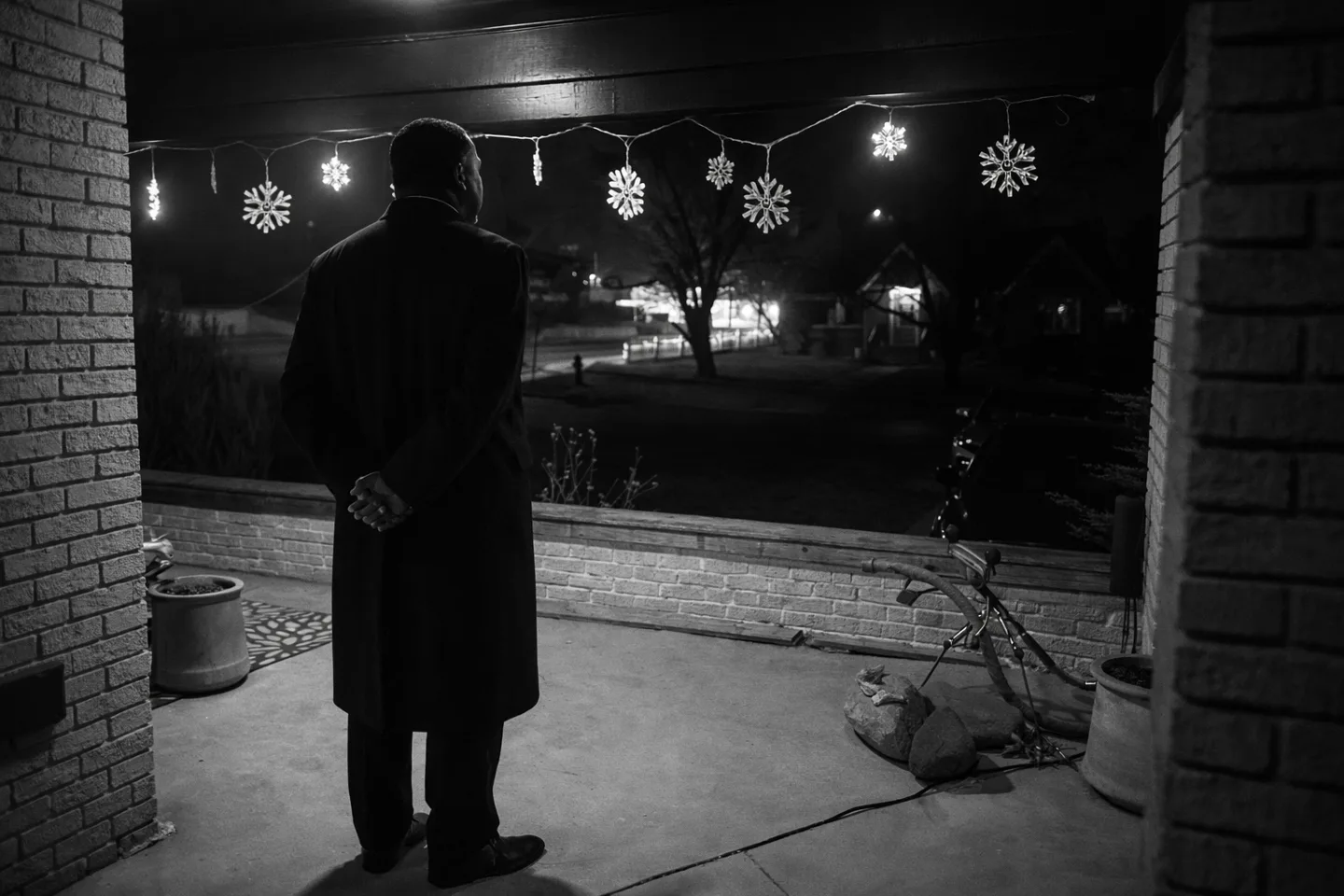
This morning, the porch was colder than usual. The cats lingered by the door, cautious, ears twitching. Something in the air made the whole world feel like it was holding its breath.
That’s when I saw him.
He wasn’t sitting in the chair like others who’ve come before. He was standing at the edge of the porch, hands clasped behind his back, coat buttoned against the morning wind, looking out across the town as if he had been watching it wake for a long time. As if he were measuring not the buildings, but the weight they carried.
Dr. Martin Luther King Jr.
He didn’t turn when I stepped outside. He didn’t greet me. He just stood there, steady, bearing witness. When I moved beside him, he nodded once—slow, solemn—and kept his eyes on the horizon.
For a while, we said nothing. A garbage truck groaned somewhere down the street. A siren flickered and disappeared. From a nearby house, a radio leaked a voice full of certainty and fear, preaching a version of America that sounded smaller than the one beneath our feet.
“I’ve been watching the news,” I said. “ICE raids. A woman shot in Minneapolis. Protests met with force. No investigation. Files hidden. Wars started quietly. Trade deals torn up. Allies pushed away.” I paused. “It feels intentional. Like all of this is meant to narrow the future. To make it whiter. Harder. Meaner.”
He closed his eyes for a moment, as if letting the words pass through him instead of bounce off.
“There are ghosts in this country,” he said quietly. “And every time justice is delayed, they grow louder. Old wounds reopened. New ones layered on top. But the cry is always the same.”
I told him people were angry. That they wanted to push back but didn’t know how. That peaceful protest feels fragile now—easy to dismiss, easy to crush. That every attempt at solidarity is met with surveillance, spin, or violence. That the country feels engineered to keep us suspicious of one another.
He finally turned toward me. His voice was calm, but it carried the weight of something tested.
“Nonviolence is not fragility,” he said. “It is discipline. It is clarity. It is the decision to resist injustice without surrendering your humanity. Power hopes you will meet cruelty with cruelty—because then it no longer has to change. Nonviolence denies it that escape.”
I told him it feels like division itself has become policy. Race against race. Citizen against immigrant. Neighbor against neighbor. Every difference sharpened into a blade.
He nodded. “Of course it has. Unity is the one thing injustice cannot survive. If people ever truly stood together—across race, class, borders, belief—this system would collapse under its own weight. So fear is taught. Lies are repeated. And the people are encouraged to fight each other instead of the machinery that profits from their division.”
We stood there as the sun rose higher, light touching the rooftops without warming them yet. He let the silence do its work.
Then he spoke again, not to me alone, but outward—into the town, into the morning, into whatever future was listening.
“I once spoke of a dream,” he said, “where my children would not be judged by the color of their skin, but by the content of their character. That dream is not dead. But it is incomplete. And now, another dream is asking to be born.”
He stepped forward, just slightly, as if leaning into time itself.
“I see a dream where dignity is not granted by papers or profit, but recognized as inherent. A dream where protest is not feared, but understood as love demanding better. Where government is not a throne, but a table wide enough for everyone to sit. Where borders do not erase compassion. Where allies are not abandoned. Where truth is not hidden because it is inconvenient.”
He turned back to me, eyes clear.
“I see a dream where courage is collective. Where we refuse to be divided into silence. Where we do not ask who will let us be free, but who will walk with us. And I believe—because history has taught me this—that such a dream is possible. But only if we choose it. Together.”
Then he stepped down from the porch and began walking toward the town, unhurried, resolute, like someone who had never stopped marching—only paused long enough to remind us why.
I stayed where I was, letting the cold sink in, letting his words settle somewhere deeper than thought. And before I went back inside, I whispered them—not as hope alone, but as responsibility.
Only if we dream it together.