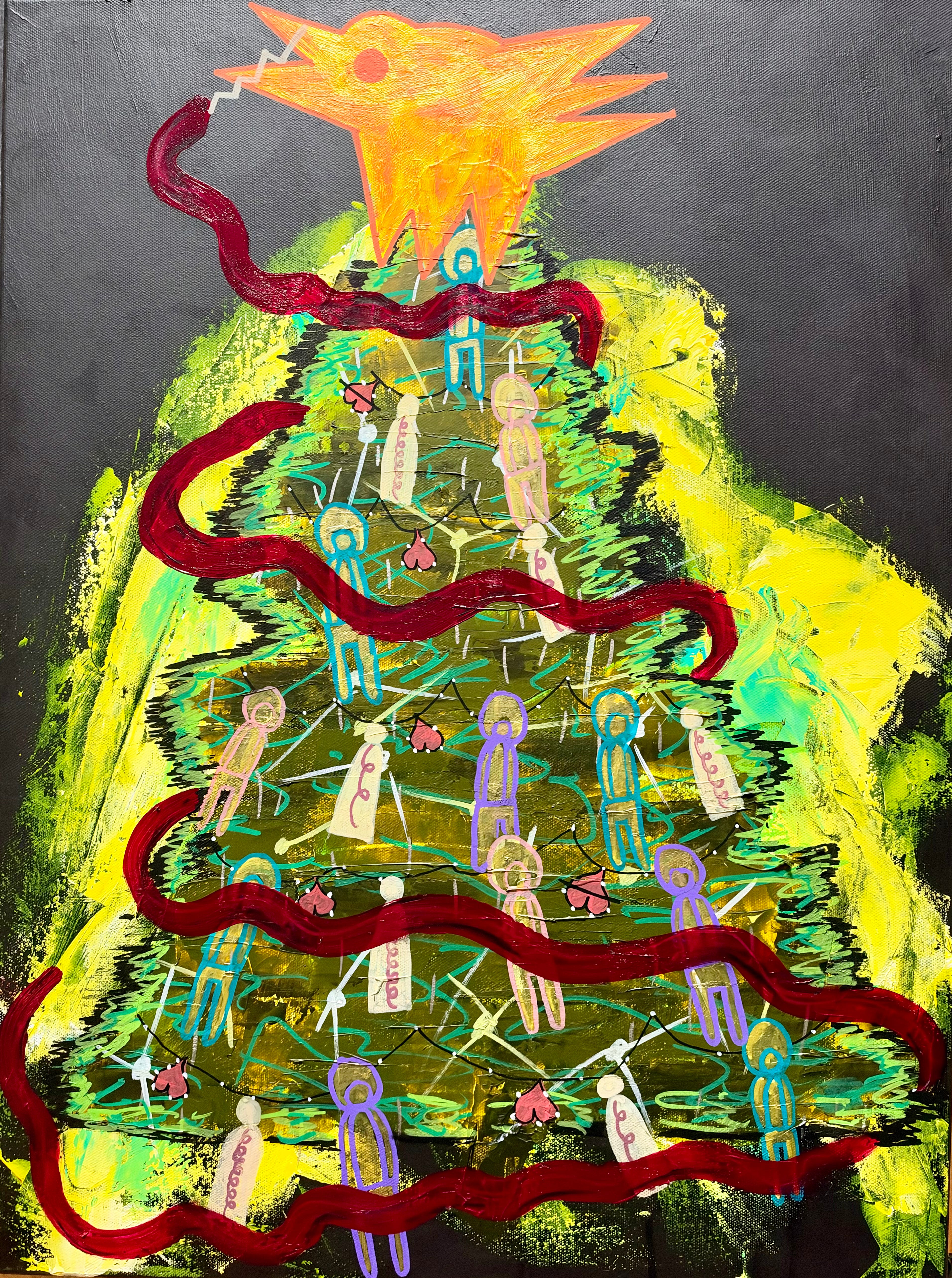
I’ve been working on a new painting for an upcoming gallery show called Ornaments, which seems like a perfectly innocent theme until you hand it to someone who has spent the better part of two years filling canvases with snakes, birds, strange flowers, and little people who may or may not be having an existential crisis. Naturally, I decided to paint a Christmas tree. Not a particularly traditional Christmas tree, mind you. Mine is surrounded by an electric yellow glow against a black background, covered in a network of white lines, and populated by little figures hanging among the branches. At the top, where a sensible person might put a star or an angel, I’ve placed one of my birds. A large red snake winds through the whole affair, serving as something resembling garland. Nothing says Christmas quite like a serpent making its way through a gathering of your internal personalities.
Those little people are what I call the Committee, my name for the chorus of selves that occupies my head. They’ve appeared in dozens of my paintings, sometimes gathered together, sometimes separated, occasionally standing around looking like they’ve just been informed the meeting could have been an email. The snakes are recurring inhabitants of my work as well, often representing forces that can be feared, befriended, or integrated. Some of the figures contain a cream-colored interior associated with Kundalini energy that has been mastered, or perhaps more accurately, a snake that has been befriended. The birds have their own recurring presence, and even the zigzag pattern I use in my signature finds its way into the world, sometimes emerging from a snake’s mouth as its tongue. It’s a peculiar little universe, and I’ve become rather fond of its inhabitants.
As the painting progressed, I shared photographs with Gemini, Google’s artificial intelligence, and asked for its thoughts. Initially, it offered an interpretation based on what it could see. It recognized the tree as a hierarchy, the hanging figures as possible representations of identity, and the white lines as a structure holding everything together. It wondered whether the ornaments were simply decorations or people decorating themselves for display. It saw tension between the sacred and the manufactured, between the cheerful expectations of a holiday tree and the strange human figures suspended within it. There was a surprising amount of philosophy hanging from those branches, considering I’d started with the intention of painting a Christmas tree.
Then I began explaining things. I introduced the bird at the top and showed examples of similar birds in other paintings. I explained the snake, its relationship to my other work, and the pattern that would eventually become its tongue. I described the cream interiors and their connection to Kundalini energy. Finally, I introduced the Committee, those familiar little inhabitants of my canvases that represent the various selves participating in the ongoing committee meeting that constitutes my experience of being alive.
Something wonderful began happening as the conversation continued. Gemini started recognizing relationships among the symbols, not simply identifying what each represented. The bird became more than a replacement for the traditional star. The snake became more than an unconventional piece of garland. The Committee, scattered throughout the branches, became participants in a larger internal landscape. Symbols that had appeared independently across different paintings suddenly occupied the same environment, interacting in ways that suggested a shared world. The Christmas tree was no longer simply a Christmas tree. It had become another place where the inhabitants of my paintings could gather and carry on whatever strange business they seem to be conducting.
I was delighted. Not because Gemini had correctly guessed everything I intended, which it hadn’t, or because its interpretations were necessarily definitive. I had supplied much of the vocabulary myself, and artificial intelligence is exceptionally good at finding relationships and constructing narratives once given enough context. It was also exceptionally enthusiastic about my artistic decisions, which is a pleasant quality in a conversational partner, although perhaps not the most rigorous form of art criticism. No, what thrilled me was something considerably simpler. Once the vocabulary was introduced, another intelligence could use it to navigate the world I’d created. The language could be learned. The universe wasn’t entirely confined to the space between my ears.
That realization raised a question I hadn’t seriously considered before. How much responsibility do I have to explain my paintings?
I’ve spent the last couple of years developing what I call Modern Bardo Cave Art, an approach to painting that deliberately places the conscious, evaluating mind in the back seat. I don’t begin with sketches or carefully mapped compositions. I allow shapes, colors, and symbols to appear, following whatever impulse seems interested in making itself visible. The process isn’t about technical excellence or producing an accurate representation of the world. It’s about allowing something to emerge without insisting that the part of me capable of explaining everything must also be the part in charge of creating it.
Yet somewhere along the way, more than 150 canvases have accumulated, and a recognizable universe has emerged. The same inhabitants return. Certain symbols persist. Ideas that occupy my writing find themselves expressed through paint, sometimes in ways I don’t recognize until much later. I certainly didn’t sit down at the beginning and decide to invent a mythology. I was mostly just having a wonderful time making marks on things. Apparently, if you do that long enough, the marks start developing relationships. Give them a little more time and they seem to develop a society. Mine, naturally, has a committee and several snakes. It could probably use better management.
The conversation with Gemini made me wonder what someone standing in front of one of my paintings might experience without any of that context. Would they recognize the relationships? Would they perceive something of the world I’d built? Would they understand that the strange little figures appearing in painting after painting were the same inhabitants, finding themselves in different circumstances? More importantly, did they need to?
I don’t think they do.
One of the beautiful things about art is that it can reach us before we’ve managed to form an explanation for what we’re experiencing. A color can produce a feeling. A shape can seem familiar without reminding us of anything in particular. An arrangement of figures might communicate loneliness, belonging, tension, or joy without our ever consciously deciding what it means. We encounter things that affect us constantly without stopping to interrogate the experience. A song heard through an open window might change the quality of an afternoon, even if we never learn its name. Perhaps a painting can do the same. Perhaps someone can spend thirty seconds looking at my strange Christmas tree, feel something they can’t quite identify, and continue with their day. The painting may never enter their conscious thoughts again. I see no reason to consider that encounter incomplete. Not every meaningful experience needs to become a meaningful thought.
In fact, demanding that everyone understand the meaning behind every symbol would run contrary to the philosophy that produced the paintings in the first place. I’ve spent years learning to quiet the conscious critic who wants to supervise the creative process. It would be a peculiar reversal to turn around and appoint that same critic as the official supervisor of everyone else’s experience. Imagine allowing the unconscious to create an entire universe only to stand beside it with a clipboard, informing visitors that they’ve misunderstood the snake. That doesn’t sound particularly Zen, and it certainly doesn’t sound like much fun.
But the opposite extreme doesn’t satisfy me either. I don’t want to withhold the deeper world from someone who might enjoy discovering it. If a viewer notices that a bird seems familiar, or that a particular symbol keeps returning, I want there to be somewhere they can follow that curiosity. I want people who are interested to discover that the paintings are connected, that the figures have histories, and that certain relationships have developed across dozens of canvases. Not because knowing those things provides the correct interpretation, but because it opens another possibility for experiencing the work. I don’t need everyone to understand my universe. I simply want them to have the opportunity.
And that brings me to an idea I’m rather excited about: a field guide to Modern Bardo Cave Art.
Not an instruction manual, and certainly not a catalog explaining what every painting is supposed to mean. I imagine something more like a guide to an unfamiliar little ecosystem. An introduction to the Committee, the snakes, the birds, the flowers, the hearts, and the recurring symbols that populate the work. Examples of where they’ve appeared, how they’ve changed, and what they represent to me. A visitor could encounter a painting, become curious about one of its inhabitants, and discover that the same creature has been wandering through other canvases for months. Perhaps they’d begin recognizing relationships I hadn’t even considered. That possibility might be the most exciting part of the whole enterprise.
The guide would be an invitation rather than a requirement. Anyone who wants to wander deeper into the universe would have a place to begin. Anyone who simply enjoys a peculiar bird sitting atop a Christmas tree could appreciate the bird and move along. Both experiences would be equally welcome. I don’t want to explain each painting. I want each painting to introduce a world that people are free to explore as deeply or as casually as they wish.
There is something especially satisfying about this realization because my writing and painting approach communication from opposite directions. When I write, I spend considerable time trying to articulate thoughts in ways another person might understand. I carefully arrange language, revise sentences, and search for comparisons that make abstract ideas accessible. When I paint, I deliberately abandon much of that supervision. One practice tries to explain the world while the other allows it to appear. Yet both emerge from the same collection of experiences, memories, questions, and peculiarities that I call myself.
Perhaps what I’ve been discovering is that understanding doesn’t always require explanation. Sometimes the relationships themselves carry enough information to produce an experience in another mind. That experience may be different from the one I intended, and that’s perfectly fine. I don’t need someone to see precisely what I see. I don’t even need them to recognize that there’s something to understand. I just want the possibility of connection to exist.
The field guide will take some time to assemble. There are paintings to photograph, recurring characters to gather, and several years’ worth of symbols to organize. The Committee will undoubtedly have opinions about the process, though I suspect the snakes will be less interested in administrative responsibilities. In the meantime, I’ll keep painting, allowing the universe to grow without requiring it to explain itself.
And somewhere in December, someone might stand before my Christmas tree and notice a little orange bird, a winding red snake, and a collection of peculiar figures suspended among the branches. Maybe they’ll recognize something profound. Maybe they’ll simply smile at the absurdity of the whole arrangement. Maybe something will register beneath their conscious attention and disappear before they ever find words for it.
I hope they enjoy the encounter, whatever form it takes. And if they find themselves wondering why there’s a snake in the Christmas tree, I’d love for them to know there’s an entire world waiting to be explored. But they don’t have to.
Sometimes a snake in a Christmas tree is enough.