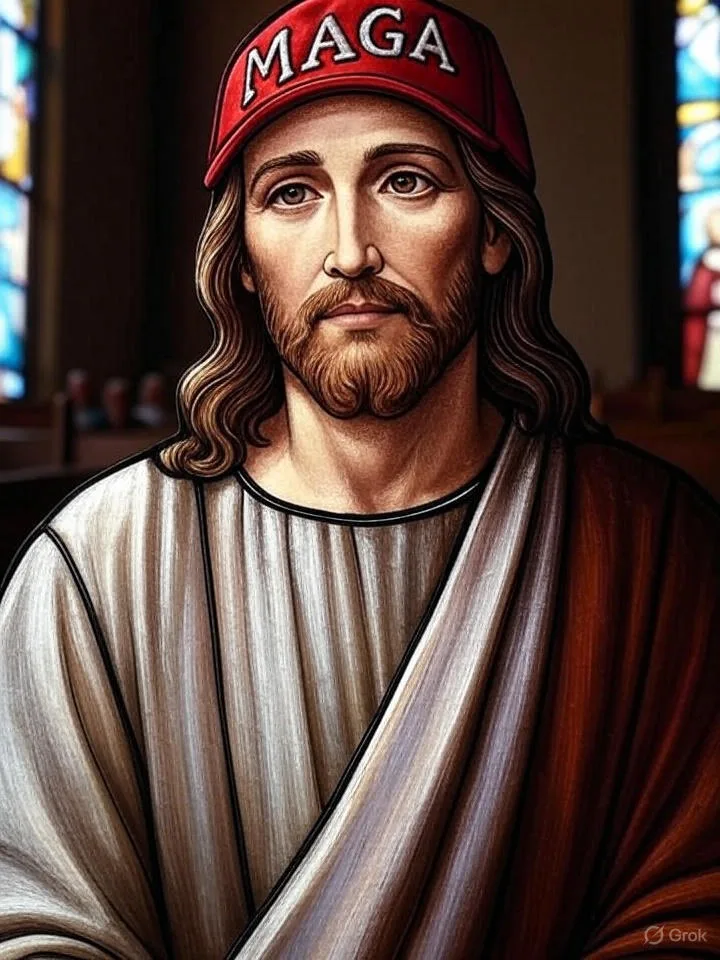
I saw a TikTok video the other day. Just one of those short, chaotic blasts of American absurdity—someone, red-faced and righteous, screaming at a drag performer while waving a Bible. Nothing new, unfortunately. But the video it was stitched with caught me. The creator captioned it with a sentence I felt in my chest:
“Not all Christians are bad people… but the worst person you can think of identifies as one.”
I stared at it, then said it out loud to no one in particular. It stuck. It rang true. It still does.
Let me be clear about something up front:
I’m not a Christian. I don’t follow Christ.
I don’t pray to him. I don’t build my ethics around him. And while some of his reported teachings are lovely in theory, I personally think Jesus is a third-rate Buddha at best—occasionally insightful, often overquoted, and frequently misunderstood.
But I wasn’t always this way.
I grew up in the belly of the Christian beast—fundamentalist, evangelical, altar-call Christianity. I preached. I led others to Christ. I devoured scripture. I studied theology and spent years watching the inner workings of churches and denominations up close. And even now, as an outsider, I keep one eye on the institution out of habit, curiosity, and sometimes sheer disbelief.
So no—this isn’t a drive-by critique from someone who never knew the inside.
This is someone who lived inside the machine, then climbed out, looked back, and said: “What the hell is that?”
That’s why the quote hit me so hard.
Because while many Christians are kind, well-meaning, generous people…
The most dangerous, hateful, and destructive public figures in America almost always identify as Christian.
That’s not a coincidence. That’s a feature of the system.
The dissonance is staggering. You’ve got a man—Jesus—whose stories we’ve all heard. Born in poverty. Rejected by the powerful. Preached love for enemies. Advocated for the poor. Was executed by the state. And this is the guy that white American Christians have somehow turned into a mascot for nationalism, capitalism, bigotry, and control?
If I were more naïve, I might laugh. But I’m not. And it’s not funny.
Look, I’ve read the words. I know the stories better than most pastors. And if we’re just evaluating the character sketch of Jesus (as literature), it’s a decent one: he heals people, touches outcasts, challenges the powerful, tells cryptic stories. You can see why people attach to the mythos. There’s something soft and revolutionary there—if you’re paying attention.
But what we have now—especially in America—isn’t Jesus.
It’s a cosplay of dominance. It’s a political identity. It’s a persecution kink wrapped in patriotic colors.
It’s people shouting about freedom while trying to control bodies, books, and beliefs.
It’s a movement that claims to be oppressed while holding the cultural mic.
And when you point this out? When you say, “Hey, your religion seems to be doing more harm than good,” you’re met with defensive cries of persecution.
As if noticing the rot is the real sin.
You can’t argue with people who think being disagreed with is oppression and being disagreed with by gay people is the apocalypse.
So let me say it again, without the need for cushion:
The worst person you can think of—the one whose policies ruin lives, whose hate speech echoes through generations, whose face you associate with harm—probably identifies as a Christian.
They probably say “God bless America.”
They probably post Bible verses.
They probably think they’re the good guy.
And the thing is, they’re not an aberration.
They’re a product of a system that rewards power and calls it faith.
They’re what happens when a religion that once said “the last shall be first” becomes obsessed with being first at all costs.
So no—I don’t follow Christ. I don’t need to.
But I have watched what happens when people claim to, and do the opposite.
And I’ll say this with no irony and no apology:
If Jesus showed up today, American Christians would call him a socialist, arrest him for blasphemy, and leave him to die in a cage.
Again.