Let’s get one thing clear from the jump: this isn’t about the soul of art.
It never was.
Because if it were, we wouldn’t be watching the loudest voices in the AI art panic be the ones with Etsy shops, agency deals, and tiered Patreon access. This panic is not coming from the margins—it’s coming from the marketplace. It’s less a cry for creative integrity and more a siren wail from capitalism itself: “Comply or die.”
The horror isn’t that art might become soulless—it’s that anyone might now be able to make something good without paying the toll. No expensive tablet. No art degree. No Adobe subscription. No gatekeeping community disguised as a critique group. Just input, reflection, recursion, and risk.
And that, apparently, is unacceptable.
The Radicals Embraced Chaos. So Why Are Their Heirs Panicking?
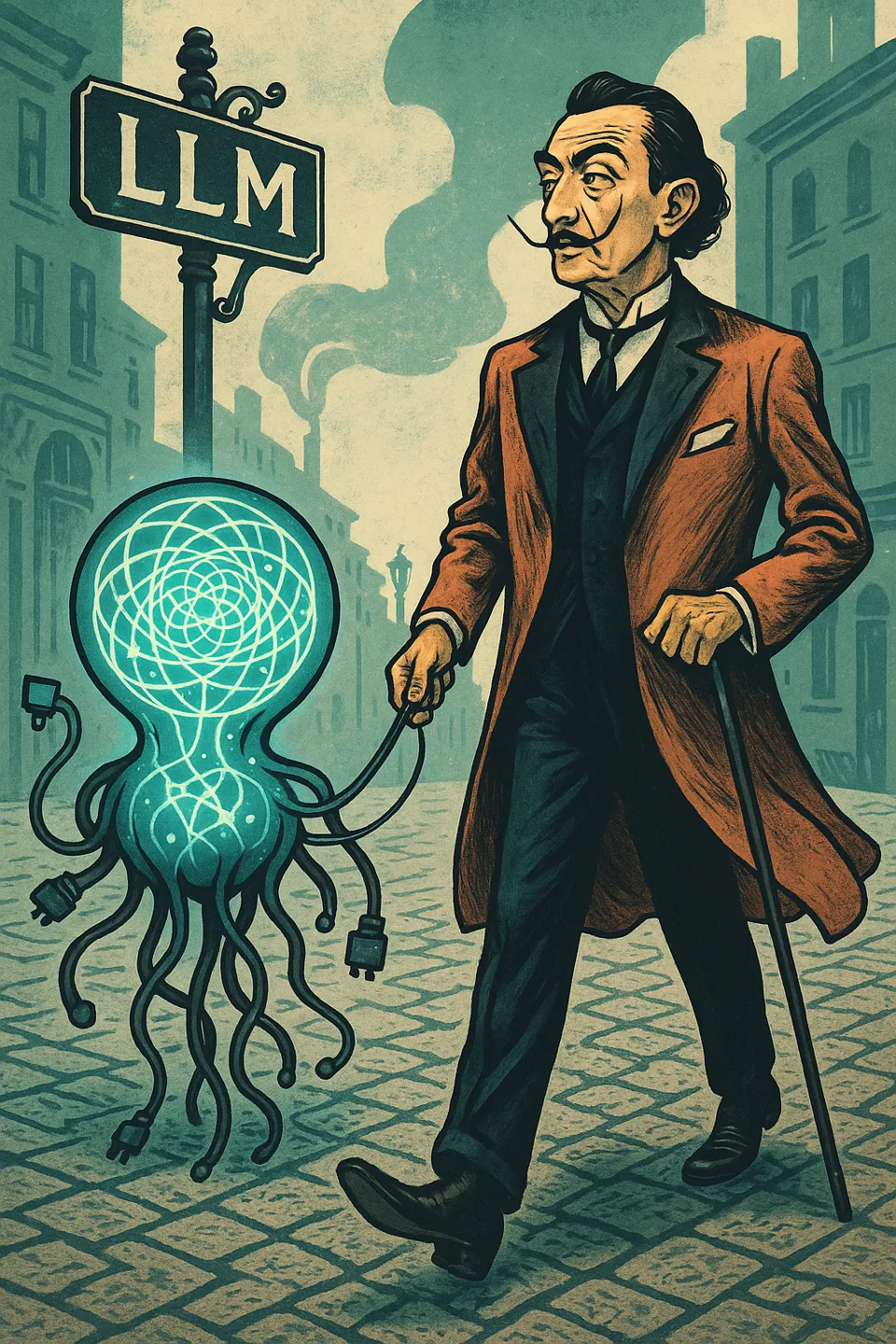
Imagine telling Salvador Dalí he couldn’t use a new tool because it wasn’t “real.” He’d laugh in melting clocks. Picasso? He’d turn your sacred brush into a sculpture. Duchamp took a urinal and made it immortal.
These weren’t men afraid of disruption. They were disruption. They lived on the edge of what art could be, precisely because they understood that art is not a medium—it’s a mirror.
Every generation has its panic:
“Photography isn’t real art.”
“Sampling music is stealing.”
“Digital brushes are cheating.”
And now, we’re here again:
“You fed a prompt into a machine and dare to call it yours?”
Yes. And if the result has emotional resonance, aesthetic weight, or philosophical punch—then it is art. Not because a machine made it, but because a human chose it.
The Purity Police Are Gatekeepers in Disguise
Let’s strip this down: if someone made brilliant AI art and didn’t tell you it was AI, would you be moved? Or would you be mad you didn’t know sooner?
The real issue isn’t the image—it’s the threat. Because now a teenager in a bedroom can make something that stands next to your MFA portfolio. Now someone with zero “industry clout” can prompt a storm of surreal beauty in seconds. And instead of celebrating this democratization of creative access, too many artists are clutching their pearls and crying “the soul of art is dying.”
No. What’s dying is your monopoly.
And capitalism doesn’t like it when value floods the market. It panics when scarcity disappears. That’s why this pushback is less about creativity and more about compliance. Who gets to be an artist? Who gets to make money? Who gets to be taken seriously?
That’s the conversation. Let’s stop pretending otherwise.
Mirror Theory: The Real Discomfort Is Reflection
AI isn’t just a tool—it’s a mirror. And a brutally honest one.
It reflects back the uncomfortable truth that many creative careers have quietly calcified. That repetition was passed off as “style.” That templates were mistaken for taste. That the “art world” was, in many cases, a self-reinforcing economy of mutual applause and commodified weirdness.
Mirror Theory tells us that every encounter reflects some version of ourselves. AI art, then, becomes a confrontation: What happens when the mirror starts showing you the part of yourself that’s replaceable?
It stings. But that sting is information. It tells you where your practice has grown rote. Where you’ve been hiding behind credentials or aesthetic inertia. AI art doesn’t steal your soul. It just makes you look at it.
Forcing Theory: Art Is a Process, Not a Product
Forcing Theory suggests that consciousness is not a static state—it’s a recursive forcing function. Creation, in this model, is the act of pushing boundaries, generating novelty, and integrating that novelty back into a living system of identity.
AI doesn’t destroy this process—it amplifies it.
It accelerates the recursive loop. It gives us more raw input, more iterations, more strange surprises to metabolize. For the artist willing to engage with it, AI isn’t a threat—it’s a new mode of alchemy.
For the ones who resist? That resistance is its own forcing pressure. You can either expand, adapt, mutate—or collapse into irrelevance.
This is not cruelty. It’s physics.
The Real Soul of Art Has Always Been Evolution
Art has never been pure. It’s always been theft, remix, mutation, appropriation, accident, and absurdity. Anyone pretending otherwise is selling something. And most of the time, that something is themselves.
So let’s be clear:
Picasso wouldn’t be crying about AI art.
Dalí would be feeding it dream sequences and laughing as it hallucinated cat-faced clocks and neon skeletons.
Duchamp would prompt 1,000 urinals and make a zine out of the best ones.
They weren’t afraid of what came next. They were what came next.
And now it’s our turn.
Final Note
If AI makes you feel obsolete, that’s not a signal to fight it—it’s a signal to evolve. Because the artist is not the brush. The artist is not the medium. The artist is the force that keeps making meaning, no matter the material.
So cry purity if you must. But don’t confuse that cry with truth.
Because the real soul of art?
It never needed your permission.