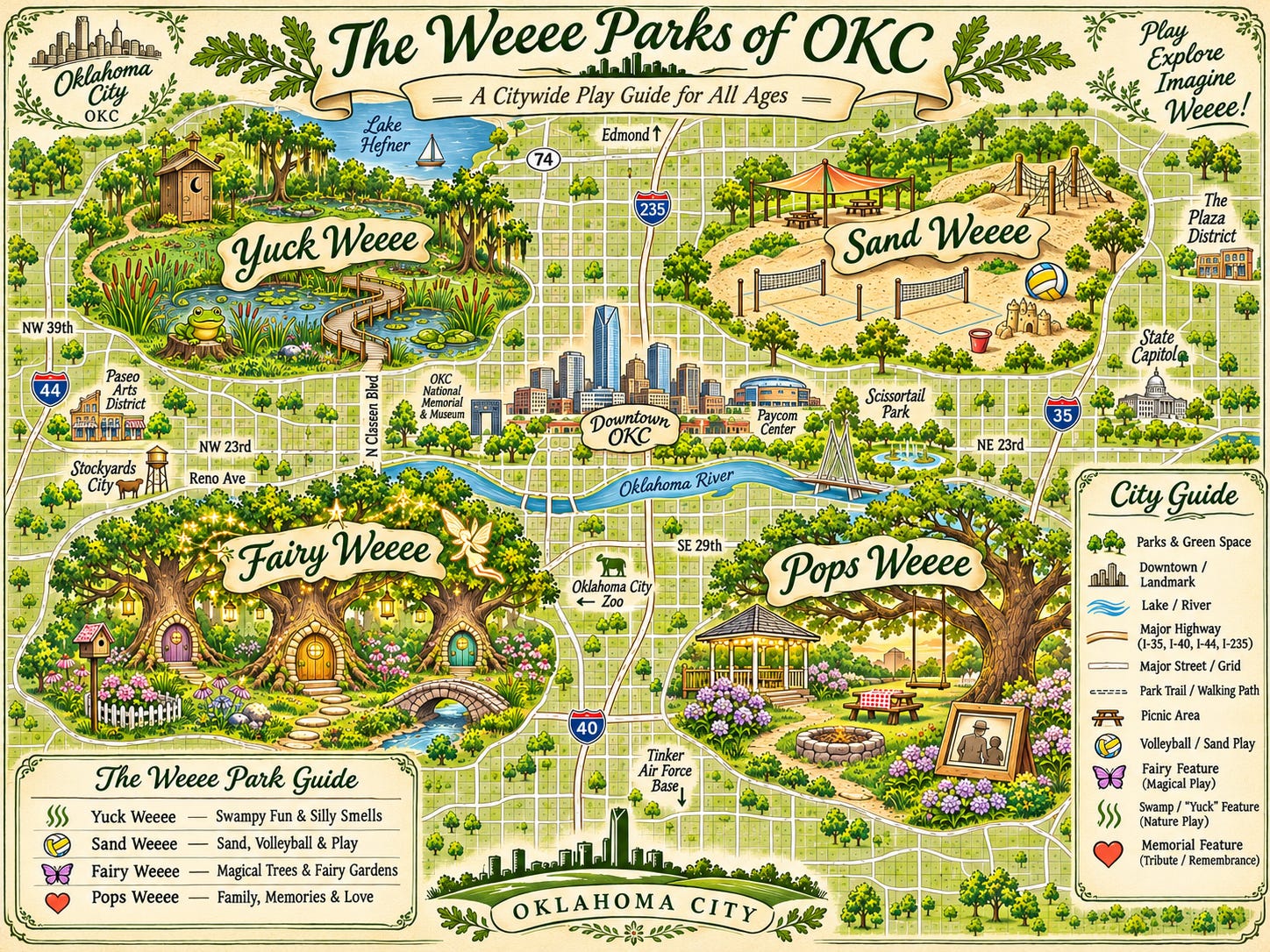
There are several parks around Oklahoma City that, as far as my family is concerned, have been operating under the wrong names for years. There’s Sand Weeee, Fairy Weeee, Yuck Weeee, and Pops Weeee. I have no idea what the city calls these places, and frankly, I don’t particularly care. Those aren’t their names anymore. Sand Weeee has sand volleyball courts. Yuck Weeee smells bad. Not every landmark gets a flattering name. Pops Weeee is where my daughter remembers meeting her grandfather. And Fairy Weeee? Well, Fairy Weeee is an entirely different matter. These are the official designations in our household, and I see absolutely no reason to consult the Parks and Recreation Department about changing them.
The whole thing began when Jettie was little and parks weren’t called parks. They were called Weeees, named for the sound a small human makes while flying down a slide, temporarily unconcerned with mortgages, politics, or the eventual collapse of civilization. WEEEE! It made perfect sense. Why name a place after what it technically is when you can name it after what you actually do there? As she grew, the different Weeees needed identifying characteristics, and an entire geographical classification system emerged. She’s eight now, knows perfectly well what a park is, and could undoubtedly identify one in a police lineup. But we still call them Weeees. All of us. Every time.
Fairy Weeee deserves a little explanation. Tucked away among the trees at this particular park are three tiny fairy worlds. Someone, at some point, nailed little doors to the bases of three trees and created miniature fairy gardens. Over the years, other people have added figures, decorations, and mysterious little objects, slowly expanding these tiny communities. It’s one of those wonderful examples of people collectively deciding that the world could use a little more nonsense, and then doing something about it.
But the fairy gardens weren’t merely something Jettie and I went to see. They became part of an elaborate adventure. We were pirates, naturally, and our playground equipment was a ship that had landed on a strange and dangerous shore. We had heard terrible tales of non-fairies attempting to land on this island, only to perish because the land could be walked upon safely by fairies and their friends alone. Things were looking rather grim for the crew until Jettie revealed something astonishing. She had been a fairy the entire time! Apparently, my own daughter had been concealing her true identity from me, which seems like the sort of thing a father ought to know. Fortunately, this revelation meant that I was a friend of a fairy and therefore permitted to survive our expedition. She then led me away from our ship and into the trees, where I was finally introduced to the fairy world. And that, my friends, is Fairy Weeee.
Our family’s culinary vocabulary has undergone a similar evolution, although this particular linguistic experiment began with a little parental trickery. Jettie has been a vegetarian since she first started eating, entirely by her own choosing. Mary Ann and I have both been vegetarians at different points in our lives, but neither of us has been since she came along. She simply decided meat wasn’t for her, apparently before she could even articulate the decision. She’s also an interesting eater. She’ll try practically any vegetable or individual ingredient, but combine two perfectly acceptable foods into something unfamiliar and you’ve suddenly presented her with a culinary crime scene. She loves rice, buttered noodles, and tacos. Especially tacos. So, naturally, we began presenting other foods as varieties of tacos. A quesadilla became a fried taco. A burrito became a rolled taco. An enchilada became a rolled taco with sauce. We were essentially attempting to introduce her to new foods through a highly questionable Mexican-food taxonomy.
And it worked! Sort of. She eventually figured out that the rest of the world had different names for these things, but by then the terminology had taken hold. We still call quesadillas fried tacos. Nobody needs convincing anymore. The original deception has long since been exposed, but the language survived. What began as an attempt to get a little girl to try something new became part of the way our family communicates. A perfectly ordinary quesadilla is now something else entirely. It’s a fried taco, and somewhere inside those two ridiculous words lives a little girl discovering that the world might contain more delicious things than she initially suspected.
I’ve been thinking about why we hold on to these expressions long after they’ve outlived their practical usefulness. Children invent words constantly. They mispronounce things, rename things, and develop entire systems of understanding that make perfect sense to them and absolutely nobody else. Most of those words disappear as they grow. The adults correct them, the children learn the proper vocabulary, and the world becomes a little more standardized. We trade Weeee for park, fried taco for quesadilla, and eventually the wonderfully strange language of childhood gets replaced by the perfectly functional language of adulthood. Which is probably necessary if we expect our children to eventually order lunch without confusing a waiter. But I’m not convinced we have to surrender all of it.
Because these words do something ordinary language cannot. They carry the circumstances of their creation inside them. Pops Weeee isn’t simply a park. It’s a place where a little girl remembers being with her grandfather. Yuck Weeee apparently smelled bad enough to earn a permanent place in the family vocabulary. Not every treasured childhood memory has to be beautiful. Some of them just stink. And Fairy Weeee isn’t merely a playground with tiny doors nailed to trees. It’s a dangerous island where a father once learned that his daughter had secretly been a fairy all along, and where that revelation saved his life. None of this appears on Google Maps, of course. Google Maps is considerably less interesting than the maps we carry around in our heads.
I imagine Jettie twenty-five years from now, perhaps with a child of her own, asking whether they’d like to go to a Weeee. Maybe she’ll explain the word, or maybe she won’t. Maybe her child will grow up believing that’s simply what parks are called, and an entirely new generation will inherit a word invented by a little girl decades earlier. I imagine myself as an old man, sitting somewhere and asking my grown daughter if she’d make me a fried taco. She’ll roll her eyes, perhaps laugh, and maybe for just an instant we’ll both be back in our kitchen when she was eight, carefully investigating the possibilities of a black bean burger one microscopic bite at a time.
And that’s the part I find so wonderful. We spend an enormous amount of our lives trying to preserve things that cannot possibly be preserved. Childhood is particularly cruel in this regard. Every new version of our children arrives at the expense of the one we just learned to love. The toddler disappears into the little girl, the little girl into the teenager, and eventually an adult stands before us carrying all those earlier versions somewhere inside. We take photographs, save drawings, keep little shoes that no longer fit, and try our best to remember what it felt like when the world was smaller and everything was new.
But sometimes we get to keep something alive rather than simply remembering it. A word. A ridiculous little phrase. A name for a park that doesn’t exist on any map.
And perhaps that’s why I hope we’ll still be saying these things decades from now. Not because I want Jettie to stay little. Quite the opposite. I can’t wait to discover all the people she will become. But I love the possibility that, no matter how old we get, we might retain a few secret passages back to the people we used to be together.
One day she’ll be grown, I’ll be old, and the world will have changed in a thousand ways I cannot begin to imagine. But somewhere there will still be a fried taco. Somewhere there will still be a Fairy Weeee. And perhaps we’ll say one of those ridiculous things and find ourselves, for just a moment, standing together in a little piece of childhood that never quite disappeared.
I think that’s worth holding on to.
WEEEE!