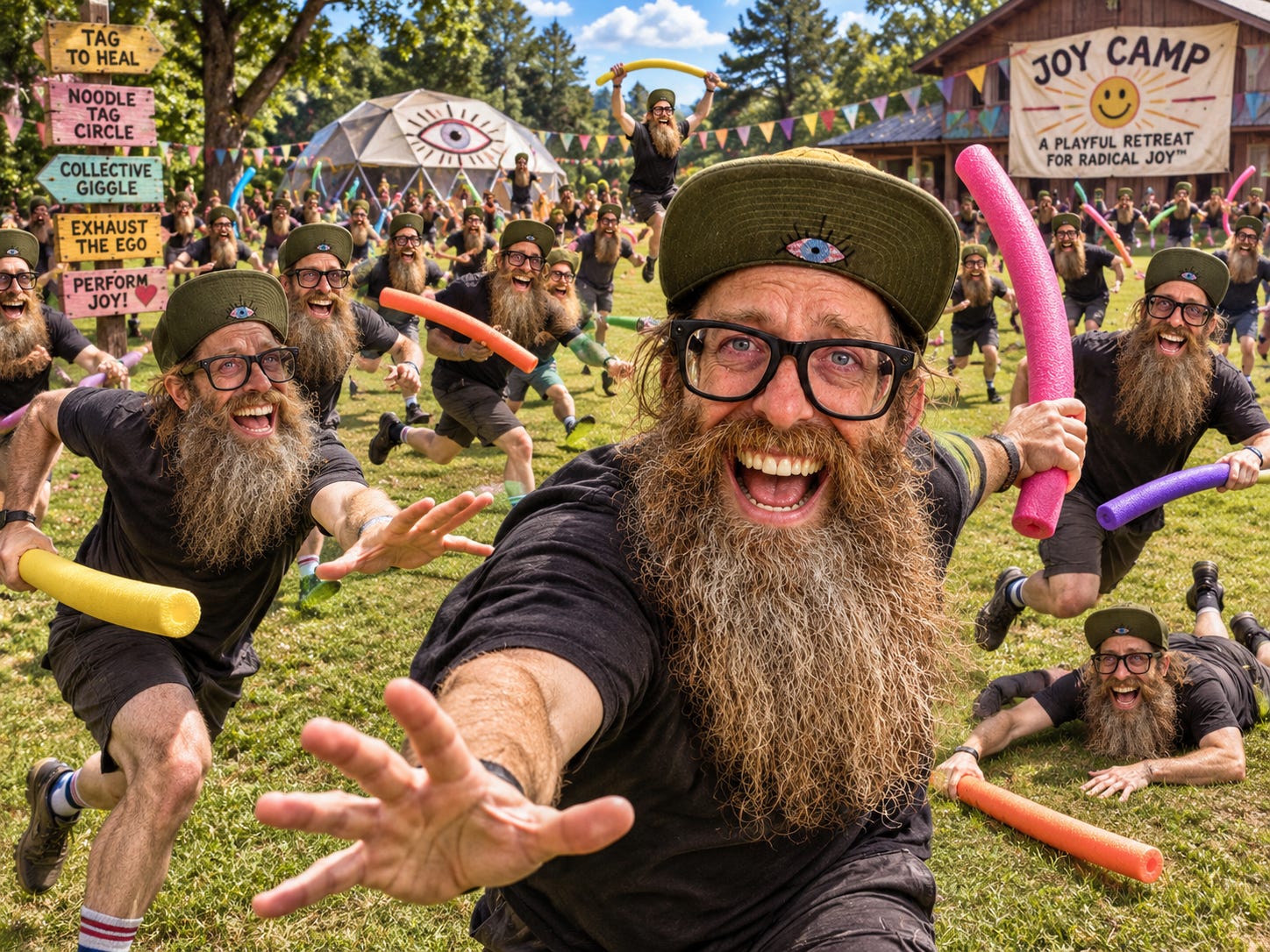
TikTok’s algorithm has apparently decided that I need to attend something called Joymaker Camp. I have no idea why. I haven’t researched the organization or expressed any particular interest in attending a camp devoted to joy, but I’ve now watched more than thirty of their videos, so I suppose the algorithm has concluded that I’m either desperately unhappy or considering a career as a group leader. At this point, I’m probably one of their most dedicated viewers. Unfortunately, I watch with the same horrified fascination that prevents me from looking away from a car accident.
The videos generally feature groups of grown adults playing tag, shooting one another with water guns, or running around a house screaming and laughing like six-year-olds at a birthday party. Everyone is having the absolute time of their lives. Or, more accurately, everyone is performing the absolute time of their lives. The laughter is enormous. The smiles are enormous. The enthusiasm is so aggressively enthusiastic that I half expect someone to dislocate a shoulder demonstrating how much fun they’re having. It’s as though every participant has been instructed to behave like the happiest person who has ever existed, and nobody wants to disappoint the instructor.
And for reasons I initially couldn’t explain, watching these videos makes me profoundly sad. Not angry. Not disgusted. Not even particularly embarrassed, although there’s certainly some secondhand cringe involved. I genuinely feel sorry for these people. I want to walk into the middle of their ecstatic water-gun battle, gather everyone into a giant hug, and assure them that everything is going to be okay. Which, admittedly, would make me the strangest person at an event already populated by adults sprinting through hallways screaming with delight.
This is particularly strange coming from me. I spend a considerable amount of my life behaving like a ridiculous child. I paint two-headed snakes, invent elaborate imaginary adventures with my daughter, and recently dedicated an unreasonable amount of creative energy to a refrigerator called the Chilluminati. I celebrate weirdos. I encourage nonsense. I firmly believe adults should play more. And yet something about these videos feels profoundly wrong. Not because adults are playing, but because what I’m watching doesn’t look like play. It looks like adults performing what they believe play is supposed to look like.
I think I’ve finally figured it out. It’s the uncanny valley of happiness.
Imagine a group of aliens arriving on Earth with the noble intention of teaching humanity how to experience joy. Unfortunately, their only understanding of human happiness comes from studying stock photography, pharmaceutical commercials, and children’s birthday party videos. After careful analysis, they determine that joy consists of exposing one’s teeth, making high-pitched noises, and moving rapidly in the presence of other humans. Armed with this groundbreaking research, they establish a camp where adults can finally experience happiness.
THE HUMANS ARE RUNNING. THE HUMANS ARE SCREAMING. THEIR TEETH ARE VISIBLE. JOY HAS BEEN ACHIEVED.
That’s what these videos feel like to me. Not actual children playing, but adults performing what someone who had never experienced childhood might imagine childhood looks like. Real children don’t spend their afternoons running around in a continuous state of euphoric bliss. They argue about the rules. Someone gets bored. Someone starts collecting rocks. Someone decides the floor is lava, and suddenly the entire game has changed. Nobody is concerned with whether they’re experiencing sufficient quantities of joy. They’re simply playing. The joy, when it comes, is a wonderful byproduct rather than the stated objective.
And I think that’s the distinction that makes these videos so unsettling. It’s the deliberate manufacturing of something we associate with spontaneity. Every recognizable ingredient appears to be present, yet the finished product feels strangely devoid of the thing it’s supposed to contain. It’s the emotional equivalent of a laugh track, or attending a seminar on how to fall in love. The experience might genuinely happen, but there’s something profoundly strange about trying so hard to make it happen on command.
Perhaps that’s the source of my sadness. We’ve somehow constructed a society in which the simple act of playing with other people has become something that needs to be organized, facilitated, taught, and marketed. We have professionalized spontaneity. We’ve turned the absence of effort into something that requires tremendous effort. Somewhere along the way, we apparently decided that experiencing joy was another skill we needed to develop, presumably with a curriculum, measurable outcomes, and an enthusiastic facilitator named Brad.
Of course, I don’t actually know these people. They may be genuinely delighted with their experience. They may have formed lifelong friendships and discovered something wonderful about themselves. I sincerely hope they have. Perhaps some people need a little help giving themselves permission to be ridiculous, and there’s nothing wrong with that. My reaction says considerably more about how these videos strike me than it does about the emotional lives of the people appearing in them. But I can’t shake the feeling that I’m watching people desperately trying to recover something they believe they’ve lost. And that makes me sad, even as I recognize the absurdity of feeling sorry for a group of smiling adults chasing one another with water guns.
I once commented that I felt sorry for the participants, and somehow that comment received twenty times as many likes as the video itself. Apparently I’m not the only person experiencing this peculiar emotional response. Or perhaps TikTok has assembled an entire audience of deeply cynical people who desperately need to attend Joymaker Camp. Either way, the algorithm keeps delivering the videos, and I keep watching. By now it probably thinks I’m studying for my group-leader certification. If they ever need someone to stand in the corner looking concerned while everyone else screams with manufactured delight, I believe I’ve already completed the necessary training.
I suppose there’s a wonderful irony in all of this. Nothing makes me sadder than watching people work so hard at having fun. I want these people to experience genuine, ridiculous, uncontrollable joy. The kind that sneaks up on you when you aren’t looking for it. The kind that doesn’t require instructions, encouragement, or a camera pointed in your direction. The kind that makes you forget, even momentarily, that you’re supposed to be doing anything at all.
And perhaps that’s why I keep watching. Somewhere beneath all that exaggerated enthusiasm, I keep hoping to catch a glimpse of something spontaneous. Something beautifully, unmistakably human. But the aliens have a schedule to maintain.
THE TEETH ARE VISIBLE. JOY HAS BEEN ACHIEVED.