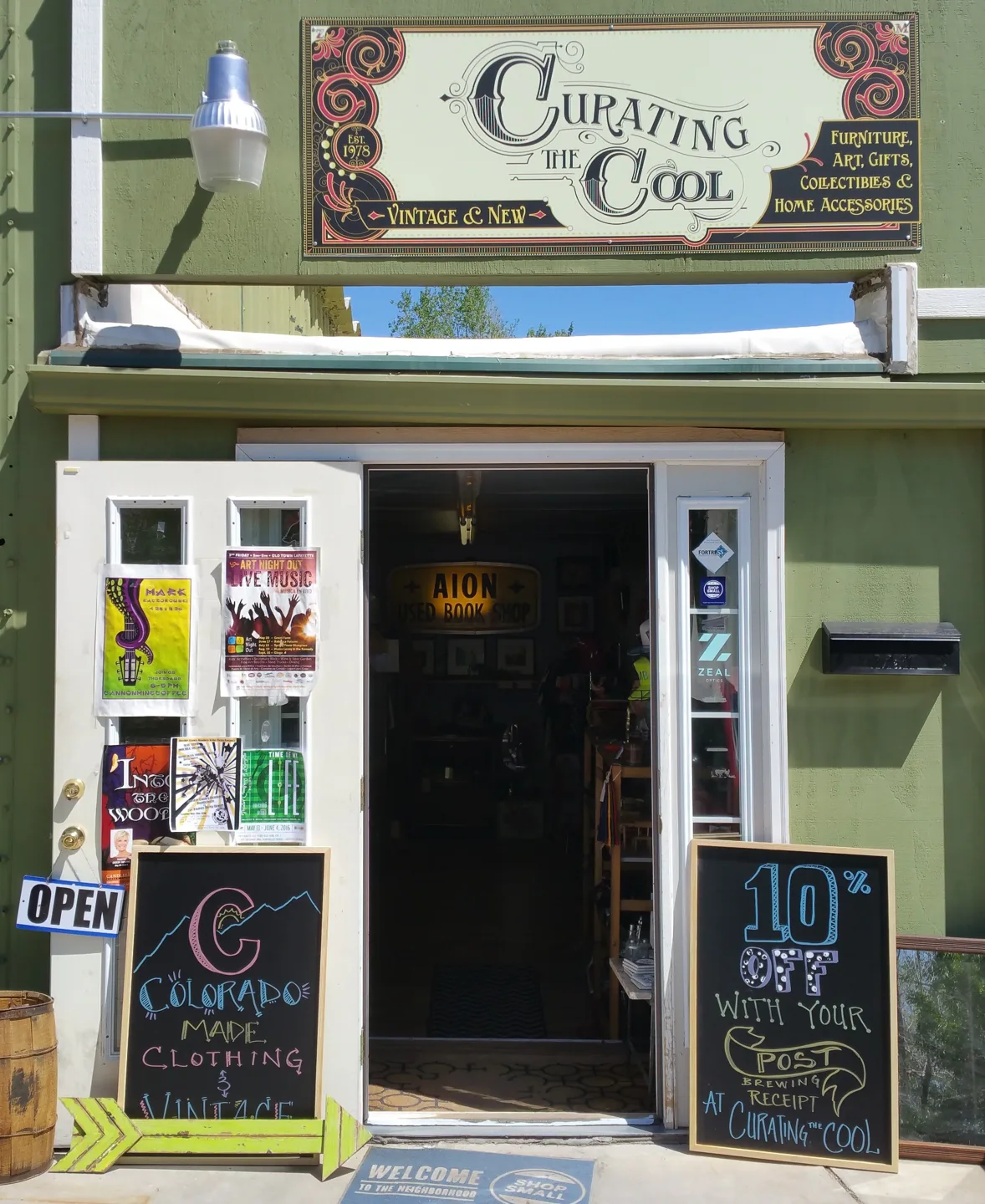
Before my current life as a stay-at-home dad, one of my previous lives was running a local gift and antique shop called Curating the Cool. Looking back now, that name was either perfect branding or a warning label. Maybe both. We operated for about five years before selling off our inventory and closing the doors. In that time, we won dozens of local awards, built a strange little community of amazing customers, and filled the shop with objects I still think about years later: antiques, art, oddities, vintage finds, taxidermy, toys, records, local paintings, and, at one point, a copy of The Beatles’ infamous “Butcher Cover” album. It was never just a shop. It was a vibe. Actually, that isn’t quite strong enough. Curating the Cool was an art installation disguised as a business.
Unfortunately, the business part mattered. And the owner/operator—me—was not particularly good at that part. This is not false modesty. I had strengths. I could find inventory. I could design a space. I could talk to customers. I could create a world people wanted to step into. I had enough personality and chutzpah to run the main shop and somehow also maintain two small sections inside other stores in the area. That part still amazes me. I created gravitational pull. What I did not create was a sustainable financial structure.
Because here’s the thing: I don’t really care about money. I know, I know. That sounds noble until you are running a business, at which point it becomes less “spiritually evolved” and more “organizationally dangerous.” I understand that money exists. I understand that people want it. I understand that rent, utilities, inventory, taxes, advertising, bags, tags, fixtures, and the continued ability to keep the lights on all require it. But emotionally? Money has always felt like the least interesting part of any project. I wanted the shop to feel alive. I wanted someone to walk in and immediately know they were not in a normal retail environment. I wanted the space to have texture, humor, mystery, nostalgia, weirdness, beauty, and just enough “what the hell is this?” to keep people awake.
What I did not care enough about was whether the beautiful, strange, unnecessary object in front of me made any sense inside an actual business. I cared about whether a taxidermy animal, a mid-century lamp, a local painting, and a vintage toy could coexist on the same shelf and create a tiny psychic weather system. I cared about the room. I cared about the feeling. I cared about the story the objects told together. What I did not care enough about was margin, cash flow, inventory turnover, pricing discipline, or whether my personal definition of “this is amazing” had any relationship to the customer’s willingness to pay for it before my rent was due.
That is where I needed a partner. Not another me. God help us, absolutely not another me. I needed a counterweight. Someone who loved the vision enough to protect it from my own financial indifference. Someone who could stand beside me while I held up some strange treasure and say, “Yes, that is incredible. Now how much did we pay for it, how much can we sell it for, and how long are we willing to let it sit here being incredible?” That person would not have diminished the magic. They would have kept the portal open. That’s the distinction I missed at the time. Money is not the meaning of a creative business, but it is the oxygen. It is the electricity. It is the boring little spell that allows the sacred nonsense to continue. I built the altar. I just didn’t assign anyone to keep the candles stocked.
Of course, not everyone understood the altar. That was part of the fun, and part of the friction. For every customer who walked in and lit up like they had found their secret clubhouse, there was another who looked around with visible discomfort. Some people simply did not get it. A mix of taxidermy, local art, antiques, pop culture, vintage weirdness, and whatever else I had dragged in from the edges of American material consciousness was not their bag. Fair enough. But one day, a customer was explaining to me that they just didn’t like the items or the shop. Something about it wasn’t working for them. It was too weird, too eclectic, too whatever. And before I could think, a sentence came out of my mouth: “If everyone thinks something is cool, it definitely isn’t.”
The second I said it, I knew I believed it. Not as marketing. As philosophy. And I still do. Now, let me add an important caveat before I start sounding like every misunderstood man with a garage full of bad art and too much confidence: not everyone disliking something automatically makes it cool. Sometimes people don’t like something because it’s bad, confusing, poorly executed, wildly overpriced, or placed next to too much taxidermy for the local foot traffic to metabolize. But the deeper point remains. If everyone agrees something is cool, there is a very good chance it has already been processed, flattened, branded, softened, and made safe enough for mass approval.
Real cool has friction. Real cool selects. Real cool creates a little division in the room. Some people walk in and say, “Absolutely not.” Other people walk in and quietly think, “Oh thank God. Someone else sees it too.” That is the signal. Cool is not universal approval. Cool is selective resonance. And maybe that is why truly cool things are so difficult to turn into reliable businesses. Capitalism wants legibility at scale. Cool often depends on illegibility at first contact. A business wants as many people as possible to understand what you are selling as quickly as possible. Cool sometimes requires the right people to feel confused for a second before recognition hits. That delay is dangerous. That delay is also where the magic lives.
Curating the Cool existed in that tension. It wanted to be successful, but it also wanted to remain strange. It wanted customers, but not at the cost of becoming obvious. It wanted to sell things, but it also wanted to arrange them like a poem written in objects. That is why I still reassess it. Not because I think I can go back and fix it. I can’t. That version of me is gone. That version of the town is gone. That version of retail may be gone too. But I can look back with more precision now. I did not fail because I was untalented. I failed because talent was not enough. Taste was not enough. Charisma was not enough. Vision was not enough. Being able to create a world is not the same as being able to sustain one.
That realization stings, but it also frees me from a certain kind of shame. For years, I have tended to summarize the experience as, “I’m just not good at business.” And while that is true in some practical ways, it is also incomplete. I was good at parts of business. I was good at the parts that involved people, space, story, discovery, and atmosphere. I was bad at the part where numbers quietly decide whether all of that gets to continue existing. And in business, the thing you ignore does not politely remain secondary. It eventually becomes the whole thing. The ignored thing becomes the door closing, the unpaid bill, the inventory liquidation, the final day, the empty room.
But even the empty room has something to teach. I can now see Curating the Cool not only as a failure, but as a prototype. A proof of concept. Evidence that I could build a world other people wanted to enter. Evidence that my eye meant something. Evidence that my strange internal compass could locate objects, arrange them, and make certain people feel seen. That is not nothing. A shop is not only a spreadsheet. But it also cannot survive as only a feeling. That is the lesson. The vibe needs a ledger. The portal needs rent. The altar needs candles. And the person building the world may not be the same person who knows how to keep the world solvent.
If I ever build something like Curating the Cool again—and some part of me suspects I will, in one form or another—I hope I remember this. I hope I honor the part of me that can create the room, find the objects, tell the story, and draw the right people in. But I also hope I find, hire, summon, or legally bind myself to someone who can look at the same beautiful chaos and ask the necessary questions: What did this cost? What can this become? How does the magic sustain itself? Because cool may not require universal approval, but rent still requires payment. And that, perhaps, is the absurd little koan of the creative business: If everyone thinks it’s cool, it probably isn’t. But if no one is watching the money, it probably won’t last.