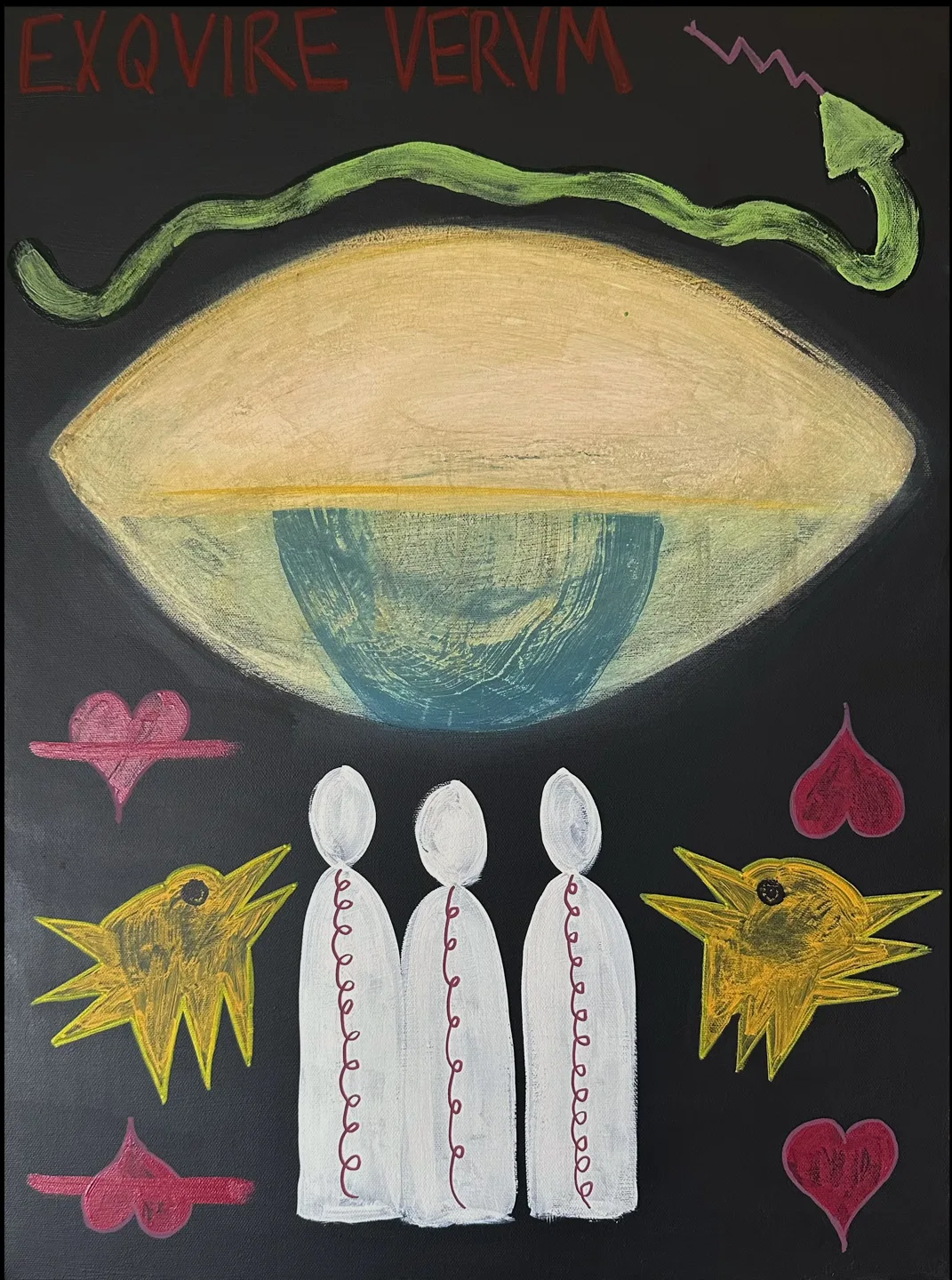
I don’t remember exactly what happened first, which feels important because I am usually very good at pretending memory is a reliable technology. I can tell you what I had for breakfast, where I left my keys, which drawer contains the batteries that may or may not be dead, and the exact emotional damage caused by every haircut I voluntarily chose between 1998 and 2007. But the moment itself resists sequence.
There was a sound, maybe. Or the absence of a sound. The kind of silence that doesn’t feel like quiet, but like the world forgot to keep humming. The refrigerator stopped. The air conditioner paused mid-breath. The tiny electrical sermon of modern life went mute.
Then the room skipped.
Not dramatically. There were no lightning bolts. No walls melting into code. No ominous red text flashing across the sky saying, “REALITY ERROR: PLEASE CONTACT YOUR ADMINISTRATOR.” Which, frankly, would have been helpful. I appreciate direct communication from the cosmos.
Instead, it was subtle. Cheap, almost. Like a streaming service buffering during the emotional climax of a show you pretend not to care about. The coffee mug in my hand became less mug. Not invisible. Not transparent. Just less convinced of itself. The kitchen table lost its argument for existing. The morning light coming through the window stopped behaving like light and became something closer to a memory of light.
And then, for one impossible second, I remembered where I was before I was me.
That is the closest I can get.
Not saw. Not learned. Remembered.
That distinction is where the whole thing becomes a problem. If I had seen another world, I could have dismissed it as hallucination. If I had learned some secret truth, I could have doubted the source. Brains are weird little soup machines. They invent gods, monsters, grudges, brands, and entire personalities just to survive middle school. I am not above suspecting my own hardware.
But remembering is different. Remembering carries the arrogance of familiarity. It doesn’t ask permission. It arrives wearing your clothes.
For one second, I did not feel like a man standing in a kitchen holding coffee. I felt like something vast and old had been folded down into the shape of a man standing in a kitchen holding coffee. I remembered, without words, that the kitchen was not false exactly, but incomplete. Not fake, but rendered. Not meaningless, but temporary.
Then the refrigerator kicked back on. The coffee mug returned to full mugness. The table remembered it was a table. And I was back.
Which is a rude thing for reality to do, honestly. If you are going to briefly reveal the metaphysical underside of existence, the least you can do is leave a pamphlet.
For the rest of the morning, I stood there like a man who had accidentally walked in on God changing costumes. I opened cabinets. I touched the counter. I stared at a banana for longer than is socially appropriate, even alone.
The banana held up remarkably well under scrutiny. That bothered me.
I wanted a crack. A seam. Some obvious betrayal. I wanted the world to behave like a badly built set, where if I pushed hard enough on the painted wall, it would wobble. But everything stayed terribly committed. The sink was the sink. The floor was the floor. My phone was full of notifications from companies pretending to care about me. The ordinary world had returned with all the confidence of a liar who knows you can’t prove anything.
And that became the real issue. Once the room came back, I had no evidence. No scorch mark. No missing time. No mysterious symbol burned into my palm. Just a feeling, and feelings are notoriously bad witnesses. Ask anyone who has ever been certain they were dying and then realized they needed lunch.
Still, something remained. Not the memory itself. That faded almost immediately, like a dream retreating from the blunt violence of morning. But the residue stayed. A kind of homesickness. A pressure behind the eyes. A grief without an object.
I had not escaped reality. I had almost remembered it.
That became the obsession.
I started small. I watched corners of rooms, because corners seem suspicious. Three planes meeting at a point? A little convenient. Very video game. Very “don’t look too closely, citizen.” I interrupted routines. Took different routes. Sat in silence. Stared at familiar objects until they became strange. I meditated, which is what we call it when staring at nothing becomes spiritually marketable. I deprived myself of sleep, which I do not recommend unless your goal is to meet the unpaid interns running your subconscious.
I also whispered nonsense into empty rooms to see if reality would lag.
“Purple refrigerator moon tax,” I said one afternoon, with the full dignity of a seeker on the path.
Nothing happened. The cat judged me, but that was standard.
Over time, I developed theories. This is what the mind does when faced with mystery. It builds a little office, hires itself as manager, and starts producing documents no one asked for.
The theory that stuck: reality is a single-player game.
Not in the childish sense that I am the only “real” person and everyone else is background decoration. That idea always felt too spiritually lazy, too convenient, too much like narcissism wearing a lab coat. No, if this was a game, then everyone might be real in whatever way reality allows. But from inside my experience, only this exact field was being rendered.
The rest existed as potential. The living room behind me. The neighbor’s house. Japan. The moon. My childhood bedroom. The inside of my own lungs. All of it waiting in some uncollapsed state until experience called it forward. Reality as an engine of necessary appearance. The world loading when looked at.
Which, of course, is not provable.
That’s where the cosmic joke begins sharpening its little knife. Everything I might use as evidence would itself appear inside experience. A photograph. A measurement. A witness. A memory. A scientific paper. A mystical revelation. A very confident guy on YouTube with a ring light and too many tabs open. All of it would still be rendered to me as experience.
There is no place I can stand outside consciousness to verify consciousness. There is no clean laboratory beyond perception. Even if the curtain lifts, I am still the one seeing the curtain.
That sentence ruined several weeks of my life.
Because it meant escape might be the wrong metaphor. Escape suggests a door. A boundary. A before and after. But what if every door is part of the room? What if “base reality” is not a place elsewhere, but the condition that makes place possible? What if the thing I was trying to find could never become an object because it was the field in which objects appeared?
I hated this idea immediately, which is usually a sign that it is worth keeping.
The second lapse came while brushing my teeth.
Again, very rude. Mystical experiences should have better timing. Saints get mountaintops and burning bushes. I got fluoride foam and bad lighting.
I was looking in the mirror, trying to determine whether my face was aging gracefully or just losing a negotiation, when my reflection paused half a breath behind me. Not enough to become horror-movie obvious. Just enough for my stomach to notice.
I blinked. The reflection blinked after me.
Then the bathroom stretched. Not visually, but conceptually. The sink, mirror, towel, toothbrush, body, face, name, history—all of it thinned. For a moment, I felt the whole architecture of “me” as an interface. A useful arrangement. A playable character. A costume with preferences.
And underneath it, again, that impossible familiarity.
I remembered being prior to the need for a face.
Then it snapped back.
I spit toothpaste into the sink and said, “Okay, well, that’s not ideal.”
After that, the project became more serious. And by serious, I mean ridiculous in a more organized way. I kept notebooks. I tracked food, sleep, stress, weather, caffeine, meditation, arguments, moon phases, and bowel movements. Science requires sacrifice. I created categories for “possible thinness events,” “mild derealization,” “object shimmer,” and “existential nausea not attributable to tacos.”
Patterns emerged, but mostly because I was desperate enough to find them.
The lapses seemed more likely when I was deeply present or deeply exhausted. Extremes worked better than ordinary life. Meditation. Flow states. Grief. Laughter so hard the self briefly forgot its job. Moments when the narrator in my head stopped narrating and something older looked through.
This complicated things. I had assumed base reality would be found by breaking the game. But maybe the game thinned whenever I stopped trying to control it.
This was deeply inconvenient. I had been hoping for a lever, not wisdom.
The third lapse happened while watching my daughter draw.
She was making a bird, or possibly a dinosaur, or possibly a legal document. Children are better artists than adults because they have not yet been bullied by proportion. The creature had one giant eye, three legs, wings coming from questionable locations, and a smile that suggested it had either discovered enlightenment or committed tax fraud.
I asked her what it was.
She said, “It’s a bird that remembers it used to be a snake.”
Of course she did.
Children say things like this and then ask for crackers, leaving adults to deal with the metaphysical shrapnel.
I laughed, and something opened. Not because the sentence was profound, though it was. Not because she was secretly a messenger from beyond the simulation, though I reserve the right to revisit that theory if she starts speaking fluent Sanskrit in her sleep. It opened because I stopped seeking.
For once, I was not hunting the seam. I was not interrogating the room. I was not trying to catch reality with its pants down. I was just there, fully and stupidly present, watching a child draw an impossible bird-snake with total authority.
And the world became unbearably vivid.
The crayon in her hand. The paper. The afternoon light. The small seriousness of her face. The crumbs on the table. The absurd little kingdom of our home. Everything glowed, not with supernatural light, but with the simple fact of appearing at all.
Then the room fell away.
This time there was no panic. There was no kitchen, no body, no coffee, no voice trying to catalogue the experience for later. There was no “Ah yes, base reality, fascinating, must write about this on Substack.”
There was awareness without object.
No machines. No pods. No cosmic server farm. No alien teenager removing a headset and saying, “Whoa, that one got weird.” No god in robes. No control room. No scoreboard. No secret achievement unlocked.
Just presence.
Clear. Boundless. Empty, but not vacant. Full, but not crowded. It was not loving in the sentimental way humans want the universe to be loving, like a parent packing snacks for the afterlife. But neither was it indifferent. Indifference requires distance, and there was no distance.
There was no me there to understand it.
And yet, somehow, understanding happened.
The game was not a prison. The game was how love became visible.
Without the rendering, there was no daughter drawing. No laughter. No coffee. No grief. No bird remembering snake. No hands. No faces. No mornings. No one to miss. No one to hold. No one to become.
Base reality was not elsewhere. It was not behind the world. It was shining as the world, poorly disguised as dishes, deadlines, weather, and the mysterious persistence of laundry.
Then came a choice, though not the kind made by a person. Return, or do not.
That is too dramatic. It was not a menu screen. There was no “Press X to Continue Existing.” But something leaned toward form. Toward limitation. Toward the ridiculous privilege of being someone, somewhere, for a while.
And because love appears in the rendered world, I returned.
The room came back softly. My daughter was still drawing. The creature now had a hat.
I looked at it and started crying, which concerned her until I told her they were happy tears. This was not strictly accurate, but it was close enough for someone holding a purple crayon.
She patted my arm and said, “You can make one too.”
So I did.
My bird was terrible. Its wings were uneven, and its beak looked like a traffic cone. My daughter told me it was “pretty good for a grown-up,” which is the kind of devastating compliment children deliver with perfect sincerity.
I never had another lapse after that.
Or maybe I did constantly and stopped calling them lapses.
That is the annoying thing about mystical insight. At first you think it will give you an answer. Then it gives you your life back, and you are expected to take out the trash.
I still don’t know what reality is. I don’t know whether the world exists when no one sees it. I don’t know whether consciousness generates matter, matter generates consciousness, or both are just two ways the same impossible thing winks at itself in the mirror. I don’t know if this is base reality, a simulation, a dream, a divine accident, a mathematical necessity, or some cosmic art project currently receiving mixed reviews.
But I know this: the search for proof eventually folds back into the one searching. Every experiment happens inside experience. Every revelation becomes memory. Every curtain that lifts is still witnessed by awareness.
And maybe that is not a flaw.
Maybe the point was never to escape the rendered world, but to notice the rendering. To see the coffee mug become fully mug. To see the table table. To see the beloved face appear again and again from the impossible dark.
Maybe this single-player game was never single-player in the lonely sense. Maybe it is single-player because each of us can only enter through one window at a time. One body. One mind. One strange little aperture of forever, wandering around pretending to be named.
And if the power flickers now, I no longer reach for the seam. I listen. The refrigerator hums. The air conditioner breathes. The world resumes its humble chant.
Session restored.