I was watching a clip from Antiques Roadshow the other morning, which is something I genuinely enjoy. There’s something wonderful about watching people discover that the hideous vase their grandmother left them is actually a priceless example of nineteenth-century craftsmanship rather than something Grandma picked up at a yard sale because she liked the flowers. Occasionally the appraiser informs someone that their family treasure is worth approximately eleven dollars, which is also entertaining, assuming you aren’t the person who just paid to have it insured. But this particular morning, I found myself paying less attention to the antiques and more attention to the people. Specifically, the extraordinary emotional response that occurs when someone learns that an object they’ve owned for years might be worth ten or twenty thousand dollars.
The owner begins to cry. The audience gasps. People applaud. Sometimes an entire room seems to collectively experience something approaching a religious revelation. All because someone has discovered they possess an object worth roughly the price of a used car, and depending on the car, possibly one that comes with a mysterious knocking sound and a seller who assures you it’s always done that. Don’t misunderstand me. As someone living in a one-income household, I’d be delighted to discover that something sitting on my bookshelf could be exchanged for $20,000. I’d probably cry myself, although I suspect my tears would be accompanied by an immediate mental inventory of everything in the house that might have been manufactured before 1950. But what struck me wasn’t the reaction of the person receiving the appraisal. It was the reaction of everyone else.
An entire room of ordinary people understood exactly why that person was crying. They didn’t need an explanation. They didn’t need to know the person’s financial circumstances, how much they owed on their mortgage, or whether their car had recently developed a concerning relationship with the check engine light. The announcement of ten or twenty thousand dollars was enough. Everyone understood that something wonderful had just happened. And for some reason, watching that collective excitement made me profoundly sad. Not because their happiness was misplaced, but because it was so completely understandable.
Consider what $10,000 actually represents in modern America. It’s a significant amount of money, certainly, but it’s hardly a fortune. It might pay off a credit card, cover an unexpected medical bill, or provide a few months of breathing room. Twenty thousand dollars might accomplish several of those things at once. For someone facing immediate financial hardship, either amount could genuinely change the direction of a life. I’m not dismissing that possibility. In fact, I think that’s precisely the point. There’s an enormous difference between changing the immediate circumstances of a life and changing the economic conditions governing that life. Ten thousand dollars might rescue someone from a terrible situation without doing much to prevent the next one. We live in a society where an amount of money that wouldn’t fundamentally transform the financial circumstances of many middle-class households can nevertheless feel like a miracle. Not because it makes someone wealthy, but because it might briefly free them from the exhausting business of worrying about money.
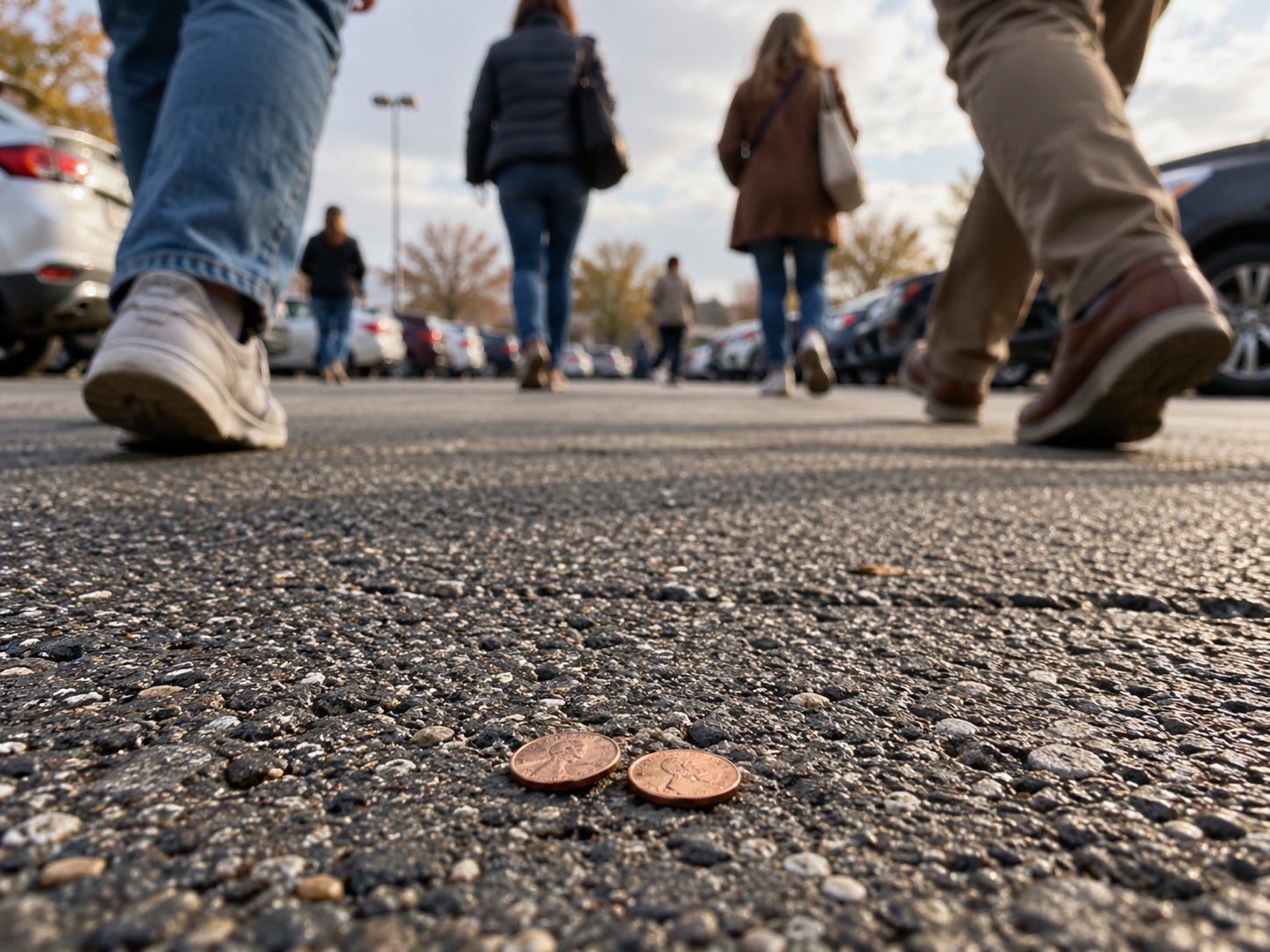
And then my mind wandered to Elon Musk, because apparently I can’t even watch a pleasant television program about antique furniture without eventually arriving at the absurdity of American wealth. Imagine someone worth $100 billion. That’s not a claim about Musk’s exact fortune today, just a nice round number for an exercise in ridiculousness. For someone with that much wealth, $20,000 represents the same proportion of their net worth as two cents does for someone worth $100,000. Two pennies. The sort of money people occasionally leave lying in parking lots because bending over to retrieve it seems like an unreasonable amount of effort. Yet here was a room full of people nearly brought to tears by the discovery of an amount that, proportionally, wouldn’t even register as pocket change to someone at the very top.
Now imagine an episode of Antiques Roadshow featuring a hundred billionaires. The appraiser carefully examines a beautiful eighteenth-century clock, removes his glasses, and announces that it’s worth twenty thousand dollars. Silence. Perhaps someone checks their phone. Another asks whether the parking is validated. Nobody cries. Nobody applauds. The clock hasn’t changed. The appraisal hasn’t changed. The money hasn’t changed. The only thing that’s different is what that money means to the people hearing the number. The exact same twenty thousand dollars can represent an extraordinary opportunity to one person and an accounting inconvenience to another. Same planet. Same economy. Entirely different realities.
And that’s where the whole thing begins to feel especially obscene. We have individuals who possess enough wealth to purchase companies, influence governments, and fund ambitions that would have sounded ridiculous to kings a few centuries ago. Meanwhile, a room full of ordinary people experiences collective joy because someone has stumbled into enough money to temporarily stop worrying about the electric bill. We celebrate the billionaire’s ability to accumulate more money than they could reasonably spend in multiple lifetimes, and we celebrate the ordinary person’s discovery that they might finally be able to replace the transmission in their twelve-year-old Honda. Somehow, both are presented as examples of financial success. One gets a magazine cover. The other gets a standing ovation and perhaps an awkward hug from the appraiser.
I’m not suggesting that everyone should have billions of dollars, or even that everyone needs to be wealthy. I’ve spent enough of my life thinking about desire to recognize that acquiring more possessions doesn’t necessarily make anyone happier. There are countless ways to live a meaningful life that have nothing to do with accumulating money. But there’s an enormous difference between having enough and constantly worrying about whether you’ll have enough. Money might not purchase happiness, but it can certainly remove some of the circumstances that make happiness difficult. There’s a particular cruelty in telling people that money isn’t important when the lack of it dictates so much of their daily existence. It’s much easier to contemplate the spiritual emptiness of material possessions when you’re not wondering whether the grocery bill will clear your checking account. Even the Buddha had to eat.
Perhaps that’s what bothered me most. We have become so accustomed to financial insecurity that even the temporary possibility of escaping it feels extraordinary. We’ve turned relief into a spectator sport. We sit in front of our televisions watching strangers discover that they might be able to pay off a debt or fix their roof, and we experience their excitement as though they’ve won the lottery. In a sense, they have. Not the kind of lottery that buys a yacht or a private island, but the kind that might let someone sleep a little better at night. And the audience understands because they’re all buying imaginary tickets to the same lottery. They’re imagining what they would do with the money, which bills they’d pay, which burdens they’d set down, and how wonderful it might feel to have one fewer thing to worry about. They’re not necessarily celebrating the possibility of becoming rich. They’re celebrating the possibility of becoming a little less vulnerable.
Of course, there’s something genuinely beautiful about that shared happiness. People celebrating the good fortune of a stranger is one of the nicer things humans do, especially when there’s no obvious advantage to doing so. I’m not interested in taking that away. The tears, applause, and excitement are expressions of empathy, and I love that about us. I just wish the circumstances producing such an extraordinary reaction weren’t quite so ordinary. I wish ten thousand dollars didn’t have to feel like divine intervention. I wish a modest amount of financial security weren’t something so many people could only imagine arriving through luck, inheritance, or the discovery that Grandma had surprisingly expensive taste in ceramics.
There’s also a difference between discovering an object is worth twenty thousand dollars and actually having twenty thousand dollars in your bank account. Someone still has to buy the thing. There may be fees, taxes, and the rather inconvenient possibility that Grandma’s vase means more to the family than the money ever could. But none of that matters in the moment. The number is announced, the room erupts, and for a few seconds everyone shares the same wonderful fantasy. A little less debt. A little less anxiety. A little more freedom. Not freedom in some grand philosophical sense, but the kind that lets you buy groceries without doing arithmetic in your head. The kind that lets you say yes to something without first calculating what you’ll have to say no to.
I started watching Antiques Roadshow because I enjoy old things and the occasional surprise. I ended up thinking about how dramatically we’ve distorted the meaning of wealth, and how a sum that barely registers in one person’s financial universe can represent an answered prayer in another’s. We have normalized a world in which one person’s loose change is another person’s opportunity to breathe. And perhaps the strangest part is that we can all recognize the absurdity without being particularly surprised by it.
The next time an appraiser announces that an old lamp is worth $10,000, I’m sure I’ll smile along with everyone else. I’ll be happy for the owner. I’ll probably wonder whether I have anything similar in the attic. But I suspect I’ll also be listening to the audience, because somewhere in that collective gasp is a story much larger than the antique sitting on the table.
A hundred people celebrating two pennies.
And every single one of them knows exactly what those pennies could buy.