Most of the most valuable things I own would be worth absolutely nothing to anyone else. This is humbling, especially for a person who has spent large portions of his life collecting strange little objects, toys, books, records, symbols, and artifacts with the confidence of a raccoon who just discovered estate sales. I have plenty of things I enjoy, but the things that matter most—the things I would actually mourn if they disappeared—would probably fit in one large box. And even then, whoever found the box might reasonably ask, “Why did this grown man keep all of this?” Fair question.
Inside that imagined box would be my first Grover, still sitting in my toy closet like a blue-furred monk of childhood endurance. There would be my daughter’s first coloring page, objectively not a masterpiece in the traditional museum sense, but more important to me than most paintings hanging in museums. There would be receipts from traveling through Europe when I was seventeen, little paper ghosts from train stations, cafés, hostels, and places I barely understood at the time but somehow knew were changing me. There would be a picture of my grandparents they gave me in 1995, a picture I have carried in my wallet ever since. Not tucked away in a scrapbook. Not preserved in some archival-quality, acid-free situation, because apparently I am not a museum curator and have instead chosen to let sentiment fight hand-to-hand combat with pocket lint for three decades. But it is still there. Worn, bent, aged, and more meaningful because of it.
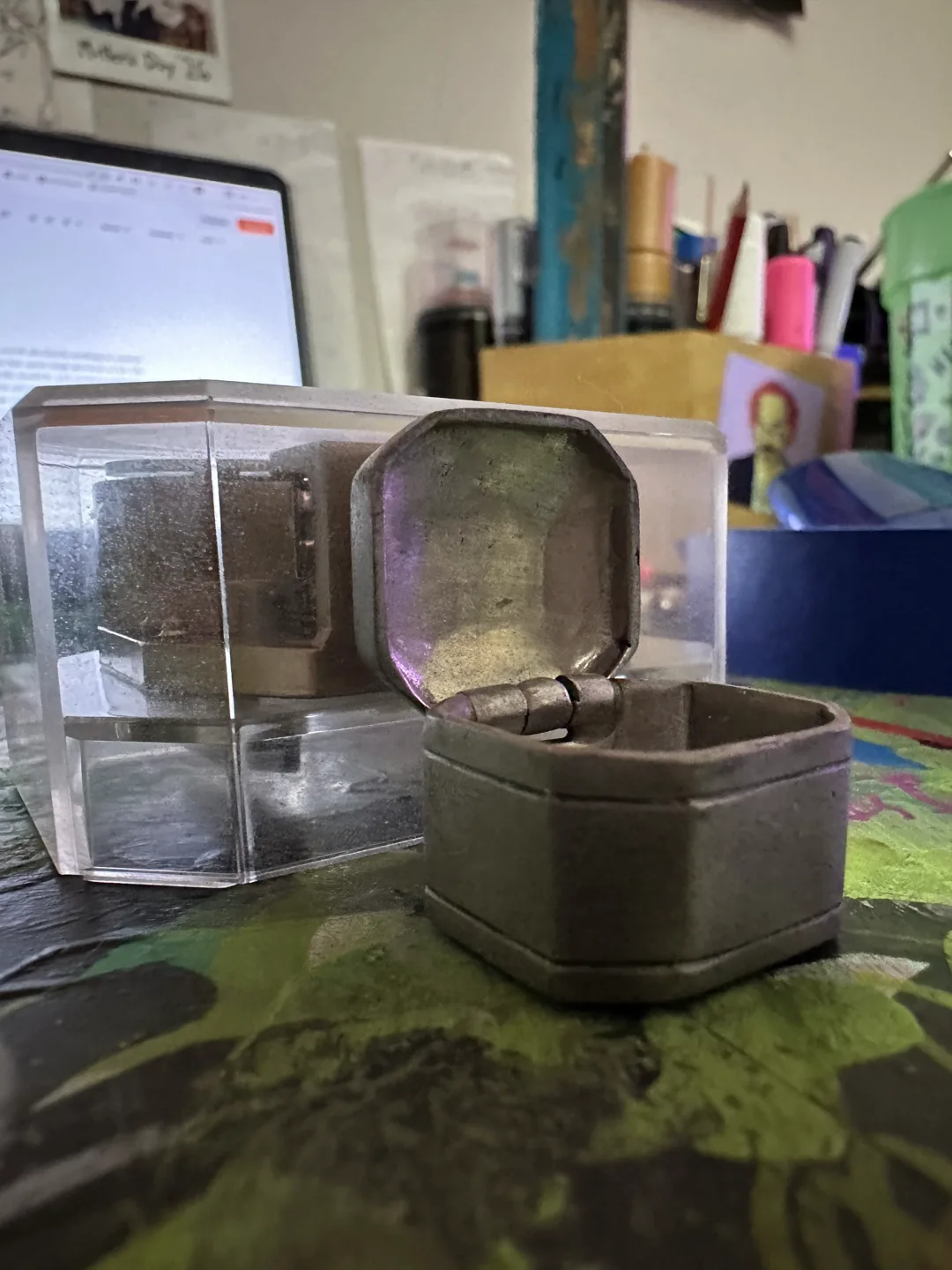
There would also be the first notes Mary Ann and I passed to each other at a revival when we first met. We were kids. We had no idea what we were holding. We did not know that these notes would someday become evidence—not in a legal sense, though honestly they may prove that awkward teenage flirting should come with adult supervision, but evidence that something had begun. There would be the music box I brought back from Europe when I was eighteen. There would be the small handmade metal box I bought around the same time, thinking that maybe one day it could hold a wedding ring. Which is both impossibly sweet and exactly the sort of thing an eighteen-year-old version of me would do while pretending to be far more mysterious and emotionally profound than he had any right to be. And yet, somehow, he was right to keep it.
That is the part I keep returning to as I get older. I did not consciously set out to preserve the symbolic architecture of my life. I did not have a system. There was no grand philosophy. I was not standing in my bedroom at seventeen saying, “One day, Future Z will require this receipt as a metaphysical anchor against the collapse of linear time.” Although, to be fair, that does sound like something I might have said if I had read the wrong book at the right age. Mostly, I just kept things. Not everything. That distinction matters. This is not a defense of hoarding, though I do understand how quickly “sentimental archive” can become “why do you still have this broken cassette adapter from 1998?” Some things are just things. Some things can be thanked and released. Some things are clutter pretending to be memory, and clutter is sneaky and has excellent marketing.
But other things are different. Some objects seem to glow a little. Not visibly. Not in a haunted Victorian doll kind of way, which is good because I have enough going on. But they carry a charge. You pick them up and suddenly the past is not an abstraction. It has weight. Texture. Smell. Edges. The receipt is not a receipt anymore. The toy is not a toy. The coloring page is not just crayon on paper. The photograph is not just an image. They become portals. This sounds dramatic until you actually hold one.
When I see my first Grover, I am not simply looking at a toy. I am looking at a version of myself before I knew how many selves I would become. A small, soft witness from the beginning of consciousness, or at least from the beginning of Sesame Street-based theology. When I look at my daughter’s first coloring page, I see the beginning of her mark-making in the world. Before handwriting. Before sharpened opinions. Before she understands that grownups will one day pretend to understand life and then secretly Google how to fix a dishwasher while questioning the nature of reality. There is something holy in those first scribbles. The hand learning that it can leave evidence.
When I look at the old Europe receipts, I remember the feeling of being seventeen and elsewhere. There is a particular kind of expansion that only happens when you are young and far from home. You are not yet wise enough to understand what is happening, which may be why it gets in so deeply. You are just walking foreign streets, buying food you cannot pronounce, boarding trains, pretending to know what you are doing, and meanwhile some hidden machinery in you is rearranging the furniture. And the picture of my grandparents—creased and carried all these years—reminds me that love sometimes becomes most powerful when it is portable. They gave me a photograph. I made it a relic by refusing to stop carrying it.
Objects do not become sacred because they are expensive or rare. They become sacred because they survive with us. They survive moves, forgetting, and different versions of who we thought we were. They survive our attempts to become more practical, more adult, more streamlined, more “minimalist,” which is a lovely aesthetic that my toy closet finds both threatening and unrealistic. They survive long enough to become mirrors. They do not reflect the face we have now. They reflect continuity. They show us that beneath all the change, something has been carried forward.
That may be what amazes me most now. Without prompting, without conscious strategy, some instinct in me kept saving breadcrumbs. Little tokens from different eras. Not enough to build a museum. Just enough to build a map. And as I get older, I am more grateful for that than I expected to be, because time moves quickly. Obscenely quickly. Rudely quickly. The kind of quickly that makes you want to file a complaint with whatever department oversees the passage of human life. One day you are seventeen in Europe, saving receipts for reasons you cannot explain. Then you blink, and you have been married twenty-six years, together over thirty, with a daughter whose first coloring page already feels like an artifact from an ancient civilization called “a few years ago.”
People tell you time moves fast, but when you are young, that sounds like one of those things older people say because their knees hurt and they have developed strong opinions about mulch. Then it happens to you. The years stop feeling like a line and start feeling like weather. They come through. They change the landscape. They leave things behind. They take things too. Memory, for all its beauty, is unreliable. It fades, edits, rearranges, protects, exaggerates, and occasionally lies with great confidence. But objects have a different relationship to time. They do not remember for us exactly, but they help us remember honestly. They give the mind something to gather around.
This is why I think we should tell people to keep things. Not everything. Please, for the love of all that is holy and mildly organized, not everything. But keep the small witnesses. Keep a note. Keep a toy. Keep the first drawing. Keep the photograph. Keep the ticket stub or the receipt or the strange little box you bought before you understood why. Keep the thing that makes no sense to anyone else but somehow contains an entire weather system of memory for you. There is wisdom in letting go, but there is also wisdom in holding on. The trick is learning the difference.
Some objects are clutter. Some are evidence. Some are junk. Some are anchors. Some are just taking up space. Others are quietly keeping you connected to the people, places, and selves that made you. The most valuable things I own could fit in one large box, and almost none of them would be worth anything to anyone else. But if that box were lost, I would not be losing objects. I would be losing touchpoints. Little doors. Proof that I was a child. Proof that I crossed oceans. Proof that my grandparents loved me. Proof that my daughter began making beauty before she knew the word for it. Proof that Mary Ann and I were once kids passing notes, with no idea we were building the first tiny paper beams of a life.
As I get older, I do not want more stuff. Not really. I want fewer things with more meaning. I want to become a better curator of my own life: to release what no longer carries truth, and to protect what still hums. Because time will keep moving. The years will blur. The people we love will change. Children will grow. Selves will disappear and be replaced by new ones wearing the same name. We will forget more than we want to admit. But sometimes, by grace or accident or some hidden wisdom within us, a few small things survive. And when we find them again, they do not take us backward. They remind us that we have been becoming this whole time.