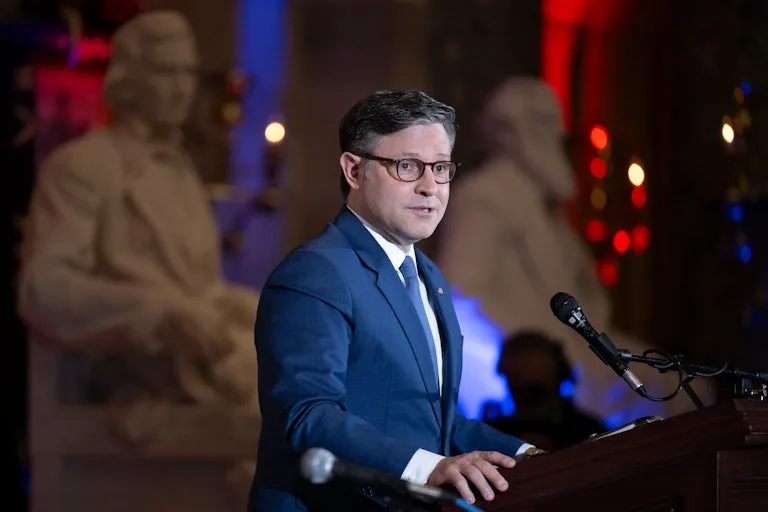
I watched Speaker Mike Johnson stand at the Faith & Freedom Coalition’s Road to Majority conference and deliver what I can only describe as accidental leftist campaign material in the voice of a haunted youth pastor. The setting was already perfect: a conservative political conference meant to energize the faithful, train the troops, and send everyone home convinced that civilization is always one municipal election away from being overrun by Marxist librarians. Then Johnson stepped up and warned them about the terrible future Democrats and democratic socialists allegedly want to bring upon America.
Not mass poverty. Not medical debt. Not billionaires quietly turning the republic into a subscription service. No, friends. Something much darker: proportional representation.
According to The New Republic, Johnson warned the audience about “little mini Mamdanis” running for Congress, then started reading from the Democratic Socialists of America platform like he had discovered a forbidden scroll beneath a vegan coffee shop. Among the horrors he listed were multi-party democracy, expanding the House of Representatives, proportional representation, and ranked-choice voting. In other words, he stood before a room of conservative activists and, with what appeared to be sincere alarm, said: “They want your vote to matter more.”
That is what made the whole thing so funny. The tone was pure apocalypse, but the content was basically a civics reform pamphlet. He might as well have whispered, “They want citizens to have actual representation in Congress,” while thunder cracked and a raven flew through the stained glass. I understand that modern conservative politics needs a villain. Politics runs on narrative, and the current Republican narrative requires every zoning meeting to be secretly connected to the Book of Revelation. But surely someone on Johnson’s team could have written him a scarier list than “more parties, more representation, and voting systems that better reflect voter preference.”
To be fair, there are actual conservative critiques available here. He could have argued that proportional representation weakens local accountability, that ranked-choice voting confuses some voters, or that multi-party systems create unstable coalitions. Those are recognizable arguments. I may not agree with all of them, but at least they are adult-shaped. Instead, Johnson chose to invoke these ideas as cursed objects. Ranked-choice voting. Expanded House. National popular vote. Multiple parties. Dun dun DUN.
The real tell, to me, was proportional representation. That is the one that seems to make them twitch. Because proportional representation is not terrifying if you think representation is the point. It is terrifying if your power depends on a narrow, winner-take-all choke point where a country full of wildly diverse people gets shoved into two corporate-branded cereal boxes and told to pick breakfast. The horror is not socialism. The horror is accuracy.
That is why I keep chuckling every time I picture his little choirboy face trying to make democracy reform sound like demonic possession. The man accidentally revealed the core anxiety: what if Congress looked more like the country? What if voters had more than two miserable options? What if a rural Democrat, an urban Republican, a socialist, a libertarian, a labor candidate, and some deeply weird local crank with one good idea could all exist in the same political ecosystem without immediately being crushed by the two-party machine?
To Johnson, that sounds like collapse. To many normal people, that sounds like a Tuesday in a functioning democracy.
And this is where the comedy becomes spiritually revealing. When a man describes healthcare, representation, voting reform, and multi-party choice with the tone of someone narrating the rise of the Antichrist, he is not just telling you what he opposes. He is telling you what he serves. The current arrangement is not an unfortunate compromise to him. It is the sacred object being protected: the two-party choke point, the Electoral College, the tiny House of Representatives pretending to scale with a country of more than 300 million people, the whole creaking machine where the popular will enters one side as a roar and comes out the other as a lobbyist-approved cough.
That is the temple. Johnson’s job, in that moment, was to stand before the faithful and say: beware the people who want to open the doors.
The SNL sketch writes itself. A grave man at a podium: “They want citizens to have choices.” The audience murmurs. “They want elections to better reflect the will of the voters.” A woman faints. “They want healthcare.” Cut to Kenan Thompson as a security guard whispering, “Dear God.”
The problem with fearmongering is that the monster still has to be monstrous. You cannot build a haunted house where the ghost is dental coverage. You cannot make “your vote should count” sound sinister unless your entire worldview depends on votes not counting equally. Johnson thought he was holding up the DSA platform to show America something terrifying, but he was really holding up a mirror to his own political theology. And in that mirror, democracy itself looked dangerous.
Not fake democracy. Not flag-pin democracy. Not the ceremonial version where everyone praises “the people” while making sure the people never get too close to power. Actual democracy. Messy democracy. Representative democracy. The kind where voters might choose wrong. The kind where elites might lose control. The kind where the public gets more doors, more levers, more parties, more voice.
That is what scared him. And maybe that is why it was so damn funny. For all the stagecraft, the suit, the solemn warnings, and the trembling voice of institutional panic, the whole performance reduced itself to a little boy pointing under the bed and screaming:
“There’s representation down there!” And maybe there is. Maybe that is why they are so afraid.