I knew this was coming. Not because I’m psychic, radical, or some genius decoder of American power — but because I read the Stanford Prison Experiment as a teenager. And if you’ve really sat with that study — really looked at what ordinary people will do when handed a uniform, a title, and permission to punish — you felt the future moving inside it too.
I was a conscientious objector in the 1990s, already allergic to authority, already writing about power and violence while my peers were pledging allegiance or preparing for military service. I’ve spent three decades protesting, writing, documenting. Not from the fringes — but from the long view. Watching. Warning. Trying to name patterns before they hardened into policy. Even so, there is something disorienting about living inside the collapse you spent your youth predicting. It doesn’t feel triumphant to be right. It feels hollow. Like realizing the fire alarm you’ve been pointing at for years isn’t just ringing — it’s melting the walls.
This week, a woman named Renee Nicole Good was killed during an ICE operation in Minneapolis. She was shot in her vehicle while attempting to leave the scene. Publicly available video shows two agents at her car — one at the driver’s side door and one positioned in front of the vehicle. The agent in front stepped aside, then fired through the windshield. The footage does not show an immediate threat to the agent at the moment of the shot.
You may hear claims that she “used her car as a weapon.” I have watched the video. What it shows is someone trying to escape a terrifying situation. That distinction matters.
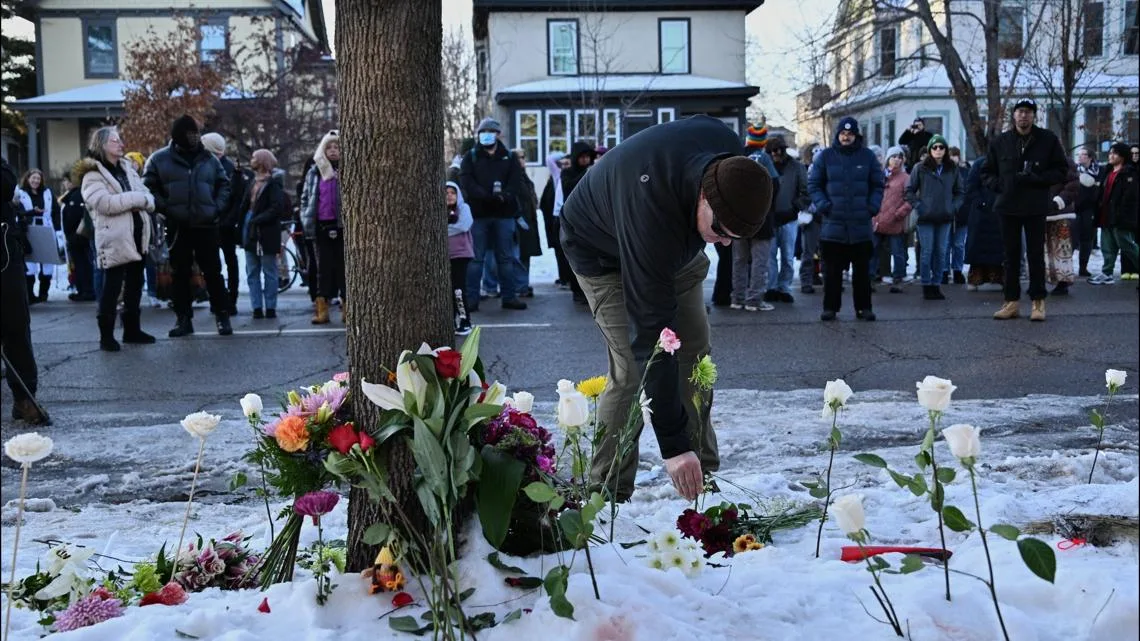
Renee was a U.S. citizen. She was 37. She had an English degree from Old Dominion. She was described by her family as compassionate and affectionate. She was the mother of a six-year-old child whose father had already died last year. Her father said, “She had a good life — but a hard one.” Now her child is orphaned. Her name is being spoken at vigils.
What has been equally disturbing is the public reaction in some spaces — celebration, approval, reflexive justification. This is what the Stanford Prison Experiment looks like when it becomes policy. This is what happens when violence is ritualized by uniform, insulated by authority, and normalized by repetition.
What feels strange is not that this happened — it’s how familiar it feels. It doesn’t arrive as dystopia. It arrives as routine. As procedure. As comment-section certainty that state killing is simply “law enforcement.” It feels like watching something ancient put on your country’s face and being told to salute.
I cannot imagine pulling a trigger on an unarmed person and calling it duty. I cannot imagine watching that footage and defending it. But I can no longer imagine being surprised.
We are living with obscene inequality, inherited racism, expanding surveillance, and algorithm-amplified fear. Power that is not reflected eventually escalates. Systems that normalize violence eventually widen it.
This is not a call to war. It is a recognition of pattern, pressure, and trajectory. We are running social equations whose historical outcomes are not ambiguous. Renee Nicole Good is not an anomaly — she is a warning light already blinking.
There is no tidy ending here. No slogan that makes this easier. All I can do is name what is happening — because sometimes naming is the last form of resistance before rupture. This is what it looks like when authority becomes theology. When a badge signals immunity. When the language of order is used to cover the face of terror.
We are living the experiment.
If you feel sick, disoriented, grieving something you can’t yet fully name — that’s not madness. It’s awareness.
Stay awake.
We may need each other.