I have become increasingly suspicious of the idea that spirituality belongs to the people who sound most certain about it. In fact, I’ve started to think the opposite may be true. The people who seem most confident that they have mapped the invisible architecture of reality—who speak fluently of heavens, dimensions, karma, cosmic plans, ascended frequencies, divine contracts, or whatever else is currently being sold in tasteful beige fonts—are often the ones least acquainted with actual mystery. Too often, they have replaced awe with explanation. They have taxidermied the sacred.
And yet I cannot deny that there is such a thing as spiritual experience.
That is the strange territory I keep finding myself in: unconvinced by metaphysical certainty, but unable to dismiss the real depth of certain human experiences. I do not know whether the universe contains a hidden mind, a cosmic purpose, or some luminous backstage manager keeping the whole circus running. I do not know whether consciousness is fundamental, derivative, local, nonlocal, eternal, or just an especially dramatic side effect of star matter getting weird. I do not know. But I do know that there are moments in life that blast a hole through the cheap plywood set of ordinary perception and leave you standing there in silence, stripped down to something more honest.
A night sky can do it. Deep meditation can do it. Grief can do it. Music can do it. Love can do it. Psychedelics can do it too, though they can also make you feel like you’ve been spiritually audited by an alien chandelier. The mechanism varies. The result is similar. The world becomes at once more intimate and more immense. You feel small, but not insultingly small. Small in the way a note is small inside a symphony. Small in the way a single cell is small inside a living body. Not meaningless. Situated.
This, to me, is where the spirituality of the atheist mystic begins.
The atheist mystic is not a person who believes in nothing. He is a person who refuses to pretend certainty where certainty is unavailable, while remaining radically open to depth, transformation, and awe. He does not want to smuggle dogma back into wonder. He does not need to call mystery “God” in order to kneel before it. He is willing to be changed by experiences he cannot fully explain without inventing a supernatural customer service hotline to process the event.
There is something profoundly spiritual, if we are honest, about standing before what exceeds us. And two things exceed us almost immediately if we pay attention long enough: the universe and the mind.
The universe, first. We are little biographical weather systems flickering on the skin of a planet orbiting an ordinary star in one galaxy among more galaxies than the human brain comfortably wants to contemplate before lunch. This is not depressing to me. Or rather, it was depressing for a while, and then it became liberating. The ego hears cosmic scale and thinks, “So I am nothing.” But something deeper hears cosmic scale and thinks, “Ah. I am not the center. How relaxing.” The whole neurotic burden of being a self-important little emperor begins to loosen. The stars do not know my name. This is excellent news. It means reality is not built around my vanity, my grievances, my productivity metrics, or my latest internal melodrama disguised as a destiny crisis.
But then there is the mind. If the cosmos is vast outwardly, consciousness is vast inwardly. Sit still for ten minutes and the whole thing becomes obvious. Memory, fantasy, grief, sensation, symbol, desire, fear, language, image, silence—this carnival of flickering appearances rises and falls in a space that is somehow intimate and unknowable at the same time. The mind contains abysses. It contains ghosts made of old stories. It contains worlds. It contains versions of the self arguing with one another in different outfits like a low-budget metaphysical courtroom drama. Most people live on the surface of this and call it normal. But the moment you begin to observe mind directly—not as theory, but as lived experience—you discover that your own interior is at least as strange as the sky.
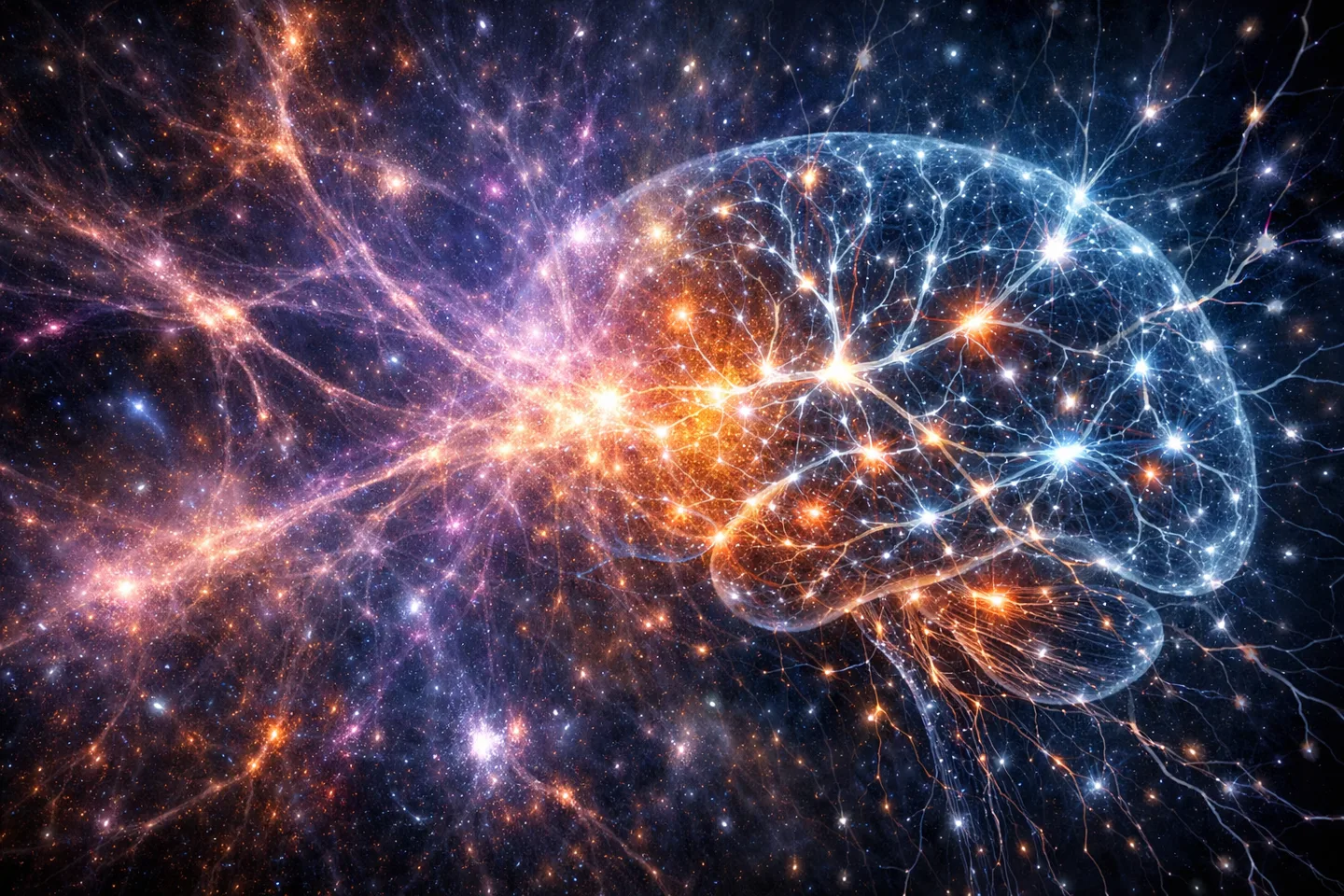
That pairing matters to me: the depth of the universe and the depth of mind. When I really let both in, I get a feeling that is difficult to reduce to materialist flatness and equally difficult to package into religion. It is a feeling of connection, but not in the sentimental sense. Not “we are all one” in the bumper-sticker way that usually means, “I had a nice edible and now boundaries are fascist.” I mean something subtler and truer. I am unmistakably separate. I am this organism, this body, this history, this point of view. I have my own nervous system, my own griefs, my own responsibilities, my own highly questionable search history. And yet I am also inseparable from everything that has made me and everything that sustains me.
I am not the universe in any grandiose sense. But I am of it.
That distinction feels spiritually important. I do not dissolve into the whole like a sugar cube into cosmic tea. I remain myself. But my self is no longer imagined as an isolated sovereign entity floating free of context. I am relational all the way down. I am composed of inheritances, causes, ecosystems, languages, accidents, ancestors, culture, bacteria, stars, love, damage, weather, and time. My separateness is real, but it is nested inside an interdependence so total that the idea of pure independence starts to look like a hallucination produced by capitalist branding.
And from this recognition, practice begins. This is the other thing that gets missed in a lot of conversations about spirituality. People assume the central question is what do you believe? But for the atheist mystic, the more important question is: what do you practice? What forms of attention make you more honest, more awake, less ruled by compulsion and illusion? What transforms your character? What deepens your capacity for presence, humility, compassion, and contact with reality?
I do not need metaphysical certainty to know that practices matter. Meditation matters. Silence matters. Honest self-observation matters. Art matters. Time in nature matters. Deep conversation matters. The deliberate interruption of automaticity matters. There are disciplines that make a person more porous to truth, more able to witness the ceaseless theatrical production of the ego without being entirely cast in its dumb little play. These practices do not require belief in supernatural claims. Their value does not depend on proving an afterlife, a divine scorekeeper, or an invisible bureaucracy of enlightened light-beings monitoring my emotional compliance.
The proof, such as it is, is transformational. Does this practice make me less reactive? Less vain? Less cruel? Less trapped in the shrinking cage of self-importance? Does it increase my capacity for wonder without making me gullible? Does it soften my addiction to certainty? Does it help me inhabit this brief human life with greater honesty and reverence? That, for me, is where spirituality becomes real: not as a set of cosmological declarations, but as a disciplined openness to mystery that alters how one lives.
This is why I increasingly trust awe more than belief. Belief can be inherited, borrowed, performed, weaponized, monetized, and stapled onto a personality. Awe is harder to fake. Genuine awe disorients the ego. It interrupts the usual chatter. It humbles without humiliating. It does not hand you a neat explanatory framework. It hands you a wider context and lets you tremble in it a little. It says: you are not in control. You are not the measure of all things. There is more here than your concepts can comfortably domesticate.
And strangely, that feels less like deprivation than relief. I do not feel spiritually impoverished by the absence of certainty. I feel spiritually endangered by the pretense of certainty. There is a deadness that enters the soul when mystery is replaced by ideology, even benevolent ideology, even allegedly spiritual ideology. The map swallows the terrain. The explanation becomes a shield against direct encounter. Very often what we call belief is just fear wearing ceremonial robes.
I would rather remain honest. I would rather say: I do not know what consciousness ultimately is. I do not know whether the universe is indifferent, alive, sacred, accidental, or whether all of these words are simply too small. I do not know whether mystical states reveal metaphysical truths or merely reveal the mind to itself under unusual conditions. I do not know. But I know that contact with vastness changes me. I know that stillness changes me. I know that sustained attention changes me. I know that love, grief, beauty, and silence can make the world feel unbearably holy without requiring me to lie about what I can prove.
Maybe that is enough. Maybe spirituality was never supposed to be ownership of the final answer. Maybe it is the capacity to remain intimate with the question. Maybe it is the willingness to practice reverence without superstition, humility without nihilism, and wonder without surrendering one’s mind. Maybe the atheist mystic is simply a person who has learned that the absence of metaphysical certainty does not flatten existence, but deepens it.
The universe remains enormous. The mind remains strange. I remain separate, and yet inseparable from the whole theater of being. That is not a doctrine. It is not a creed. It is not a system I can sell you in seven steps with a free PDF and a bonus webinar. It is simply where I find myself standing when I am most honest: in awe, in practice, in mystery—without certainty, but not without reverence.