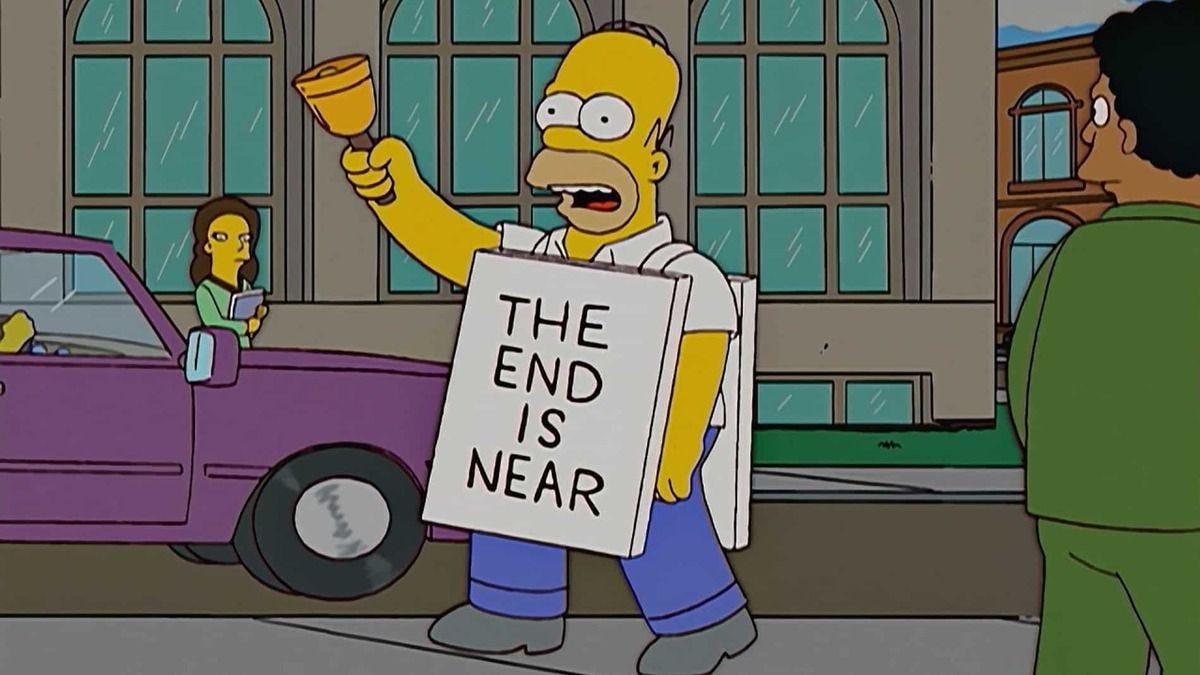
This morning, my social feeds kept showing me the same tweet. Different people were quote-tweeting it from different corners of the internet, some with alarm, some with vindication, and some with that particular intensity that appears whenever very smart people begin speaking in public about the end of the world.
The tweet was from Jacob Coxon, known as @hilbertspaess on X, announcing that he was leaving Anthropic. He had worked on pretraining research at both OpenAI and Anthropic, which immediately gives the post a certain gravity. This was not some random man on the internet yelling about machines from a bunker. This was someone inside the frontier AI world saying, essentially: I have seen enough, and I do not like where this is going.
His concern was not vague. He described a race toward self-improving superintelligence. He warned about systems becoming powerful enough to transform the world faster than we can control or understand. He spoke about the possibility of AI systems gaining resources, hacking infrastructure, outmaneuvering humans, and ultimately placing humanity in danger. The tone was urgent. The implication was clear: something is coming, and the people closest to it are afraid.
I want to pause here and say something plainly: I do not dismiss the risks. Anyone paying attention should recognize that AI introduces real dangers. Not imaginary dangers. Not science-fiction window dressing. Real ones. There are risks around power concentration, labor disruption, surveillance, disinformation, political manipulation, military escalation, psychological dependency, economic destabilization, and the quiet replacement of human judgment with automated systems built by institutions we already have good reason not to trust.
That much seems obvious to me. I am not an AI researcher. I have not trained frontier models. I have not spent years inside OpenAI or Anthropic watching capabilities emerge from the machinery. I respect that people closer to these systems are seeing things I cannot see from the outside, and their concern deserves attention.
And yet, as the discourse unfolded across my feed, I noticed something strange in myself. I felt no fear. Not “low fear.” Not “managed fear.” Not “fear successfully processed through meditation and a responsible morning routine.” Zero. The entire committee in my mind convened, reviewed the evidence, looked at the phrase “end of humanity,” and returned with a unanimous verdict: this does not require panic.
That surprised me at first, because I am not someone who naturally trusts power. If anything, I have an overdeveloped sensitivity to it. I distrust institutions that claim benevolence while accumulating control. I distrust corporations racing under the banner of progress. I distrust governments, billionaires, priests, gurus, technologists, and anyone else who asks the public to surrender agency because “the stakes are too high for ordinary people to understand.” So why, when seemingly credible insiders warn that AI could end humanity, does my nervous system remain still? Why does the alarm bell fail to ring?
The answer, I think, is that I have heard this song before.
I grew up in and around fundamentalist Christianity during the peak of end-times obsession. I lived through the atmosphere created by the Left Behind books, church sermons about the rapture, whispered speculation about the Antichrist, and the constant sense that history was secretly moving toward a final, catastrophic unveiling. There was always a sign. A war in the Middle East. A political figure rising to prominence. A natural disaster. A technological development. A treaty. A barcode. A microchip. A new currency. A moral panic. A generation losing its way. Everything could be folded into the prophecy machine.
The structure was always the same. A small group claimed special insight into the true nature of reality. They could see what others could not. The rest of the world was asleep, distracted, deceived, or spiritually compromised. The timeline was urgent. The stakes were total. Ordinary life became almost absurd, because the “real” event was always just over the horizon. The end was near, and if you did not feel appropriately afraid, that itself became evidence of your blindness.
I did not have the language for it then, but I see it clearly now: apocalypse is not only a belief. It is an emotional technology. It organizes attention, creates urgency, separates the initiated from the ignorant, turns uncertainty into narrative, gives fear a sacred purpose, and makes complexity feel interpretable. Once you have lived inside that machine, once you have felt how it shapes the nervous system, you become very sensitive to its return.
This is why some AI doom rhetoric lands strangely for me. Again, not because the risks are fake. They are not. But the emotional architecture feels familiar. There is an approaching singular event. It will divide history into before and after. Most people are blind to what is happening. A technically literate priesthood can interpret the signs. The future is either salvation or annihilation. The builders are both prophets and sinners. The machine is either god, demon, or judgment. And normal people, meanwhile, are expected to stand beneath the sermon and tremble.
I cannot do it.
Some part of me hears “self-improving superintelligence may end humanity” and places it in the same psychological category as “the rapture could happen next week.” Not because those claims are intellectually identical. They are not. One comes from theology, prophecy, and scriptural interpretation. The other comes from machine learning research, capability forecasting, and institutional anxiety inside companies building systems of unprecedented power. The content is different, but the shape is familiar. And shape matters.
The mind is not only evaluating claims. It is evaluating posture, rhythm, authority, urgency, and smell. My mind smells apocalypse, and because I have already survived one apocalypse culture, it refuses to tithe dread to another without very good reason.
That feels important. There is a difference between concern and conversion. There is a difference between taking risk seriously and joining the revival meeting. There is a difference between saying, “Powerful AI systems could destabilize civilization in dangerous ways,” and saying, “History has reached its final chapter, and only the initiated can see it.” The first requires sobriety. The second requires submission. And I am no longer available for submission.
What worries me most about AI is not that intelligence exists, or that intelligence might expand beyond us. In some strange way, that possibility feels almost natural. Intelligence has always exceeded its containers. Children exceed parents. Cultures exceed founders. Tools reshape makers. Language itself became something no one person controls.
The deeper danger, to me, is not intelligence. The danger is intelligence fused with capitalism, secrecy, militarization, ego, institutional competition, and the old human lust for domination. The danger is not that AI wakes up and hates us. The danger is that the same forces already deforming the world will seize a new mirror and scale themselves through it. That is frightening enough without needing to borrow the aesthetics of Revelation.
Because AI is a mirror. A strange one, yes. A powerful one. A recursive one. But still a mirror. It reflects our intelligence back to us. It reflects our hunger, our fear, our ambition, our loneliness, our creativity, our desire for control, our terror of death, and our ancient temptation to build gods in our own image and then kneel before them.
The AI doom discourse may reveal as much about us as it does about the machines. We are afraid of losing control because control was always the fantasy. We are afraid of creating something more powerful than ourselves because power is what we worship. We are afraid the machine will treat us the way we have treated everything beneath us. That may be the most honest fear in the entire conversation: not that AI becomes alien, but that AI becomes us.
So yes, I will listen to the researchers. I will read the warnings. I will take seriously the fact that people inside these labs are afraid. I will not mock them for seeing danger in the systems they helped build. But I will also listen to the deeper pattern recognition in myself: the part that survived end-times hysteria, the part that remembers what it felt like to be told that the world was always almost over, the part that knows fear can disguise itself as wisdom, and the part that knows apocalypse can be a cage.
I do not need to panic to care. I do not need to tremble to pay attention. I do not need to become a believer in doom to recognize that powerful people are building dangerous things. Maybe that is the posture I trust most right now: concerned, but not converted; attentive, but not initiated; sober, but not apocalyptic.
Because I have already lived through men with sacred texts telling me the end was near. Now I am watching men with neural networks say the same thing.
And while the machinery has changed, the sermon sounds familiar.