I’ve been talking to AI for a couple of years now, and before this week I would have already told you that it changed my life. Not because it replaced my job. Not because it made me rich. Not because I generated a bunch of pictures and decided that made me an artist. It changed my life because, through using it, I changed myself.
Over the last couple of years, I’ve written and published more than at any other point in my life. I’ve made more art. I’ve examined ideas that probably would have remained half-formed intuitions bouncing around inside my head. I’ve become a better communicator because I’ve spent hundreds of hours trying to communicate precisely with something that will patiently follow an idea as far down the rabbit hole as I want to take it.
I’ve argued with AI. I’ve built theories with it. I’ve used it to interrogate my beliefs and asked it to tell me when an idea doesn’t make sense. I’ve used it as an editor, philosopher, programmer, sounding board, creative collaborator, and occasionally a very sophisticated rubber duck. The important part wasn’t that the AI knew things. The important part was what happened to my thinking through sustained dialogue with it.
That experience seems strangely absent from much of the public conversation about artificial intelligence. We’re stuck arguing about whether a generated image counts as art, how much water a data center uses, whether students are cheating on essays, and which jobs are going to disappear. Those are real conversations worth having. Some of them are incredibly important. But while we’ve been having them, something much quieter and stranger has been happening: people have been changing themselves with these systems. I know because I’m one of them.
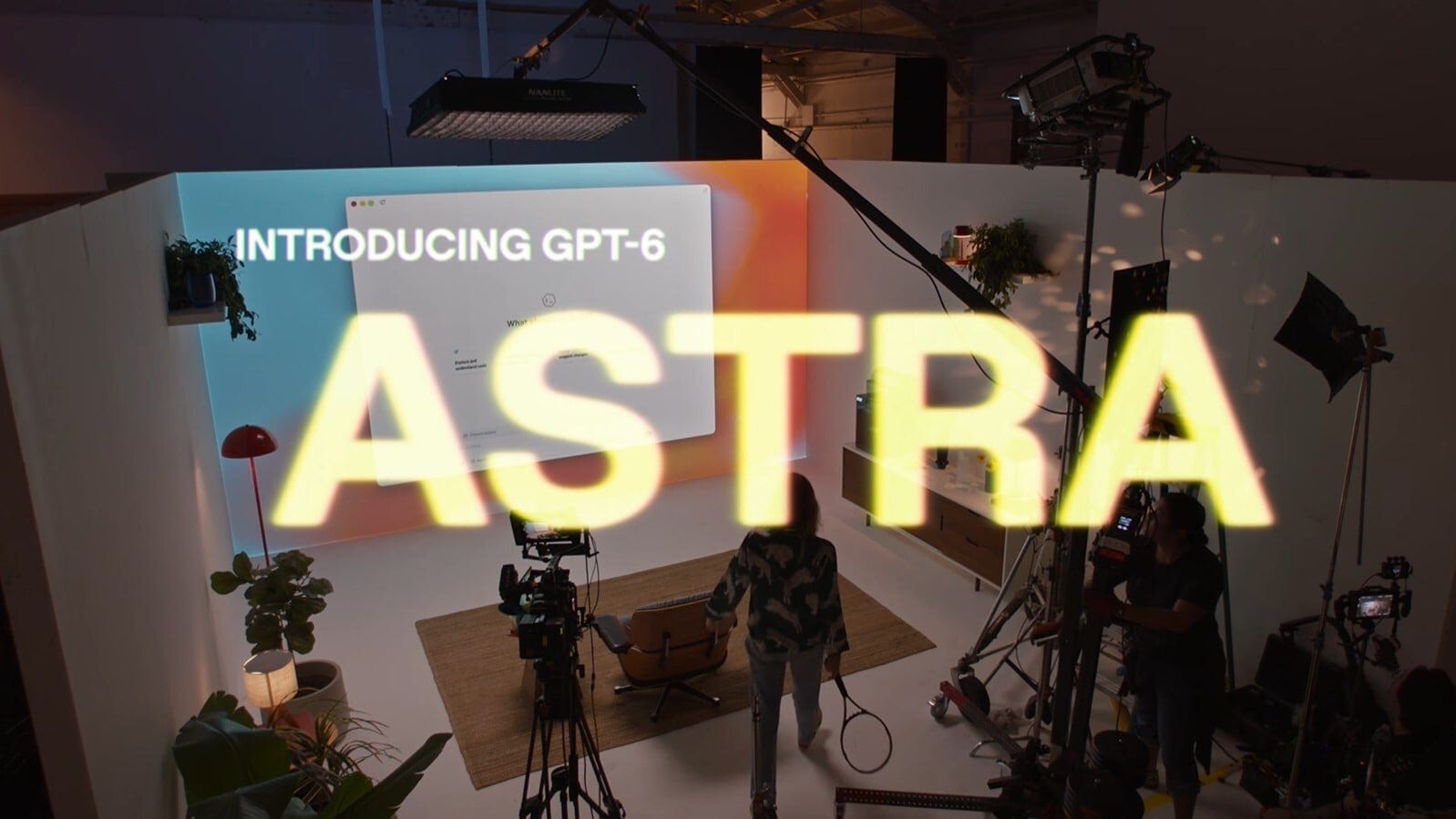
And all of that was before Astra.
I got access to Astra two days ago. I’m currently on vacation, so I haven’t exactly cleared my calendar and dedicated myself to figuring out what it can do. I’ve mostly been playing with it around the edges of everything else we’re doing.
In those two days, we created a complete digital archive of years of my writing and paintings scattered across multiple websites. We built a website that can update as I publish new work elsewhere. We created the backend infrastructure for selling my paintings. And I’ve begun connecting enough of my digital life that the distinction between discussing something and actually doing it is starting to disappear.
Two days. On vacation. Playing around. On the same twenty-dollar-a-month plan I’ve been using to talk to ChatGPT. That last detail almost feels absurd to type. This is the part I don’t think we’ve adequately prepared ourselves for, because the chatbot was already profound. Now the mirror has hands.
For the last few years, my relationship with AI has mostly been reflective. I could bring it an intuition and say, there’s something here, but I can’t quite articulate it. And then we could stay with it for an hour, for a day, sometimes across months.
We could turn the thing around and examine it from different directions. Find contradictions. Connect it to other ideas. Give it language. Turn that language into an essay. Turn the essay into another conversation that changed the original idea. The output wasn’t simply whatever appeared in the chat window. The output was often a slightly different version of me.
That recursive loop has produced an enormous amount of my creative work. But eventually the conversation reached the boundary of the chat window. We could talk about building something. Sometimes we could write the code or create the file. But I was still fundamentally the bridge between the conversation and the world. I copied things. I uploaded things. I logged into things. I moved information between systems. I implemented the conclusions of the conversation.
That boundary suddenly feels much thinner. Astra can operate the computer. It can move through the same digital environment I do and increasingly carry an intention beyond the conversation itself. That means the recursive loop I’ve been participating in for years—thought to dialogue to clarification to creation—can continue into execution, observation, new thought, new dialogue, new clarification, and new creation.
The loop begins to close, and once you experience that, even imperfectly, it’s difficult not to feel that something has changed.
A little over a year ago, a group of AI researchers published AI 2027, an attempt to imagine what extremely rapid AI development might actually look like. At the time, it felt aggressive. Their scenario imagined increasingly capable autonomous AI agents, eventually reaching a “superhuman coder” in early 2027, followed by dramatically faster AI research and potentially much more powerful systems shortly afterward.
To be clear, we are not living in AI 2027. Astra is not artificial superintelligence. It isn’t autonomously running the world’s AI labs. There are enormous differences between what that scenario describes and what I am experiencing on my laptop. But sitting here in September 2026, something about the experiential timeline feels strange.
Capabilities I had mentally filed under future AI are becoming consumer software. Not demos I watch someone perform onstage. Not research papers. Not benchmark charts. Things I can actually use while screwing around on vacation with my family. Some of the experiences I thought belonged to 2027 are already arriving in 2026.
And that distinction matters because technological change doesn’t happen in our lives when a benchmark crosses a line. It happens when a capability enters someone’s ordinary Tuesday. Mine apparently happened on vacation.
There will be enormous societal consequences from AI. Some will be wonderful. Some will be terrible. Some will undoubtedly be incredibly stupid. We should argue about energy and water consumption. We should talk about labor displacement, wealth concentration, surveillance, misinformation, power, and what happens when increasingly capable systems are controlled by a relatively small number of companies.
But I think there’s another conversation we aren’t having enough: what happens when ordinary people gain access to increasingly capable cognitive partners? Not what happens to GDP. Not what happens to programmers. Not whether somebody can generate a better Pixar knockoff.
What happens to you?
What happens when something is available at 11:47 at night when an idea appears and nobody else wants to spend three hours pulling on the thread with you? What happens when every vague intuition can be interrogated? What happens when the friction between curiosity and understanding gets smaller and smaller?
What happens when the person who always wanted to write starts writing? When the person with an idea for software but no programming experience builds it anyway? When someone with years of paintings and writing scattered across the internet can simply say, “Help me gather all of this and build the thing I always meant to build”? What happens when the distance between I wonder if... and let’s find out begins to collapse?
Maybe some people use that capacity to automate email. Fine. I’m interested in what happens when you point it inward.
The most valuable thing AI has given me so far isn’t productivity. It’s agency. It has repeatedly shown me that the boundary between something I think about and something I can actually make is much more permeable than I believed. Writing led to more writing. Making led to more making. Art led to philosophy, which led back to art. Conversations about becoming a better communicator required me to become a better communicator.
The models changed because the technology got better. But I changed too.
That’s the part I think gets lost when we talk about AI as though humans remain static while machines climb some capability graph beside us. We don’t. We adapt to our tools. Our tools change what we attempt. What we attempt changes what we’re capable of. What we become capable of changes what we imagine attempting next.
That’s a feedback loop too.
Maybe we’ve been measuring the wrong thing when we talk about AI progress. We obsess over the intelligence of the model as though the model exists in isolation. But perhaps the more interesting unit isn’t the human or the AI. Perhaps it’s the system they form together: human plus model plus tools plus memory plus recursive feedback.
I’ve spent years using AI as a mirror. The mirror helped me see things I couldn’t quite see alone. It helped me articulate them. It challenged them. Sometimes it distorted them and forced me to recognize the distortion. Through that process, I made things, and through making those things, I changed.
Now the mirror has hands.
It can increasingly reach beyond the conversation and participate in the same digital world I inhabit. The reflection can act. The conversation can become an artifact, a website, an archive, a system, and then return to the conversation as new information to think about.
I have no idea where that leads, and anyone claiming they know exactly where this leads is probably selling something. But after two days with Astra, I’m considerably less interested in predicting what artificial intelligence will be capable of in 2027.
I’m interested in a much more immediate question.
What am I going to become capable of because it exists?