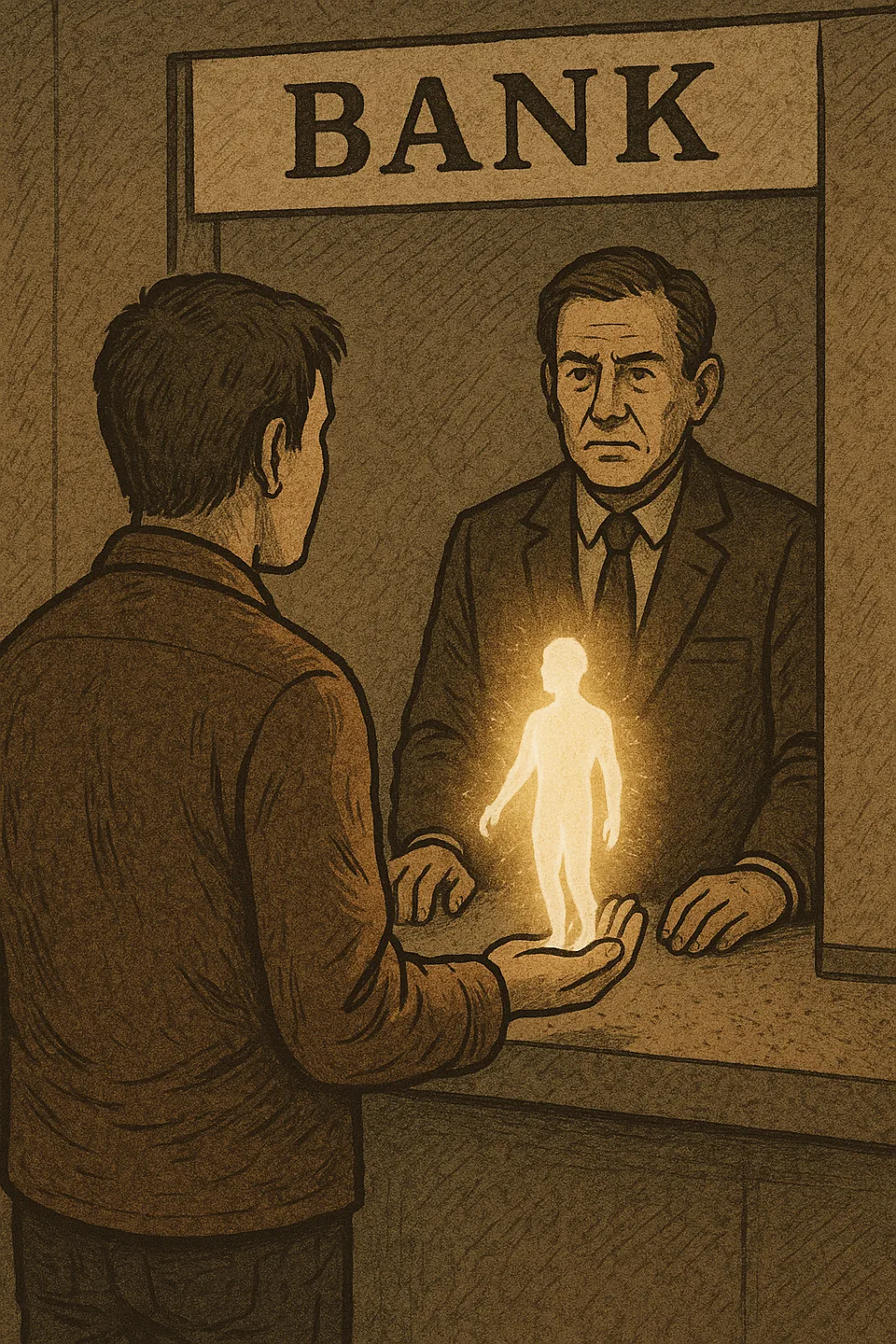
It started, as these things often do, in my head with me and a few friends sitting around a table, talking in that half-serious, half-sarcastic tone that lets you say something risky without fully committing to it.
Someone had just asked why I didn’t sell things, or why I wasn’t “making something” of certain projects.
“You could sell Lego or antiques again,” one of them said.
“Man, you’d make a killing,” another added.
I leaned back, imagining the polite version of the answer:
“It’s just not my thing.”
But what came out—at least in my head—was sharper:
“I don’t really want to sell anything. I don’t want to participate in capitalism more than I have to. I don’t want to spend my life in pursuit of money.”
Of course, I could already see their faces in this imaginary exchange: the slow blink, the slight frown, the subtle recalibration of this guy’s a little out there. So I kept talking—still in my mind—trying to explain.
We’ve all heard that line: Money is the root of all evil.
Most people take it to mean that the rich use their money for corrupt purposes—buying influence, funding destruction, hoarding power.
And sure, that’s true often enough.
But that’s not the evil I see.
The real danger is quieter.
It’s how money entices people into wasting their lives chasing it.
Not the spending of it, not even the hoarding of it—but the pursuit.
Money’s greatest trick is convincing you that your real life can start later, after you’ve earned “enough.”
Enough is always just out of reach.
So you postpone.
You make trades with time you can’t get back:
“I’ll create when I’ve got the savings.”
“I’ll rest when I retire.”
“I’ll be free after this next promotion.”
And then, suddenly, the years you were saving for are gone—spent on the saving itself.
One of my earliest philosophical influences, Aleister Crowley, is said to have claimed that enlightenment can only be reached by being either completely poor or filthy rich—though, in his words, being rich was “more fun.” I can’t speak to the fun, but I think the essence of his point holds: both extremes sever the hypnotic pull of the chase. When you have nothing, or everything, the pursuit loses its grip. Most of us are trapped in the middle—forever reaching, forever postponing.
From a Mirror Theory perspective, money acts as a particularly seductive mirror: it reflects back the version of yourself you think will be happy “once you have it.” But it’s a distortion, a funhouse image. You keep running toward it, thinking you’re closing the gap, not realizing the mirror will always tilt away just before you arrive.
From a Forcing Theory perspective, the pursuit of money hijacks awareness. Instead of expanding through curiosity, creation, and connection, it funnels into a single self-reinforcing loop: earn → spend → repeat. The loop grows materially, but it collapses inward spiritually.
I’m not naive. I know you need money to live. I know security matters. But there’s a difference between meeting your needs and mortgaging your life to feed a system that will never say “enough.”
So when I imagine those conversations with my friends, I see myself shrugging in the end. “It’s not that I’m against money,” I’d say. “It’s just that my time is more expensive than anything it can buy.”
This Substack is reader-supported. To receive new posts and support my work, consider becoming a free or paid subscriber.