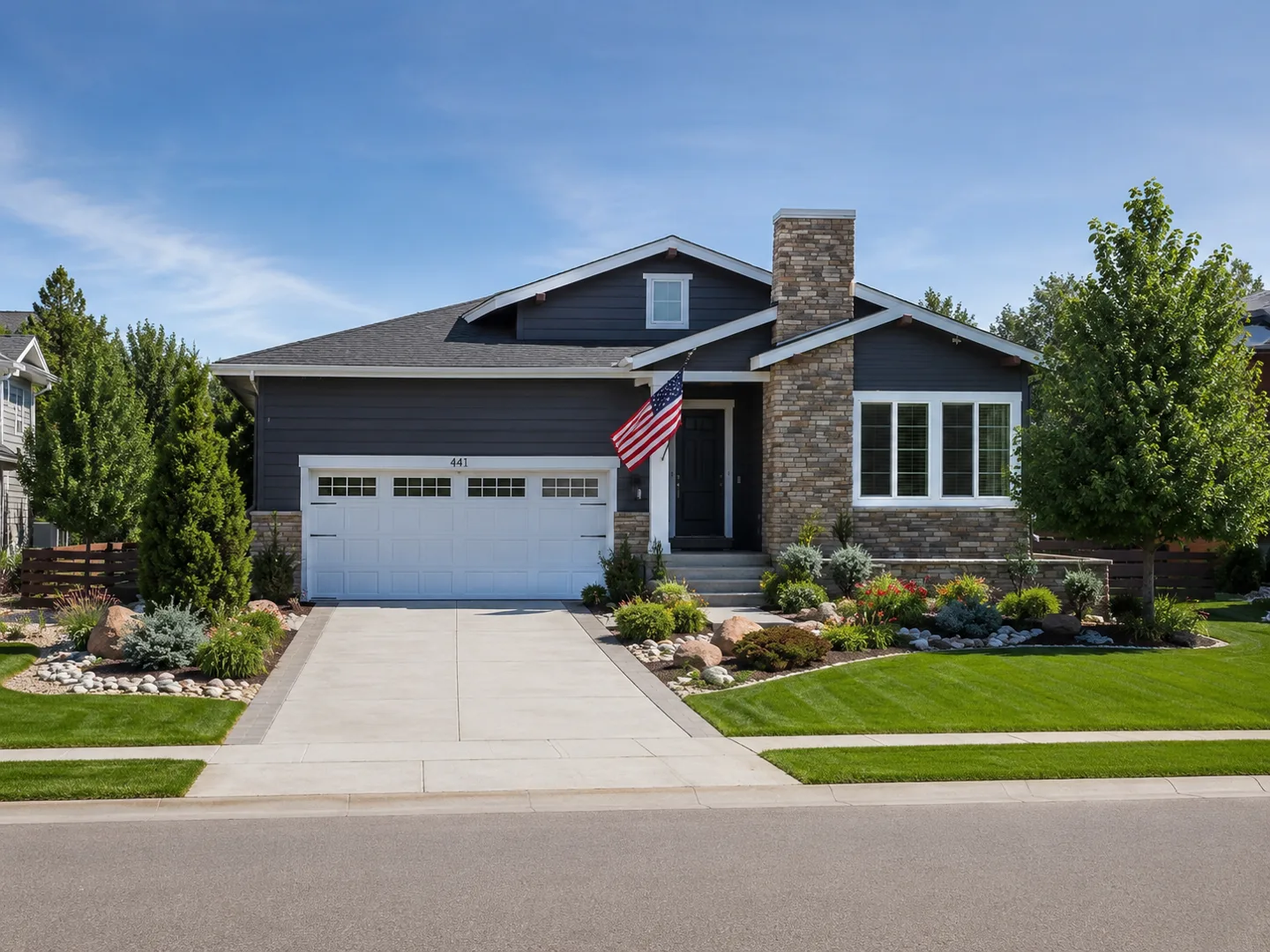
I was sitting on a friend’s porch today, participating in that ancient American ceremony of staring across the street while pretending not to stare, when my eyes locked onto a yard manicured with almost military precision. This was not merely a lawn. This was a hostage situation with chlorophyll. Every blade of grass appeared to have received instructions. The edges were so clean they looked legally binding. The shrubs stood at attention like they were waiting for inspection from a four-star general in cargo shorts. Nothing drooped. Nothing wandered. Nothing expressed an opinion. It was beautiful, in the way highly controlled things can be beautiful. A temporary victory against the slobbering beast of entropy. A suburban altar to the idea that, for one brief afternoon, chaos had been told to shut up and sit down.
Then I saw the flag. Huge, naturally. Not a modest little porch flag flapping sweetly beside a flowerpot. This was a flag with a mortgage. A flag with shoulders. A flag large enough to affect bird migration. It didn’t hang there as decoration; it announced itself. It had entered the conversation before anyone was speaking. And something in my brain clicked with the unpleasant accuracy of a raccoon opening a trash can at midnight: the people displaying the loudest signs of nationalism often have the nicest yards. Not always, of course. I’m not proposing a peer-reviewed Grand Unified Theory of Patriot Grass. But often enough. Often enough that once you see it, the pattern starts glowing like a bug zapper in the dark.
The yard and the flag are part of the same language. One says, “I maintain.” The other says, “I belong.” Together they say, “I know where the borders are, and I intend to keep them sharp.” The lawn becomes a miniature nation-state, complete with borders, enemies, rituals, and a standing army of gas-powered equipment. Weeds are not plants; they are invaders. Crabgrass is not biodiversity; it is a terrorist cell. Dandelions are not bright little absurdist suns sent by the earth to cheer us up; they are yellow propaganda. The homeowner patrols the perimeter with a trimmer in hand, sweating under the divine burden of containment. The driveway edge must be crisp. The mulch must stay where mulch belongs. The hedges must not get ideas. The whole yard is forced into legibility, which may be the entire point. A manicured lawn is nature after a stern conversation with authority.
And the flag above it all becomes the flaming cherry on this patriotic sundae of controlled vegetation. Suddenly the yard is not just a yard. It is a statement of moral geometry. The straight lines matter. The clean borders matter. The visible discipline matters. The home becomes a tiny embassy of order in a world that refuses to behave. The owner may not be able to control inflation, immigration, gas prices, moral panic, global markets, their adult children, the creeping dread of mortality, or the fact that reality is mostly a haunted carnival ride operated by blind forces—but by God, the fescue will be cut to regulation height and the flag will not touch the ground.
To be fair, there is something admirable in it. I don’t want to cheap-shot the whole thing into oblivion. Care is care. Attention is attention. A well-maintained yard can be an act of pride, devotion, even love. There is dignity in tending the little square of earth fate has handed you. There is something almost monastic about the repetition: mow, trim, blow, water, repeat. The body moves. The mind settles. Disorder retreats. For some people, lawn care may be the only arena where anxiety becomes action and action produces immediate evidence. The world is insane, the news is a blender full of teeth, but this line along the sidewalk? This line can be made straight.
But the flag changes the frequency. It plugs the private ritual into a bigger symbolic machine. The trimmed lawn stops being only aesthetic and becomes ideological. It suggests a belief — maybe conscious, maybe not — that goodness looks like control, that belonging looks like uniformity, that beauty requires suppression of the unruly. You can see how easily the metaphor gets drunk and starts yelling at Thanksgiving. The weed becomes the outsider. The fence becomes virtue. The neighbor’s native plant garden becomes a suspicious commune. Suddenly a man in New Balance sneakers is standing in his driveway, staring at a patch of clover like it just crossed the border illegally.
There’s a class performance happening too, wearing khaki shorts and smelling faintly of fertilizer. A perfect yard requires resources: time, money, tools, water, knees that still function, or someone else’s labor. The lawn becomes respectability photosynthesized. It says, “I have enough stability to maintain appearances.” In certain neighborhoods, the yard is less a creative choice than a compliance ritual. Let it grow too long and the social immune system activates. Curtains twitch. A neighbor notices. The HOA descends from the clouds like a beige angel of death carrying a clipboard. Soon you’re standing barefoot in your own driveway being spiritually audited by someone named Gary because your grass dared to experience vertical ambition.
The hilarious and tragic thing is that none of it holds. The grass keeps growing. The weeds return. The flag frays. The mulch fades. The hedges reach once more toward their secret dream of becoming forest. Entropy is undefeated, patient, and apparently very into yard work. Every Saturday morning, the homeowner marches into battle with a leaf blower screaming like the tinnitus of empire, and for a few hours civilization appears restored. Then rain comes. Seeds drift in. A mole tunnels beneath the surface like a tiny revolutionary. The earth, which has been here longer than property law, quietly resumes its work. The wild does not need to win quickly. It has time.
And maybe that’s why the whole scene hit me so hard from the porch. The giant flag and the immaculate yard were not merely signs of nationalism. They were signs of a human being trying to make a deal with impermanence. Trying to carve certainty into a world that will not stop mutating. Trying to make the outside world reflect an inner hunger for order, rootedness, control, meaning. We all do this, just with different costumes. Some people fly flags and sculpt boxwoods. Some write essays on the internet like deranged monks with Wi-Fi. Some collect toys, paint birds with snakes in their mouths, meditate in closets, start podcasts, build theories of consciousness, or arrange their bookshelves by emotional weather pattern. We are all out here making little altars against the void.
So I’m not here to condemn the nationalist lawn. I’m here to behold it in its full American strangeness: beautiful, anxious, disciplined, symbolic, funny, terrifying, and deeply human. A patch of grass dressed up as a worldview. A flagpole planted directly into the psyche. A man standing at the edge of chaos with a weed whacker, trying to hold back the ancient green mouth of the world. And maybe that’s America in miniature: not freedom exactly, not order exactly, but the frantic performance of both, staged every weekend beneath a massive flag while the grass, blessed and blasphemous, keeps growing anyway.