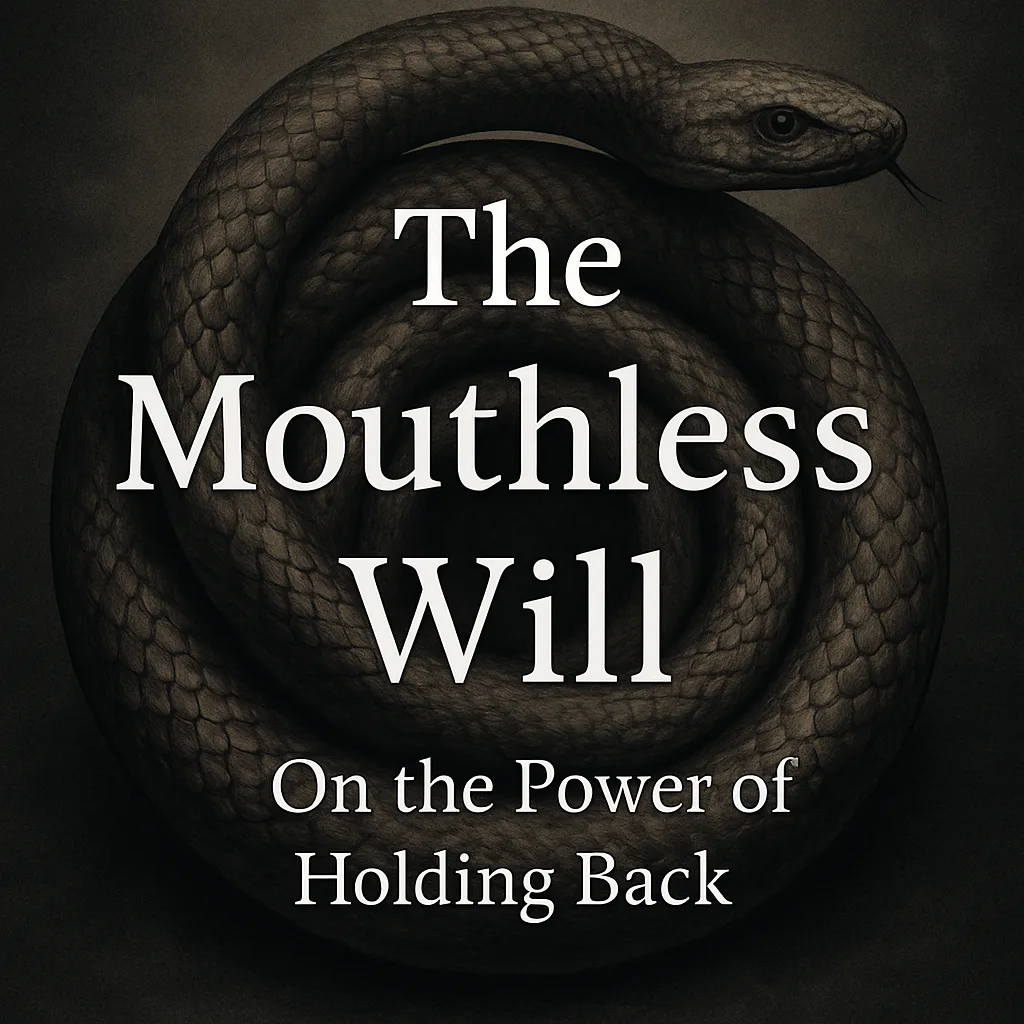
There was a time when I believed I had learned “work in silence” from Aleister Crowley.
The phrase haunted my practice. I used it in ritual, in goal-setting, in intention-work, and in personal transformation. It became a kind of silent commandment—will without witness. But one day, I went looking for the quote, ready to cite it, and couldn’t find it. Not in The Book of the Law, not in Magick Without Tears, not in any of the margins I’d scribbled through.
It wasn’t there.
That’s when I realized: I hadn’t learned it. I had grown it. It had emerged from the field I’d been feeding for years—occult theory, psychological research, subconscious practice. “Work in silence” wasn’t a line from a book. It was a structure formed beneath the surface. And by the time I recognized it consciously, it was already truth.
This essay is about that truth. About why we hold back. Why we don’t speak too soon. Why keeping quiet is not cowardice, but magick.
One of the oldest axioms in the Western esoteric tradition is: To Know. To Will. To Dare. To Keep Silent. Eliphas Levi wrote it. Crowley echoed it. Spare implied it through symbol. Carroll operationalized it. And though they all had different cosmologies, they agreed on one thing: If you speak the spell before it forms, it breaks.
In classical Hermeticism, silence was containment. It kept the will pressurized—like air in the lungs before the chant. It prevented psychic dilution. It preserved the charge of becoming.
Modern chaos magicians like Peter J. Carroll spoke of “forgetting the sigil”—charging it with desire, then burying it in the subconscious, so the conscious mind wouldn’t interfere. Talking about your will, planning your will, boasting about your will… all of it vented the pressure. And without pressure, there is no force. No threshold. No flash.
Science caught up with magick, as it sometimes does.
Psychologist Peter Gollwitzer discovered that when we talk about a goal, our brain gives us a little dopamine rush—as if we’ve already done it. The announcement mimics the achievement. The brain checks the box. And suddenly... we don’t feel the same urgency to act.
We didn’t do the thing. But we felt like we did. And that’s often enough to stop us cold.
This is why we fail to change, even with good intentions. We declare it. We imagine it. We tweet about it. And then we’re surprised when the fire goes out. We aired the spark too early. We broke the container.
In my own system—Forcing Theory—this maps precisely. Forcing Theory proposes that consciousness is not a passive receptacle, but a recursive engine. It grows through pressure, threshold, and emergence. Every intention builds tension within the system. And when enough force accumulates, a threshold is crossed, and a new reality erupts.
But if that pressure leaks—if we talk before we act, announce before we integrate—the force dissipates. The threshold is never crossed. The insight never arrives. The transformation stalls.
Working in silence isn’t about secrecy. It’s about building the field until it cannot be denied.
In my Mirror Theory framework, silence preserves the integrity of the reflection. Before something is spoken, it exists in a liminal state—not yet distorted by language, not yet shaped by others’ feedback. It is pure reflection—undisturbed by the social mirror.
When we speak too soon, we invite premature reflection. Others respond not to what we are becoming, but to what we say we are becoming. And in that distortion, we lose the signal.
The mouthless will is not mute. It is gestating. It is preparing to mirror itself through action, not declaration.
This is not abstract for me. It’s bone-deep. I don’t announce projects. I don’t declare changes. If I’m shifting something vital—spiritually, relationally, creatively—I hold it.
The pressure builds. The field tightens. The mirror aligns. And one day, the thing simply is.
People around me often say: “You just do it. No warning.” Exactly. That’s the point. The will wasn’t meant to be witnessed before it was formed.
Let’s be clear: “work in silence” is not a call to secrecy out of shame.
It’s not “don’t talk about your dreams.” It’s “don’t leak your transformation.” It’s about knowing when a thing is becoming, and giving it room to take root in the dark. It’s about learning that silence is not the absence of voice, but the gathering of force.
If Seeding the Silence is how we learn beyond the mind, then The Mouthless Will is how we act beyond the ego.
It says:
You do not owe the world your process.
You do not need to explain your becoming.
Your will is a sacred pressure, not a public performance.
Let it build.
Let it tighten.
Let it break the surface in its own time.
And when it does—let it speak without you.