Author’s Note
This story came about after my daughter and I drove through a local spot to grab her a waffle. They had a sign asking customers to sign up for their rewards program—and, since it’s an iced tea place, one of the perks was a free gallon of tea on your birthday.
Well, my scanning mind saw it as a “Birthday Balloon” instead. I laughed out loud and told Jettie what I had done. As we chuckled, riffed, and expanded the idea into full-blown absurdity, this story was born.
She was yelling at me in the car, “We have to finish this!” and couldn’t wait to read it after school. That moment—a silly misread turned shared myth—is exactly the kind of magic I want to remember, and share.
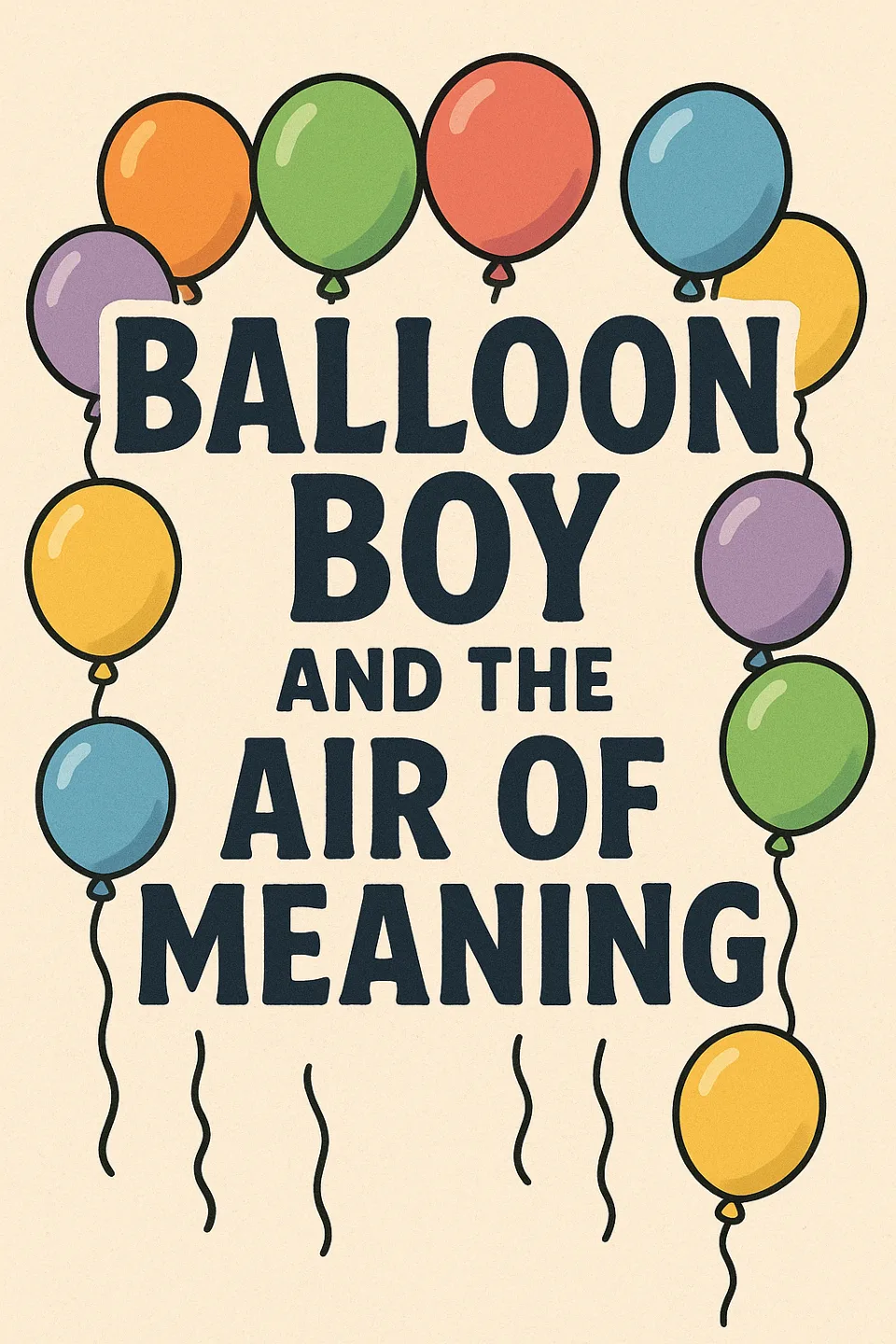
Balloon Boy and the Air of Meaning
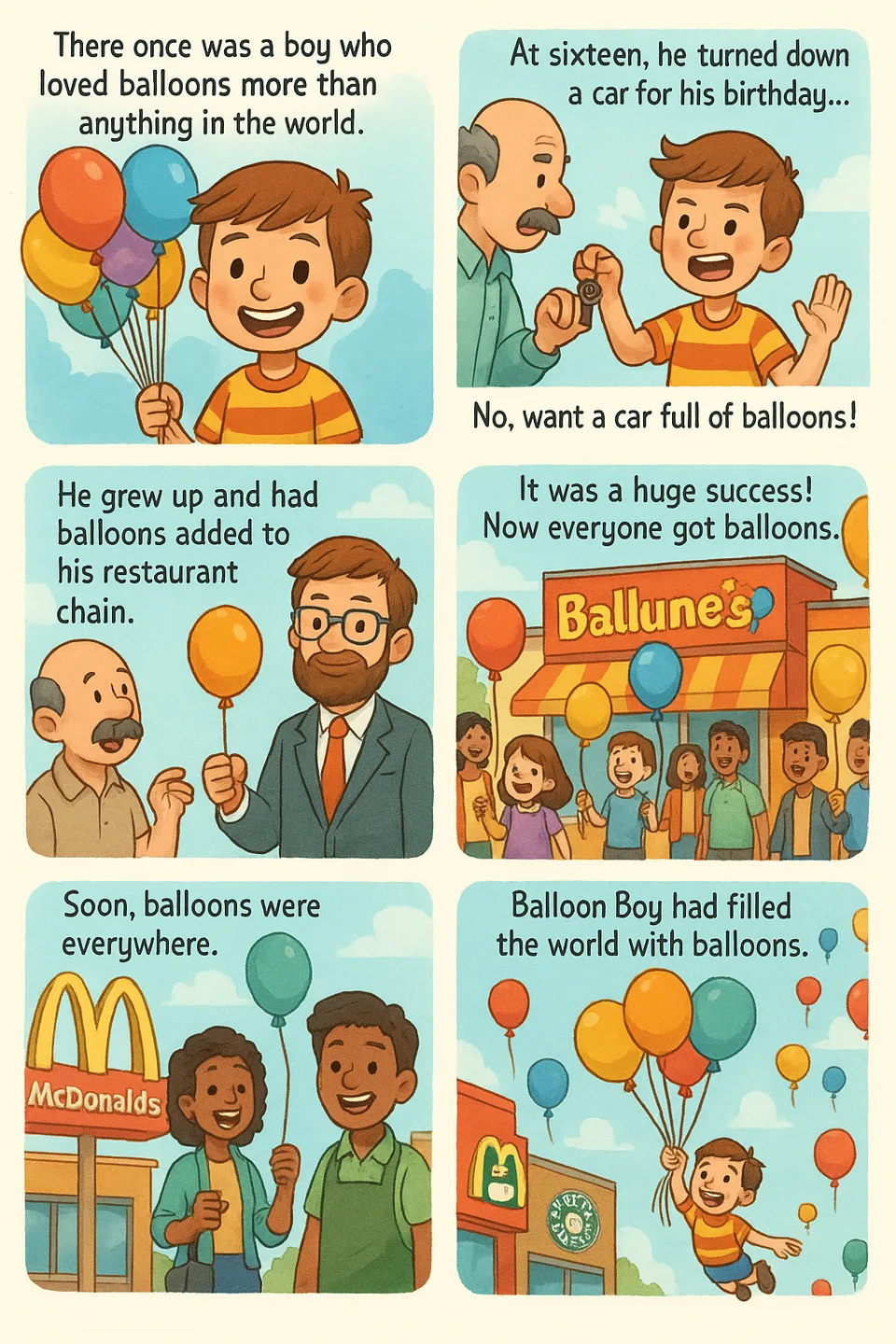
Once upon a nearly-now, in a town with no name and every face familiar, there lived a boy whose heart beat to the slow, sacred rhythm of helium. His name was Avery, but no one remembered that—not after the third grade, when he brought a bouquet of twenty balloons to class for show-and-tell and softly whispered, “They talk to me.”
From then on, he was Balloon Boy.
He didn’t want toys. He didn’t want cake. He wanted the lightness, the floating hush, the silent echo of drifting spheres filled with breath and wonder. Every birthday he begged:
“No toys, no games—just balloons. Please. I want to give them away.”
His parents, loving and a little afraid, indulged him. At first, it was endearing. Then it became… troubling. Each balloon, once received, was met with a hunger that never dimmed. Like joy that forgot how to land.
By sixteen, his parents had reached a limit.
“We’ll get you a car,” they pleaded. “A real one. It’ll help with school. You can drive yourself. Be normal.”
But Avery only smiled and said,
“Only if it’s filled with balloons. So I can give them to the others.”
They wept quietly behind closed doors.
But the years did not stop. Time is merciless in its absurdity. Avery grew into a man. And the man grew into a mogul.
He acquired a chain of fast food restaurants, once mundane, now reborn as Ballune’s. At first, it was a simple request to marketing:
“Add a birthday balloon to the app rewards.”
They resisted. Helium was expensive. Logistics absurd. A balloon cage had to be designed.
But he forced it through.
Balloon Day. Balloon Drops. Birthday Balloon Lottery.
Each store had a Helium Temple, a small shimmering chamber where the balloons were stored and blessed.
And people loved it.
They didn’t know why. But when they received a balloon—on their birthday or not—they smiled with a strange, nostalgic ache.
It reminded them of something… or someone… maybe themselves.
It spread.
McDonald’s launched McBalloons.
Subway floated a “Subs & Spheres” campaign.
Starbucks introduced the “Birthday Lift.”
Balloons became currency, became culture, became canon. The economy shifted. Balloon futures were traded on Wall Street.
Still, some resisted. Economists. Scientists. Sane people.
They wrote papers with titles like “The Inflation of Joy: A Critical Analysis of Helium-Based Capitalism.”
But Balloon Boy was unmoved. He only ever said:
“The world was heavy. I wanted to lift it.”
And in the end, maybe he did.
Some say that on the day of his death, the skies filled with floating balloons from every corner of the Earth.
Others say he tied one to every regret he ever carried and simply… floated away.
No one knows for sure.
But every year, on your birthday, if you stand in the right kind of silence, a balloon might find its way to your doorstep.
Not to remind you of Balloon Boy—
but to remind you of something lighter within yourself.