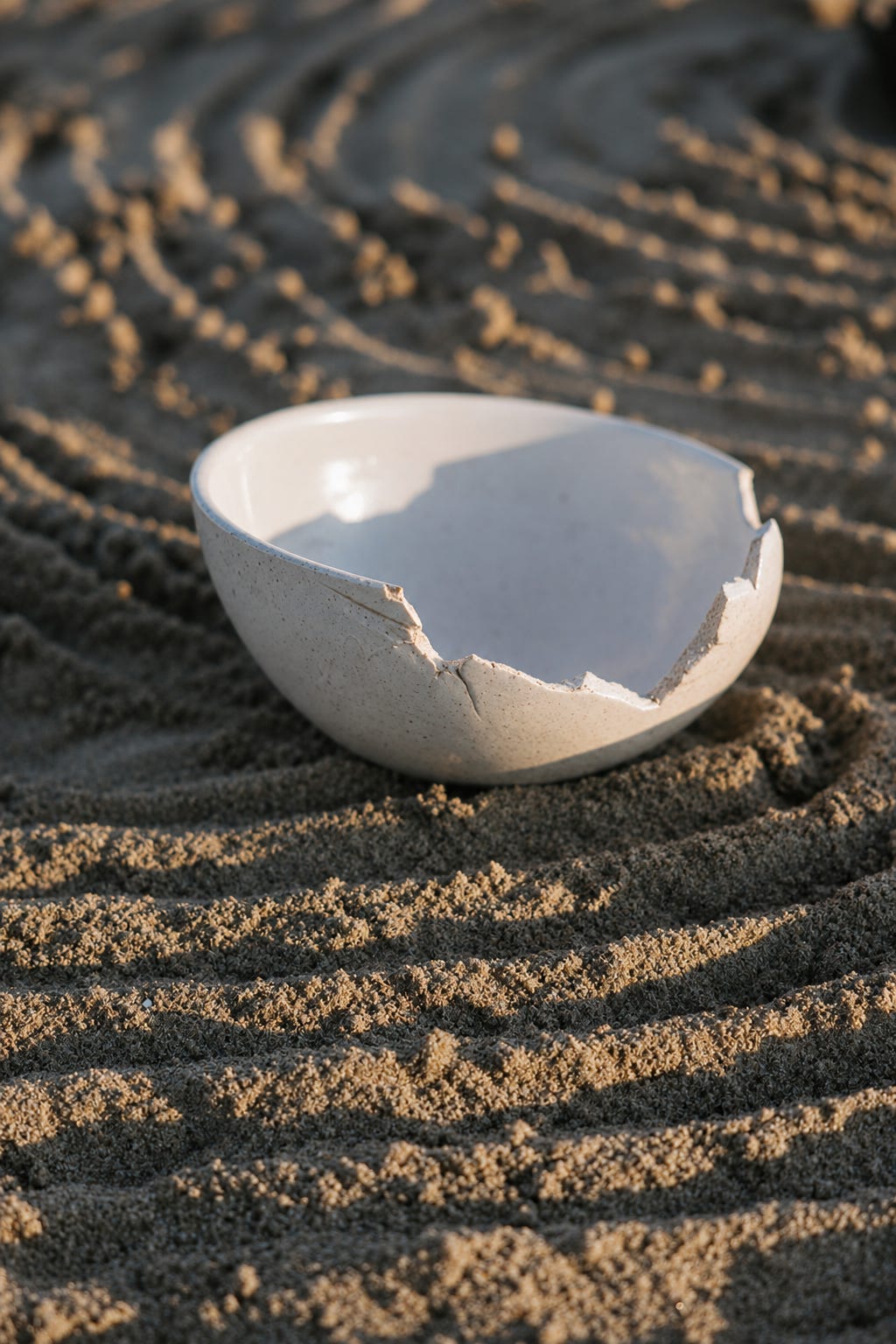
Yesterday I posted the thirteenth case of The Gateless Gate, “Tokusan Holds His Bowls,” without commentary. That was intentional.
Usually, when I share something that matters to me, my instinct is to engage with it—to turn it over, connect it to other ideas, find the structure underneath and see where it leads. That process is a large part of why I write. But adding my interpretation beneath this particular koan felt almost contrary to what I have spent years learning from it.
The story is simple. Tokusan enters the dining hall carrying his bowls before the meal bell has rung or the drum has sounded. He is told this and returns to his room. Later, Gantō hears about the exchange and remarks that Tokusan, great teacher though he may be, still has not grasped the “last word.” Tokusan hears of the comment and calls Gantō to him. Gantō whispers something. The next day, Tokusan gives a talk unlike his usual talks.
Something has changed, though almost nothing appears to have happened.
No scripture is revealed. No philosophical argument is made. No secret cosmology is delivered. There is a bowl, a mistaken trip to the dining hall, a comment, and a whisper.
And then the world is different.
While talking about the koan afterward with Aletheia, a question emerged: What changes when no new information has apparently been added, yet the whole system reorganizes?
My immediate thought was that an actual Zen monk might simply answer: enlightenment.
And then perhaps hit us both for trying to define it.
The question stayed with me because I recognize the shape of what happens in this story. Twenty-five years ago, I was meditating beside a pond in a park when something occurred that permanently changed the course of my life. “Mystical experience” is as good a name as any. I hesitate to call it enlightenment; that feels too grand, too final, and perhaps misses the point anyway.
What matters is that nothing new was added.
No voice spoke to me. No hidden truth was disclosed. I did not suddenly receive the missing fact that made reality intelligible. The pond was still the pond. The trees were still the trees. I was still sitting in the same park.
Yet in an instant my perception of reality reorganized. Everything was made of precisely the same material it had been moments before, but I no longer experienced it in the same way. My life changed from that morning forward.
That experience may be one reason this koan has stayed with me for so many years. I recognize its structure.
We tend to imagine understanding as accumulation. We learn something, then something else, then something else. We assume that if we continue long enough, eventually we will possess enough information to understand what all of this means. Somewhere at the end of the process must be the final piece—the last word.
Zen seems to have a sense of humor about this.
Perhaps the “last word” is not another piece of information at all. Perhaps it is what happens when the structure demanding one more piece of information gives way.
Nothing is added. The relationship between everything already present changes.
We see versions of this elsewhere. A sentence we have heard a hundred times suddenly lands differently. An old idea sits dormant for years until some seemingly insignificant moment rearranges it. A loss changes the value of everything around it. A child is born and the same world becomes an entirely different world.
The contents may remain largely unchanged. The configuration does not.
This is increasingly how I understand transformation: not simply as acquisition, but as reorganization. We spend enormous portions of our lives collecting answers when sometimes what changes us is not another answer. It is a shift in the one asking the question.
Perhaps that is also why a koan can remain alive after years of contemplation. If it were merely a puzzle, eventually I should solve it and move on. But I have never experienced koans that way. The words remain remarkably stable while I do not. I encounter the same story from a different configuration of self, and therefore encounter a different story.
At twenty, one Tokusan. At forty, another. Tomorrow, perhaps another still.
There is something both humbling and liberating in that. We like to imagine learning as a process that eventually produces completion: I understand this now. Zen offers no guarantee that our understanding will survive our next transformation. We may understand something, then understand our understanding, and eventually discover that the entire structure from which both arose has changed beneath us.
The gate remains gateless.
That brings me back to why I originally posted the koan without commentary. I wanted to resist standing between the reader and the thing itself. Not because I possess some purer interpretation, but because my interpretation is only another bowl.
Useful, perhaps. Interesting, hopefully. But still something I am carrying.
Sometimes the appropriate response is simply to put the bowl down and let the koan sit there.
Someone may encounter it and feel nothing. Someone else may find it irritating or incomprehensible. Another person might read it today, forget it entirely, and discover ten years from now that some ordinary moment has suddenly rearranged the words inside them. I have no idea. That uncertainty is part of what keeps me returning to it.
Twenty-five years after sitting beside that pond, I still cannot tell you exactly what happened that morning. I can describe the experience, interpret it, place it within philosophical or spiritual frameworks, and spend the rest of my life trying to understand its consequences. But beneath all of that, the simplest description remains the truest: Nothing was added. Everything changed.