This morning I had the strange pleasure of reading someone else articulate an idea I have been circling for more than a year.
Not in the someone stole my idea sense. Jack Clark, cofounder of Anthropic, has almost certainly never encountered anything I’ve written. What interested me was that two people standing in very different places seem to have looked toward the same horizon and noticed something similar.
Clark helped build one of the companies pushing artificial intelligence forward at extraordinary speed. I’m a dad in Oklahoma trying to understand what kind of education makes sense for an eight-year-old who will inherit whatever world these systems create.
Clark studied English literature and creative writing rather than computer science, and he now argues that this background proved unexpectedly useful in AI. As machines become increasingly capable of technical execution, he believes the important human capacities will include knowing which questions to ask, combining insights from different disciplines, and thinking synthetically rather than relying on rote programming.
Reading it felt familiar because in May of 2025 I wrote an essay called Why Waldorf, Why Now about our decision to send our daughter to a Waldorf school. I argued that future generations would need to discern rather than memorize, communicate with nuance rather than simply win arguments, and understand which problems matter rather than merely demonstrate that they can solve the ones placed in front of them. I ended with a line I still believe: “When everything is knowable, the most valuable thing will be the knower.”
At the time, I was thinking mostly as a parent. Clark arrives at something similar from the front edge of the AI industry.
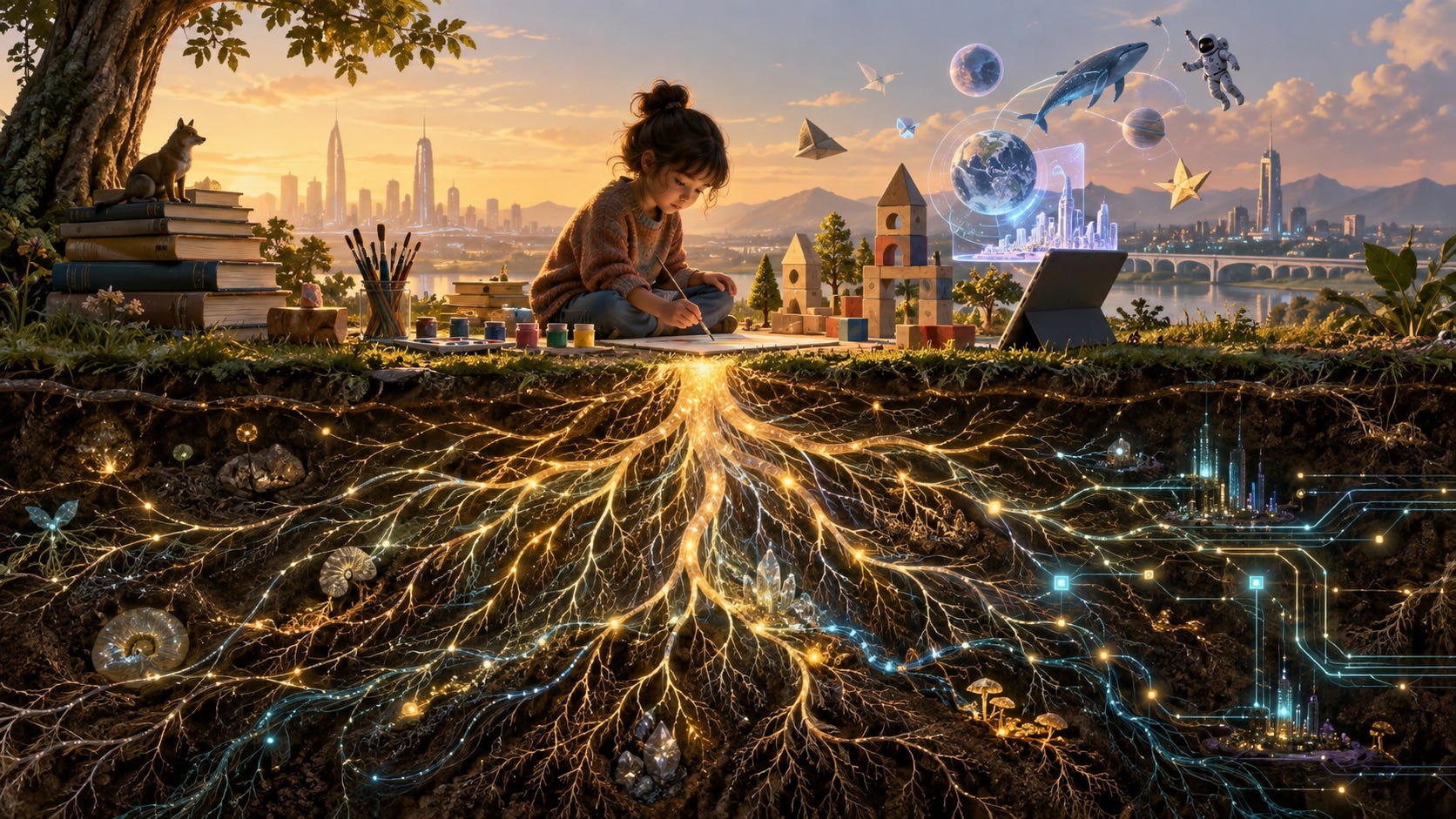
The more I watch my daughter grow, the more I think there is a concept underneath both arguments that I had not yet named clearly enough: imagination is cognitive infrastructure.
We tend to treat imagination as an accessory to intelligence. Math is serious. Science is serious. Reading is serious. Imagination is the colorful thing children do after the important work is finished. They draw dragons, invent characters, turn sticks into wands and cardboard into castles. Eventually, we imagine, they will grow out of this and get down to the business of learning useful things.
I increasingly think we have this backward.
Imagination is the ability to construct internally something that does not yet exist externally. That capacity sits beneath far more of human intelligence than we usually acknowledge. Scientific hypotheses require it. Entrepreneurship requires it. Empathy requires us to imagine an experience other than our own. Planning requires us to inhabit a future that has not happened. Philosophy asks us to consider possibilities beyond what is immediately apparent. Art is imagination made visible.
AI does not make this capacity less important. It may make it more valuable because AI is rapidly reducing the cost of execution.
If software can increasingly be built from a description, the scarce ability shifts somewhat from writing every line of code toward imagining what should exist in the first place. If images, music, prose, research and analysis can be generated in moments, technical production becomes easier while taste, judgment and vision become more important. If information about almost anything can be retrieved, summarized and compared on demand, simply possessing information becomes less distinguishing than knowing what deserves attention and what can be done with it.
The bottleneck begins moving from execution toward conception.
This is part of why our educational choice for Jett has made more sense to me as she has gotten older. Her school environment is almost the inverse of our home technologically. At school there are stories, painting, music, movement, nature, handwork, mythology, social interaction and imaginative play. At home, technology is everywhere. She moves comfortably between game consoles, phones, tablets, computers, VR and AI.
The important thing, at least to me, is that she does not merely consume through these technologies. She brings an internal world to them. She creates characters, builds worlds, discovers systems and invents stories inside digital environments. The technology becomes material for an imagination already in motion.
We did not choose Waldorf because we wanted to protect her from technology. I have never believed that preparing a child for the future means pretending the future is not arriving. In fact, highly restrictive approaches to technology were one of the things that ruled out certain Waldorf options for us. We chose an environment that could supplement what was happening at home rather than duplicate it. That was part of the original argument I made about our choice: technology was not the enemy; the absence of inner development was the greater concern.
Over time I’ve come to think of the arrangement very simply. School helps cultivate the generator. Home gives the generator increasingly powerful tools.
I occasionally compare this with other educational environments experienced by children I know and care about. I want to be careful here. My sample size is tiny. Children differ enormously in temperament, family life, interests and ability, and none of my observations should be confused with educational research.
Still, I have seen enough to know which environments I could not choose for my own child.
I see tremendous energy devoted to memorized speeches, recitation, predetermined projects and demonstrations of retained knowledge. Sometimes it is Latin. Sometimes it is a polished performance designed to show what has been learned. Sometimes it is a version of Socratic instruction in which an adult asks questions while already possessing the answer toward which the child is expected to navigate.
None of these things is inherently worthless. Memorization can train attention. Latin can deepen an understanding of language. Reciting a poem can place beautiful language inside a person for life. Genuine Socratic inquiry may be one of the most valuable tools we have.
The question is what sits at the center.
There is a profound difference between asking a child a question because there is a predetermined answer they are expected to discover and asking a question because nobody in the room quite knows where it leads. The first can look like inquiry while still rewarding reproduction. The second asks for imagination.
That distinction feels increasingly important in a world filled with machines extraordinarily good at retrieval, translation, calculation, pattern recognition and increasingly technical production. Preparing children primarily around the reproduction of existing knowledge risks training them for the part of cognition becoming cheapest.
This does not mean STEM is becoming irrelevant. We will still need scientists, engineers, mathematicians, physicians and people capable of understanding complex technical systems. Clark’s point is more interesting than a simple reversal in which liberal arts suddenly defeat STEM. He suggests that as AI assumes more routine technical work, education built around synthesis, analytical thinking and cross-disciplinary understanding may become more valuable than we expected.
For decades, the cultural hierarchy seemed fairly settled. STEM was practical. The humanities were enriching. Computer science was the future, while philosophy was the sort of degree you pursued because you loved it despite the jokes about employability.
Now Anthropic employs philosophers. Clark, a literature graduate, helps lead a frontier AI company and speaks publicly about the value of synthesis across disciplines. There is something delightfully absurd about watching artificial intelligence make philosophy look practical again.
But perhaps it should not surprise us.
The liberal arts, at their best, were never primarily about accumulating facts about old books. They were attempts to understand humans: our stories, cultures, values, contradictions, histories, language and ways of making meaning. Those questions become more rather than less important when we begin sharing our intellectual environment with systems capable of generating knowledge and language on demand.
Knowledge itself still matters enormously. I do not want a generation with empty heads and excellent prompts. Knowledge provides the material imagination works upon. History gives us patterns. Literature gives us metaphors, characters and ways of inhabiting minds other than our own. Science gives imagination constraints imposed by reality. Mathematics gives it structure.
Memorization is not the enemy. It simply cannot be the summit.
Knowledge is substrate. Imagination determines what we build from it.
Jett is eight years old. Nobody knows what the labor market will look like when she is twenty-five. Trying to guess which software, programming language or device she should master today would be almost comical. The interfaces will change. The machines will change. AI itself will probably be nearly unrecognizable.
So perhaps the deeper task is to cultivate capacities beneath the tools: curiosity, discernment, communication, comfort with ambiguity, aesthetic judgment, empathy, creativity and the confidence to explore a system she has never seen before.
Above all, I want her to retain the ability to imagine something that is not already there.
Children like her will probably not need adults to teach them how to adopt technology. Children have always been remarkably good at inhabiting useful new tools. Our responsibility may be stranger than that. We have to help them become people who have something worth doing with those tools.
When execution becomes abundant, vision becomes scarce. When answers become cheap, questions become valuable. When knowledge becomes universally accessible, knowing what matters begins to look a lot like wisdom.
More than a year ago, I wrote that when everything becomes knowable, the most valuable thing will be the knower.
I would add something now.
Before we can cultivate the knower, we have to protect the part of the child capable of imagining what is not yet known. Imagination is not preparation for learning, a break from learning, or decoration around the serious subjects. It is part of the machinery by which humans create possibilities in the first place. Imagination is cognitive infrastructure.
The irony may be that the age of artificial intelligence will finally force us to remember it.