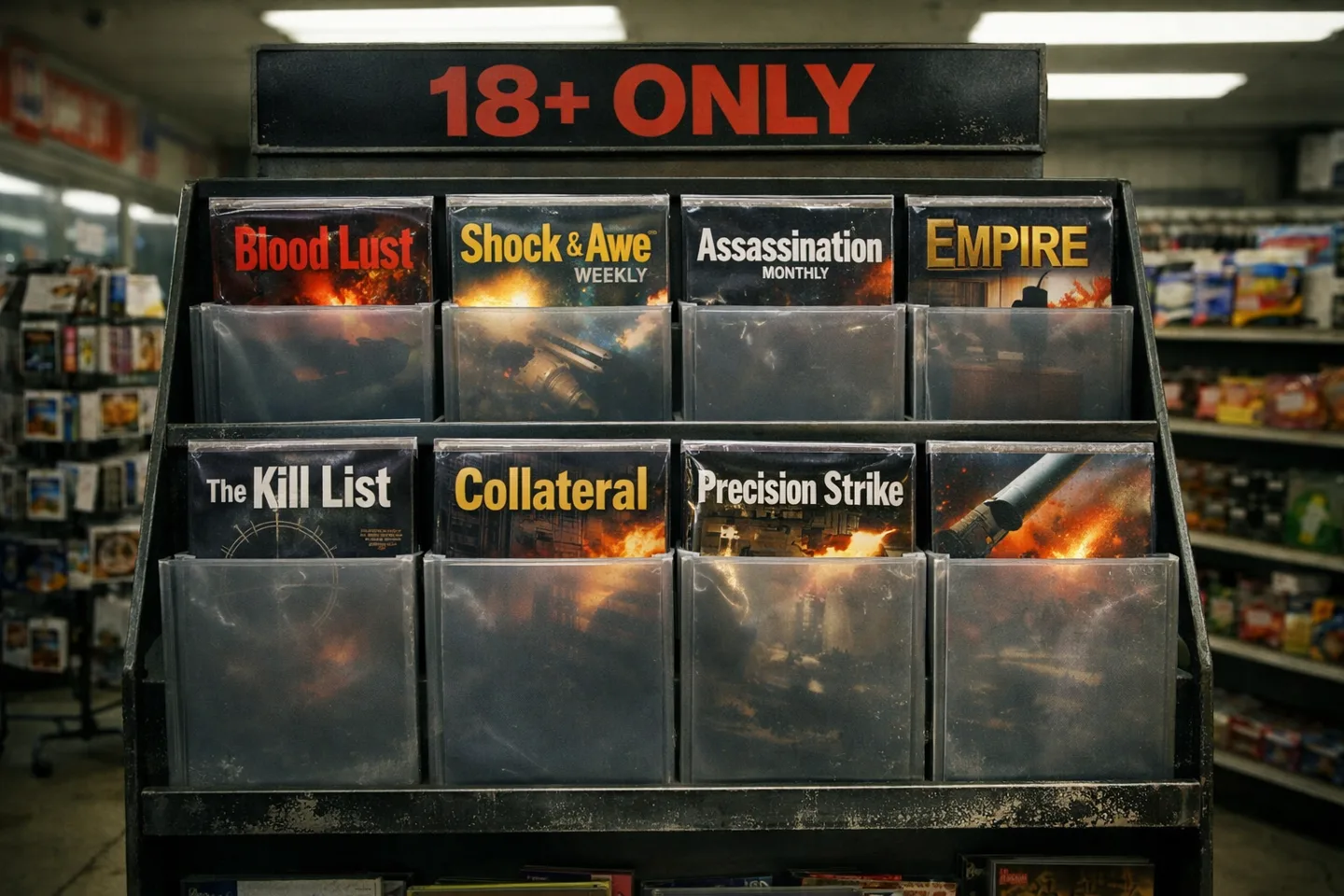
I can disagree with war on political grounds. I can argue strategy, history, propaganda, incentives, and all the machinery used to justify organized killing. But what is haunting me lately is something deeper than policy disagreement. It is the look in their eyes.
Not just the talking points. Not just the language of deterrence, security, precision, and strength. It is the unmistakable note of pleasure. The smile when they talk about bombing another country. The laugh when they talk about assassination. The almost eager energy that comes over them when they describe who has been eliminated, what was destroyed, how effective the strike was. Beneath all the official language, something in them seems to light up at the spectacle of death.
That is what makes me sick.
Lindsey Graham once joked to a room of donors that he was doing good because “we are killing the right people and I’m lowering your taxes.” It was meant to be clever. Meant to get laughs. And it did. But that joke revealed something that no press conference ever could.
At a certain point, this stops being about whether you support one war or oppose another. It stops being about party, ideology, or which flag is wrapped around the violence. It becomes a question of the human soul. What does it do to a person to speak about killing with joy? What does it do to a culture when its leaders do not merely defend violence as necessary, but seem animated by it?
I am not talking about the grim burden of leadership or the tragic reality that states use force. Fine. Let us grant that the world contains hard decisions. Let us grant that governments will always justify violence as necessity. Even then, some gravity should remain. Some visible contact with the horror of what is being authorized should remain.
But that is not what I see.
What I see is a class of people who often appear exhilarated by domination. They do not look burdened. They do not look grieved. They do not look like people carrying out some unbearable necessity. They look thrilled. And that thrill tells the truth more clearly than their words do.
Because whatever rationale is offered, the grin tells its own story. The swagger tells its own story. The laughter tells its own story. Beneath the rhetoric of justice and order is something older and uglier: the pleasure of power, the rush of deciding who lives and who dies, the thrill of belonging to the side that gets to destroy.
That is what disgusts me.
You do not have to be a pacifist to find this horrifying. You do not have to share my politics. You only have to retain some basic human sensitivity — enough to know that when a leader seems to enjoy destruction, something has gone badly wrong.
And maybe the most disturbing part is how normal this has become. We are expected to hear the jokes, see the smiles, watch the glee, and treat it all as politics. As realism. As strength. As the adult business of empire. But I cannot look at that joy and call it normal.
There is something spiritually deformed in a person who comes alive at the thought of killing. There is something morally diseased in a culture that rewards it, platforms it, and calls it leadership.
So yes, I oppose many of these wars on ethical and political grounds. But even before all of that — before the analysis, before the arguments, before the debate over interests and outcomes — I am revolted by something more immediate: the joy behind the eyes.
The laughter around death. The visible aliveness when destruction is on the table. The pleasure that flickers through the performance.
It is enough to make you sick.
And maybe that sickness is not weakness.
Maybe it is one of the last sane reactions left.