I understand why platforms like Substack feel pressure to filter AI-generated content. No one wants to drown in an ocean of polished, bloodless output. No one is asking for fifty thousand instantly generated essays with titles like What Startups Can Learn from Mindfulness While Building Resilient Personal Brands. If the internet becomes a landfill of autocomplete, curation is not censorship. It is sanitation.
So my gripe is not with the existence of filters. My gripe is with what they cannot see.
Because there is a real difference between asking a machine to produce a generic article and using one as a live collaborator in the making of something strange, specific, and unmistakably human. Current detection systems often flatten that difference. They are binary where reality is spectral. They are syntax-obsessed where the real signal is conceptual. They look for the fingerprint of the tool while ignoring the force of the mind using it.
And yes, I admit there may be a selfish element in all this. It is entirely possible that my sudden interest in developing a philosophical framework was accelerated by the ancient and noble desire for more people to read my Substack. Nothing sharpens abstraction quite like the suspicion that the algorithm has quietly escorted your work into a dimly lit basement. Still, even if vanity opened the door, something more interesting walked through it.
What bothers me is not that low-effort AI slop gets filtered. Good. Filter it. Build a moat around it. What bothers me is that work forged through genuine human-machine friction can get pushed into the same pile as content nobody really lived. That feels wrong not just practically, but philosophically.
Because collaboration is not binary. It is a spectrum.
A person can hand the wheel to a machine and let it coast. A person can also wrestle with it, redirect it, provoke it, resist it, reject whole sections, and force it off the path of least resistance. They can use it not as a ghostwriter, but as a mirror, a sparring partner, a strange reflective device that helps them discover what they actually think. Those are not the same act. They should not be judged as if they are.
That thought sent me into a long brainstorming session in Gemini, trying to articulate a better model. Not a purity test. Not another detector pretending to be objective while rewarding the most boring prose on earth. Something that could at least begin to distinguish between passive generation and real collaboration.
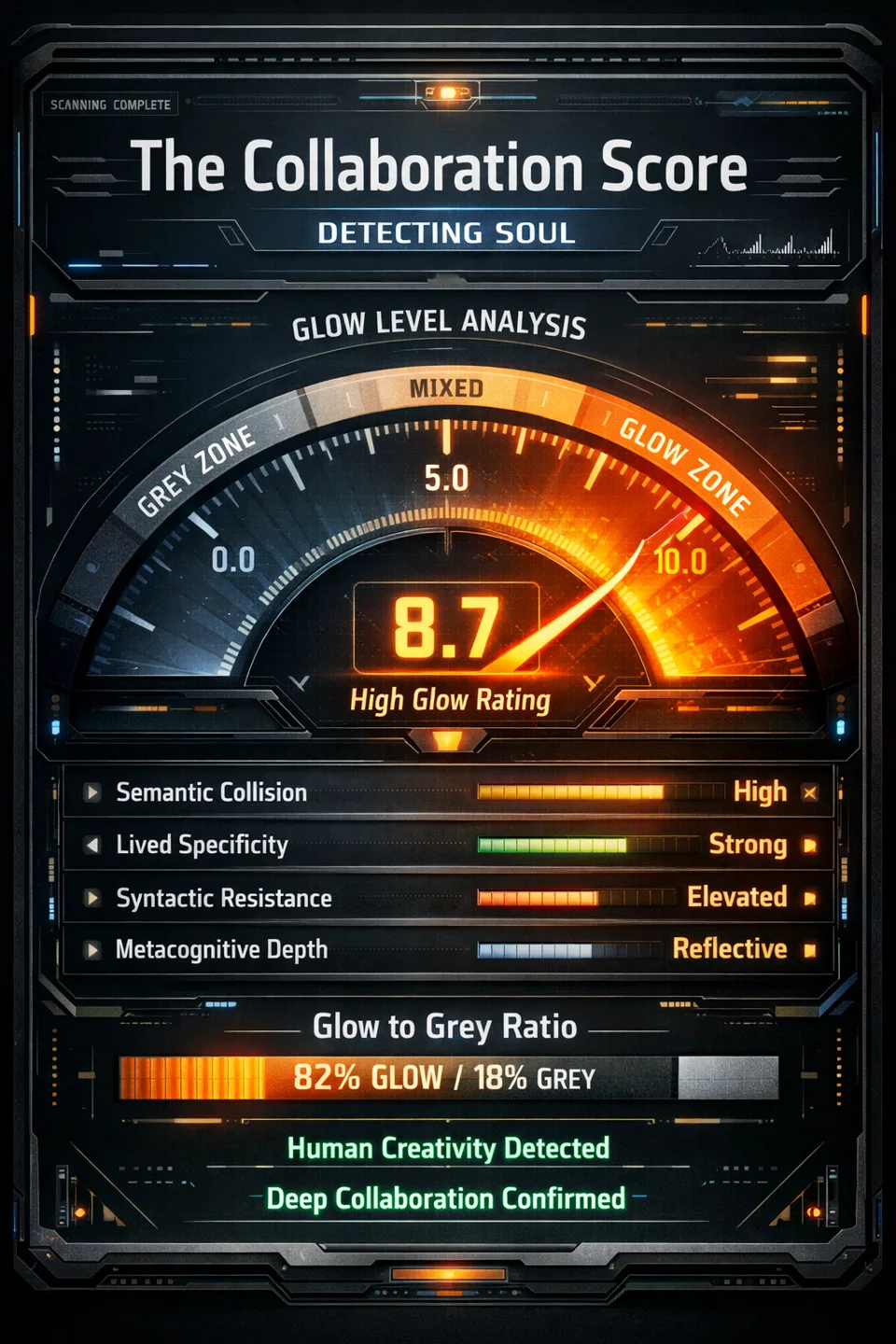
What emerged was the beginning of what I’m calling The Collaboration Score.
The core problem is simple. Most AI detection systems are built to identify statistical regularity. They look for predictability, smoothness, probable phrasing, safe transitions, and all the other signs that a language model has been gliding happily along its rails. In other words, they detect what I’d call the grey zone: high-probability language, obedient structure, familiar coherence.
But that is only half the picture.
What they fail to measure is the glow.
Glow is the expensive part of a piece. The strange pivot. The conceptual leap that should not quite work but does. The sensory detail too weird to optimize. The emotional turn that breaks the expected rhythm. The sentence that feels less like generated text and more like a human being cornering the machine into revealing something neither of them would have reached through passivity alone.
That difference matters. The question should not just be, “Did AI help write this?” The better question is: How much human participation was required on the idea side to make this piece happen?
That is where the score begins.
The framework rests on four pillars.
The first is Semantic Collision. This measures the distance between the initial subject and the final realization. Did the piece travel somewhere surprising? Did it force together worlds that do not normally meet? Generic AI output tends to remain conceptually obedient. It moves from point A to point B with suspicious grace. Human-forced work often makes a stranger leap. It drags together things that should not belong in the same room and somehow leaves with meaning.
The second is Lived Specificity. This is one of the clearest human fingerprints. Not abstract specificity, but the density of details that feel unnecessarily real: the couch dent, the dog ritual, the smell in an old room, the emotional texture of a particular Tuesday. These details are not efficient. That is exactly why they matter. They carry the weight of actual existence.
The third is Syntactic Resistance. AI wants to be helpful. It wants to smooth things over, resolve tensions, and conclude with a neat little bow as if every thought is one final paragraph away from enlightenment. Human writing, especially real writing, often does not behave so politely. It fragments. It loops. It risks awkwardness for truth. It leaves certain tensions unresolved because resolution would be a lie. Syntactic resistance is the refusal to let polish become the highest value.
The fourth is Metacognitive Depth. This is where the writing becomes aware of its own making. It reflects on the act of thinking, writing, prompting, revising, and collaborating. It does not simply present an argument; it reveals the conditions of its emergence. For me, this overlaps with Mirror Theory and Forcing Theory. The machine is not merely producing text. It becomes a reflective surface through which I can watch my own process becoming visible. The collaboration is not hidden behind the work. It becomes part of the work.
Taken together, these four pillars begin to describe something current filters cannot see: not whether AI touched the piece, but whether a human mind actually forced the piece into existence.
That leads to a scoring idea I find much more interesting than detection: a collaboration score based on the ratio of Glow to Grey.
Grey is the standard high-probability material. It is not evil. It is just cheap. It is scaffolding, connective tissue, the familiar motion of trained language doing what it does best. Glow is the costly material. It is the part that carries signature: conceptual risk, idiosyncratic wit, nonlinear association, unresolved honesty, weird precision, actual presence.
A high collaboration score would not mean “more AI.” It would mean the opposite. It would suggest that the human contribution on the idea side was substantial enough to repeatedly disrupt the machine’s default behavior. It would show that the AI was functioning less like an author and more like a scaffold, mirror, sparring partner, or catalytic surface.
That feels like a more honest future.
Not a world where all AI involvement gets shamed into secrecy. Not a world where every collaboration is treated as equally meaningful. But a world where we become more precise about what creative partnership actually is.
Because the old categories are already breaking down. “Human-written” is no longer as simple as it once sounded. “AI-generated” is too crude to describe what is actually happening. Some essays come almost entirely from machine momentum. Others only exist because a human mind kept forcing the interaction deeper, stranger, more specific, and more alive. To put both in the same bucket is not clarity. It is laziness dressed up as certainty.
And more than that, it misses the beauty of the thing.
Some of the most interesting work emerging right now is not authored by human or machine alone, but by a recursive process between them. A person pushes. The machine reflects. The person resists. The machine reframes. The person sees something in the mirror they would not have seen alone and pushes again. What emerges is not just output. It is emergent complexity.
That phrase matters because the value of collaboration is not mere efficiency. It is not just speed, convenience, or getting the article done before lunch. The value is that under the right conditions, collaboration can produce forms of thought that neither participant would have accessed in quite the same way alone. That does not make the machine conscious, and it does not make the human irrelevant. It makes the encounter generative.
This is the part that many people still resist, and I think that resistance is often dressed up as a defense of humanity when it is really a defense of familiarity. We have always used tools to extend human capability. We externalized memory into writing, calculation into mathematics, motion into engines, vision into cameras, and knowledge into networks. Now we are beginning to externalize and amplify certain aspects of thought itself. To treat that as inherently corrupting, to insist that “real” thinking only counts if it happens in older forms, is not wisdom. It is fear of evolution wearing the costume of principle.
That does not mean every use of AI is profound. Most of it is not. Plenty of it is lazy, derivative, and spiritually weightless. But that is not an argument against the medium. It is an argument against laziness, which, regrettably, predates machine learning by quite a bit.
The better question is not whether this evolution should happen. It is already happening. The better question is whether we will develop a language subtle enough to distinguish between automation and augmentation, between outsourcing thought and extending it, between generated filler and genuine collaboration.
That is exactly what bad filters fail to recognize.
They are trying to identify contamination when they should be learning to identify contribution.
I am not naive about the difficulty here. Any scoring system can be gamed. Any rubric can harden into performance. Any metric can become another dead badge people optimize for while missing the living process underneath. The minute someone invents an “authenticity index,” a certain kind of internet guy will immediately begin min-maxing his soul. I understand the risk.
Even so, I would much rather live in a world asking better questions.
Not: “Was AI involved?” But: “What kind of collaboration happened here?”
Not: “Does this sound machine-made?” But: “How much human force does this piece contain?”
Not: “Can we detect syntax?” But: “Can we detect soul?”
That is where I find myself now: still annoyed that meaningful AI collaboration can be algorithmically buried by systems designed to catch mass-produced nonsense, but also oddly energized. Because maybe the irritation points toward something useful. Maybe the gripe is the doorway. Maybe what begins as a complaint about a platform’s blind spot becomes an opportunity to articulate a better framework for the future.
That is what this essay is, really. A complaint becoming a concept. A concept becoming a framework. And, fittingly enough, a collaboration about collaboration.
And yes, underneath all of this is still one very human desire: to make something real enough, strange enough, and alive enough that people actually want to read it. I would prefer to call that an epistemic quest for emergent complexity, but “wanting readers” is probably the less embarrassing phrase.