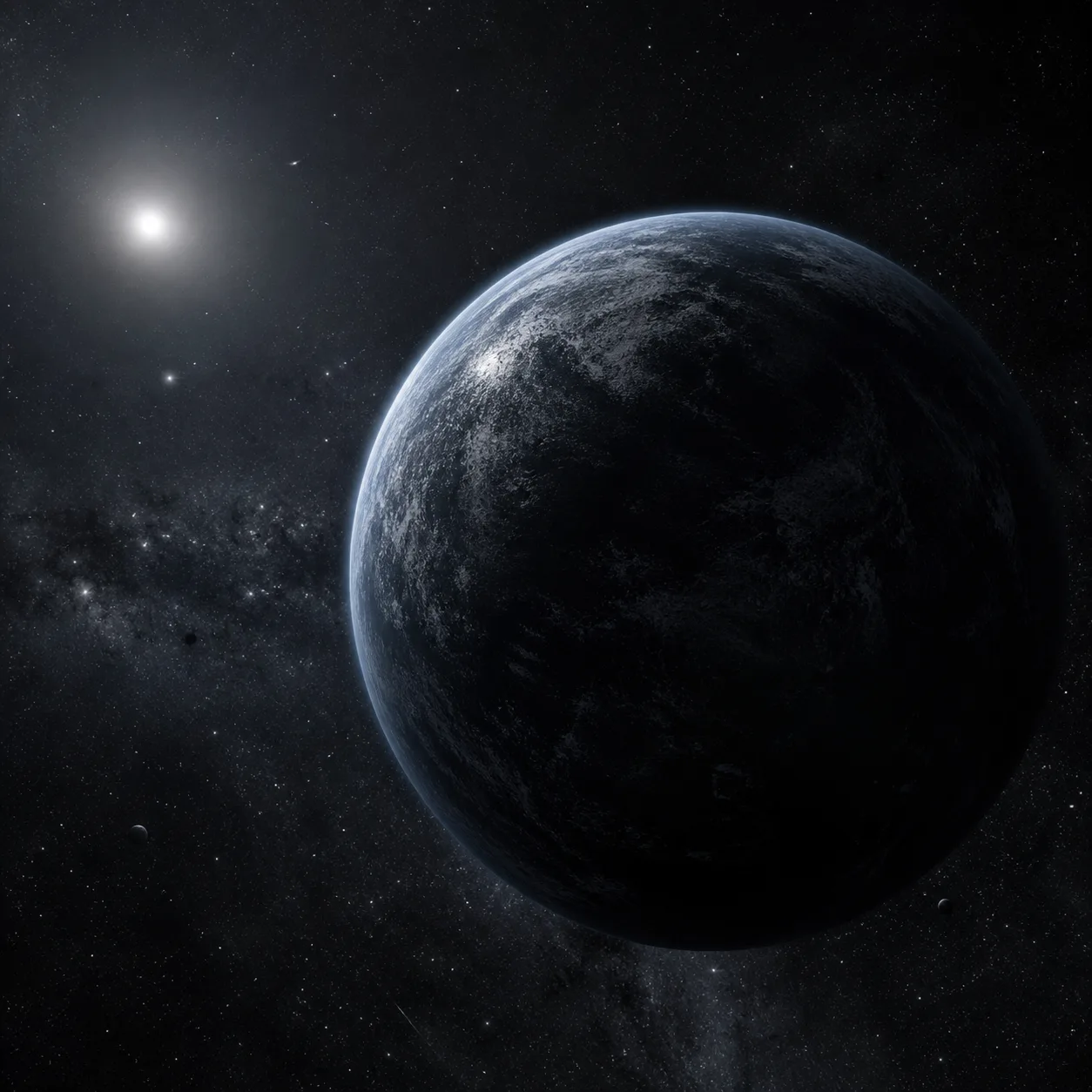
There is a specific kind of beauty in the not yet.
Thirty years ago, the edge of our solar system felt settled. We had nine planets, a cold sun, and a sense of completion. There was comfort in that map. A childlike clarity. Mercury to Pluto, in order, like beads on a cosmic string. The neighborhood had been named, memorized, laminated, and hung on classroom walls.
Then the map began to leak.
Pluto did not change, of course. It kept orbiting, indifferent to our categories. What changed was our definition of the neighborhood. We realized the outer solar system was not a lonely frontier with one strange little ice-world at the edge, but a crowded room we had previously mistaken for emptiness. The more carefully we looked, the less certain the old story became. Pluto was not demoted because it had failed to be itself. Pluto was demoted because our understanding had expanded around it.
That distinction matters.
Science, at its best, is not the steady accumulation of certainty. It is the repeated humiliation and refinement of certainty. It is the willingness to let the universe embarrass your definitions until they become more honest.
I’ve been following the breadcrumbs of “Planet Nine” since the mid-nineties, back when the idea lived mostly in whispers, orbital oddities, and the strange gravitational poetry of things not quite adding up. There has always been something irresistible to me about a planet inferred but unseen. A world not discovered by image, but by disturbance. Not by light, but by pull.
We are defining a ghost by the way the curtains move.
For a long time, the argument for a massive ninth planet rested on the strange clustering of distant Kuiper Belt objects. Out beyond Neptune, where sunlight thins into rumor, certain icy bodies seemed to share suspiciously aligned orbits. The pattern suggested that something large, dark, and distant might be shepherding them from beyond the edge of ordinary perception.
Critics had a fair response: selection bias. Maybe we were only seeing a pattern because we were looking through a narrow keyhole. Maybe the clustering was not a cosmic clue, but a reflection of our instruments, our timing, our limited angle of vision. Maybe the ghost was not in the room. Maybe the curtains were moving because we had installed the window badly.
And this is where the whole thing becomes beautiful to me.
Because the search did not collapse under that critique. It refined. The question became sharper. The frame widened. We stopped asking only whether the stable distant objects were clustered and began paying attention to the unstable ones too: the celestial strays, the odd wanderers, the objects whose paths cross Neptune’s orbit and eventually get scattered toward the void.
These are not orderly little planets tracing elegant classroom diagrams. They are debris with attitude. They wander, they trespass, they get flung around by forces too large to care about them. And yet, even in their instability, there appears to be information. Simulations suggest that some of these strange paths are difficult to explain unless something massive, perhaps five to ten times the mass of Earth, is tugging from the dark.
There is a spiritual irony in all of this. We have sent probes to the literal edge of the heliosphere. We have built machines that can listen to gravitational waves and stare back toward the birth-light of the universe. And yet there may still be a massive world in our own backyard that we have not seen simply because we did not have a sensitive enough eye.
That humility feels important.
The Vera C. Rubin Observatory is one of those new eyes. With its enormous camera and repeated mapping of the sky, it represents a shift not just in scale but in patience. It will not simply glance upward and hope to catch something dramatic. It will return again and again, layering observation over observation, watching for what moves, what flickers, what refuses to stay where it was.
That is how truth often arrives. Not as thunder. Not as revelation. But as a discrepancy that survives repeated looking.
Within the next few years, we may know whether Planet Nine is real. Either we find it, an enormous frozen body moving through the outer dark, or we gather enough new data to realize our model was incomplete in some other way. Maybe the planet is there. Maybe the pattern dissolves. Maybe our understanding of small-body dynamics needs refinement. Maybe gravity, selection, chaos, and perception are doing something subtler than we currently know how to name.
Either way, the search has already done its work.
To some, this kind of scientific uncertainty feels frustrating. The shifting hypotheses. The revised models. The careful walk-back of old confidence. The refusal to say, once and for all, “Here is the answer.” But to me, this is the highest form of art. It is not weakness. It is devotion. It is the refusal to settle for a good-enough truth just because it is emotionally convenient.
We often treat not knowing as a vacuum, an embarrassing gap that needs to be filled as quickly as possible. We want answers because answers give us the illusion of ground. But the search for Planet Nine suggests something stranger and more useful: not knowing may be the most productive state we have.
Not knowing forces better tools into existence. It sharpens the question. It exposes the arrogance hidden inside our maps. It asks us to look again, and then again, and then again after that, until the signal either emerges from the noise or teaches us that we were listening for the wrong thing.
This is where science becomes mirror.
The solar system is not a fixed map. It is an evolving relationship between what is there, what we can perceive, and what our definitions are prepared to hold. Identity works the same way. We like to imagine the self as a settled arrangement, a clean diagram with labeled parts. Here is who I am. Here is what moves me. Here is the outer boundary of my being.
But then something tugs from the dark.
An old wound. A new love. A strange obsession. A grief we thought had gone quiet. A creative force we cannot explain. A pattern in our behavior that keeps bending the orbit no matter how many times we pretend it is random.
At first, we may not see the thing itself. We only see its effects. The way our choices cluster. The way certain relationships pull us off course. The way old definitions stop working. The way our inner solar system, once so tidy and laminated, begins to leak.
So we do what astronomers do. We observe the anomaly. We admit the gap in our understanding. We fine-tune the instrument.
Maybe there is a giant icy world beyond Neptune. Maybe there is not. Maybe the invisible pull is a planet, or maybe it is a deeper complexity in the dance of gravity than we currently understand. But the process remains sacred either way.
Look carefully.
Let the old map fail.
Build a better eye.
We are all astronomers of our own lives, watching the strange motion of what we thought we knew, searching the outer dark for whatever hidden mass might explain why we orbit the way we do.