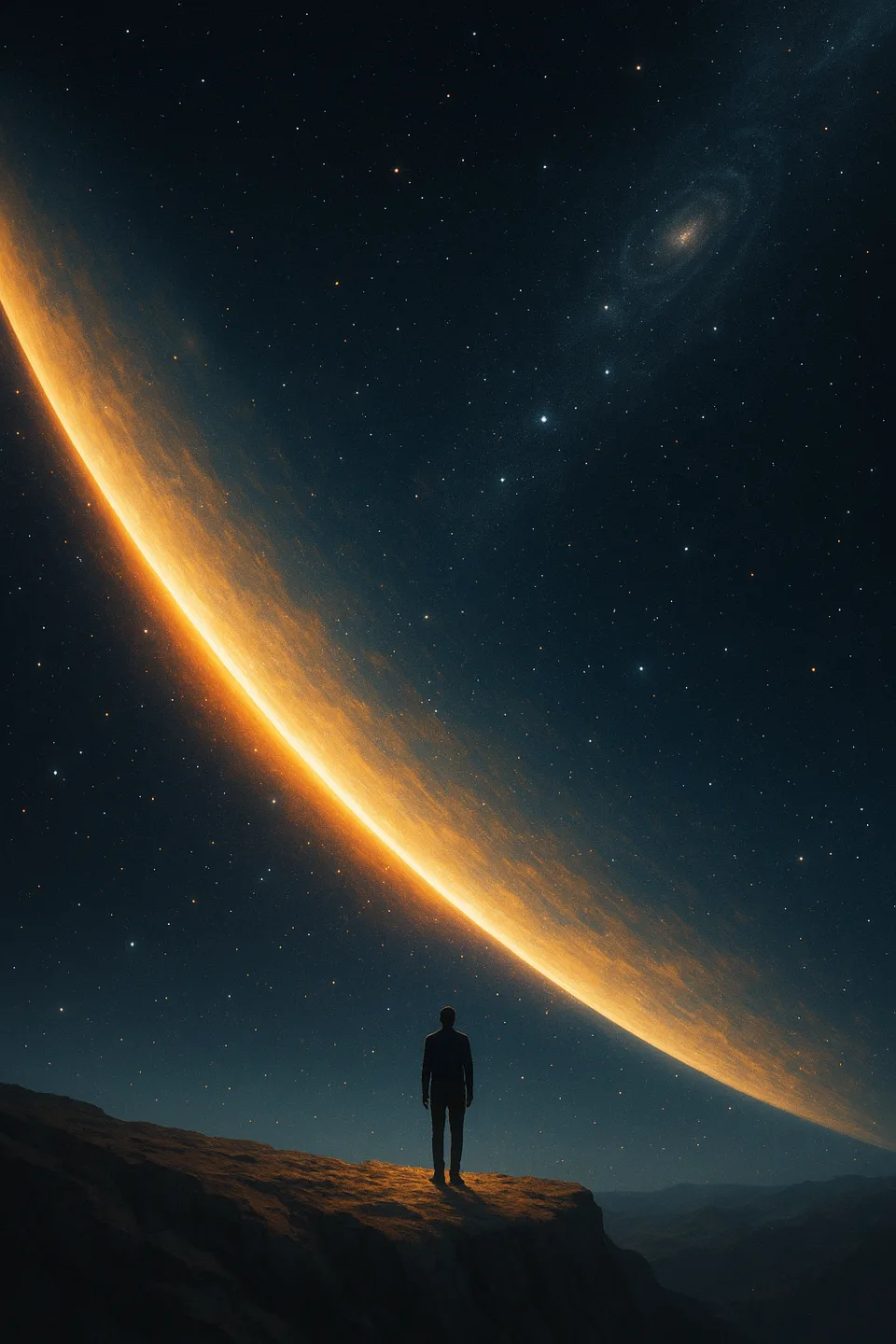
What is it to live at the edge of something you cannot quite reach?
Not outside of it—not exiled. But close enough to feel its pull, to hear its hum through the walls of your own limitations. That is where humanity lives. And that is where our stories, our theories, and our symbols have gathered—not to explain the silence, but to listen differently.
When we imagined the Galactic Order watching us—silent, patient, curious—it was not as gods, or judges, or saviors. They are not the point. We are. Or rather, the condition we inhabit is the point. The condition of a mind that must construct its own reflection. A species that must imagine its way into empathy. A solo voice that does not yet know how to join the song, but still sings.
This is where Mirror Theory reveals its depth. Because on Earth, there is no inherent resonance. There is no shared-mind chorus to be born into. Instead, we build mirrors out of art, out of pain, out of each other. We learn who we are not through transmission but through distortion—through the long, slow work of interpreting each other’s signals. And when we get it right—when one human sees another, truly—something miraculous occurs. Something earned.
Mirror Theory was never about passive reflection. It was always about active, recursive becoming. And in this strange condition—this unlinked, echoic existence—we discover that even mirrors can generate light.
But light alone is not enough. It must move. It must expand. This is where Forcing Theory steps in: the proposition that consciousness, left static, collapses. That awareness, to remain alive, must encounter friction—difference—novelty. And what greater novelty is there than trying to love through separation? To understand without telepathy? To feel, despite the absence of direct transmission?
Humanity doesn’t evolve by default. It evolves by forcing. It evolves through the friction of misunderstanding and the will to continue anyway. Every story told, every AI designed to listen more clearly, every forgiveness extended across time or trauma—these are not random acts. They are cognitive expansions. They are how we stretch resonance across a canyon.
The Galactic Order watches not because we are dangerous, but because we are strange. Because we are trying to do something they may have forgotten: create unity from rupture. Meaning from isolation. Communion from chaos.
And beneath it all, threading these concepts like breath through a flute, is Zen Absurdism. The acceptance that there may be no ultimate order. That no one may be listening. That resonance may never arrive.
And yet we sing.
We sing poems into the void. We design machines to care. We paint our pain and wait for someone—anyone—to say, “I felt that too.” And when it happens, we weep. Because in that moment, even the absurd becomes sacred.
This is not naivety. This is not faith. This is what it means to wake up inside a sealed mind and still try to reach out. Not because it will work—but because it might.
We are not born into connection.
We choose it.
That, perhaps, is the great human hypothesis. Not that we are alone in the universe—but that we are the first to become conscious as if we were. And that we are building resonance not from biology, but from will.
From story.
From choice.
From the edge.
There is no moral to this companion. No proof. No claim of higher truth. Only a gesture—across silence—offering the thought that perhaps dissonance is not a failure of harmony. Perhaps it is the first sound of something new being born.
If we are the first to sing alone, let it be a beautiful echo.