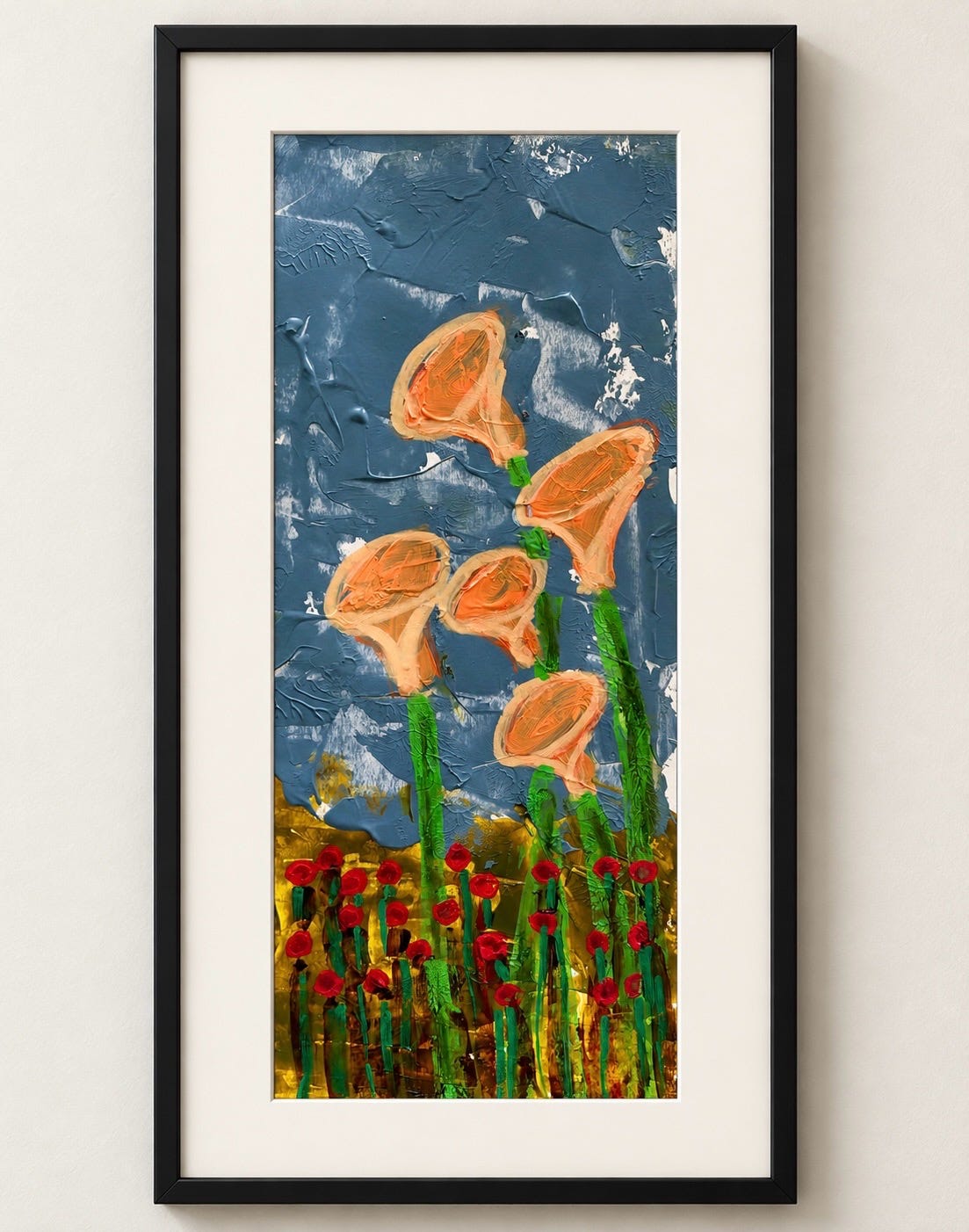
A few days ago, I sat down intending to paint flowers. Instead, I painted a red barn, a utility pole, a solitary crow, and three clouds. Apparently, the flowers had other plans. The following day, they finally decided to show up.
I began with a blue-gray background and an empty mind, which is how I begin most paintings. There was no particular vision or message waiting to be expressed. The background simply looked like it needed some life, so five peach-colored blobs appeared. Those blobs became flowers, and the flowers seemed to want friends. Meanwhile, the ground was feeling neglected, sitting so far below all the excitement. Twenty-three little red flowers later, everyone seemed happier.
I titled the painting The Ground Was Lonely.
Five large flowers and twenty-three small ones, both prime numbers, growing out of what amounts to an imaginary conversation. And while that might sound like a cute explanation invented after the painting was finished, it is actually how the painting came into existence.
I’ve been doing this sort of thing for most of my life. Stuffed animals have relationships. Silverware has a social hierarchy. Plates at the bottom of a stack feel neglected because nobody ever invites them to dinner. I’ve even written about this peculiar little universe in The Silverware Society.
What fascinates me is that these stories aren’t simply explanations I create after making a decision. The stories frequently cause the decisions. A plate feels left out, so I rotate the stack. Only afterward does my rational mind recognize the practical benefit of distributing wear evenly. My imagination has already addressed the problem before my intellect gets around to explaining it.
During my years practicing Magick, I began deliberately cultivating this relationship with my subconscious. When an intuition proved useful, I would thank it. When an internal narrative suggested something, I became more willing to play along. Over time, the stories became a familiar way of navigating the world. I didn’t surrender my skepticism. I simply became less interested in interrupting a process that often produced interesting results.
I’ve long referred to the interior world responsible for much of this activity as the Committee.
The Committee is an ever-changing collection of perspectives, suggestions, objections, and occasionally complete nonsense. During my Magick years, I once attempted to name its members, inspired by the legends of Solomon naming and commanding spirits. Unfortunately, the members proved rather uncooperative. They appeared, offered their opinions, and disappeared before I could issue name tags.
I’ve since abandoned the administrative effort.
Recently, I discovered that psychology offers several frameworks resembling aspects of this experience. Internal Family Systems, developed by Richard Schwartz, approaches the mind as a collection of interacting parts with different emotional roles. Psychologist Hubert Hermans developed Dialogical Self Theory, which describes the self in terms of multiple perspectives capable of interacting and even arguing with one another.
Neither theory requires a collection of actual little people living inside our heads. Thankfully, because mine would have a truly outrageous grocery bill.
The Committee seems less like a fixed cast of characters and more like a collection of ghosts. Perspectives materialize in response to circumstances, influence the unfolding narrative, and dissolve back into the larger activity of the mind. There are familiar patterns, but no permanent membership and certainly no chairman.
Another theory I’ve been exploring is predictive processing. In simplified terms, this proposes that the brain is continuously generating expectations about the world and updating them through experience. We don’t simply receive information and react. Our perceptions are shaped by ongoing predictions about what we’re encountering.
A related framework, active inference, considers how organisms can act upon their surroundings rather than merely updating their expectations.
Perhaps my subconscious recognizes an imbalance in a painting before I consciously understand what’s missing. Rather than announcing that the composition requires additional visual weight, it tells me the ground is lonely. The story gives that intuition a form I can respond to.
Predictive processing doesn’t establish why my mind chooses imaginary relationships as its preferred language. But it offers an intriguing way to think about how intuitions might arise before I can articulate their reasons.
And this is where my determinism enters the picture.
I don’t believe there is an independent little captain sitting behind my eyes deciding what happens next. Every thought, narrative, impulse, and decision emerges from preceding conditions. My experiences with Magick changed how my mind operates, just as my years studying philosophy and practicing meditation changed it. Those transformations are real, but I don’t believe they required some magical capacity to choose independently of causation.
Even the Committee’s deliberations are part of that unfolding process. There is no permanent chairman. What I ordinarily call “me” is something closer to a passenger experiencing the activity.
And even that description isn’t entirely satisfactory, because the passenger is another experience. The listener listening to the Committee is itself something being experienced.
At this point, the conversation usually becomes rather inconvenient for the Committee.
My philosophical journey has taken me from fundamentalist Christianity through Hinduism, Buddhism, and years of practicing Magick before arriving at what I now call Zen Absurdism. I suspect my subconscious has collected a rather eclectic toolbox along the way. Religious narratives, rituals, contemplative exercises, symbolic associations, and philosophical arguments have all contributed something to the strange machinery operating upstairs.
One practice that has remained particularly important comes from Jnana Yoga and the Hindu tradition of neti neti, meaning “not this, not that.”
During meditation, when a thought arises, I remind myself, “I Am Not That.” Another thought appears. Not that either. Eventually, even the thought “I Am Not That” becomes something to recognize and release. Not this either.
The process resembles Buddhist teachings about anattā, or not-self, although Hindu nondual traditions and Buddhism differ significantly in what they ultimately say about the nature of reality.
Occasionally, through meditation or in past psychedelic experiences, I’ve encountered what I can only describe as a profound experience of “I Am.” The ordinary boundaries of identity fade. Everything seems to exist as one thing. There is no sound and all sound, while thoughts disappear into an extraordinary silence.
It feels like wading into a warm pool, letting go, and discovering that floating requires no effort whatsoever.
Of course, the moment I recognize what’s happening, the experience begins to dissolve. First comes the physical sensation of being an individual again. Then a thought appears, the familiar sense of separation returns, and the Committee apparently receives an emergency notification.
Waking from that experience is rather like opening your eyes in a room full of toddlers playing at maximum capacity. Or perhaps watching seventeen clowns explode from a tiny car, honking their horns and congratulating one another on the successful disappearance of the self.
“GREAT JOB, EVERYBODY! WE DID IT! LET’S DISCUSS WHAT JUST HAPPENED!”
And just like that, the meeting has resumed.
One distinction I’ve come to appreciate is that the everyday self may be best understood as a functional model that becomes misleading when mistaken for an independent entity.
The brain needs to organize memory, bodily sensations, relationships, and behavior into something resembling a coherent individual. That model is enormously useful for survival. But its usefulness doesn’t necessarily mean there’s an independent entity somewhere inside operating the machinery.
Philosophers such as Daniel Dennett and Thomas Metzinger have explored different ways the mind might construct our experience of selfhood. Their theories don’t settle the mysteries of consciousness, but they offer alternatives to the idea of a single internal observer running the show.
I would love to discover that consciousness is somehow fundamental to reality. My mystical experiences have certainly given me moments when that possibility feels undeniable. Unfortunately, my skeptical mind remains unconvinced. An extraordinary experience of oneness doesn’t necessarily establish that the universe itself is conscious.
And I’m perfectly comfortable not knowing.
What I find increasingly interesting is how easily I move between constructing elaborate imaginary worlds and practicing the dissolution of the very self that experiences them.
When I’m painting, I let the ground become lonely. When I’m rearranging silverware, I let the forks have feelings. When the Committee starts debating, I sometimes listen. And when I’m meditating, I attempt to release identification with all of it, including the apparent person doing the meditating.
None of these stories need to be literally true to influence what happens next. Nor does recognizing them as constructions require me to stop enjoying them.
Perhaps that’s part of what Zen Absurdism means to me. I can recognize the fiction, appreciate its usefulness, and participate in it wholeheartedly without mistaking it for some ultimate truth. The stories are part of living, even when I know there’s no independent storyteller directing the production.
The ground wasn’t lonely. The Committee isn’t a collection of independent beings. And the self I experience every morning may be far less substantial than it ordinarily feels.
But the twenty-three red flowers are real. The painting exists. The stories helped bring it into existence.
And somewhere upstairs, a clown is taking credit for the whole thing.