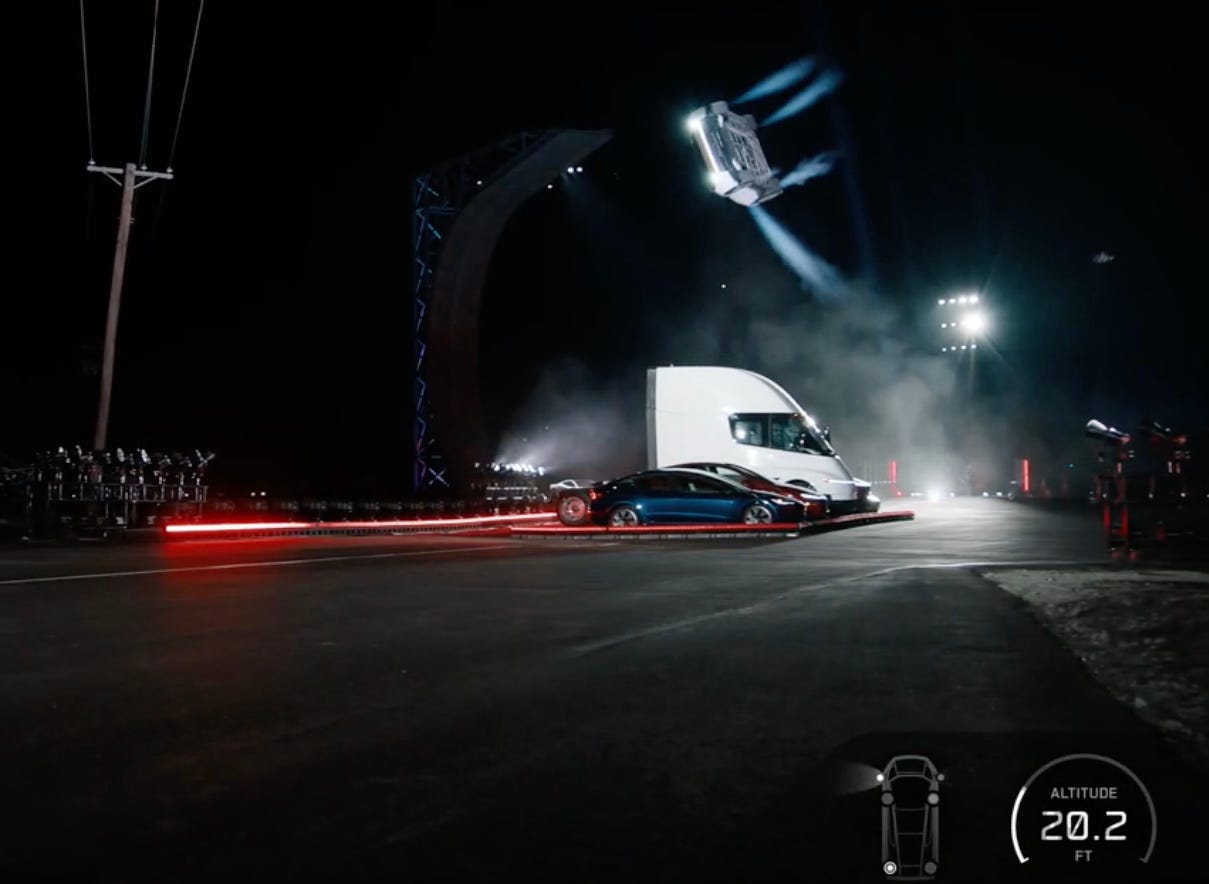
Yesterday, Elon Musk unveiled the newest Tesla Roadster, and I watched a car drive upside down, launch itself into the air, flip around, and land safely on the ground. The entire demonstration involved technology borrowed from SpaceX, an astonishing amount of engineering, and what I can only imagine was an enormous budget.
And all I could think was, “Look, Dad! I made a car that can do a kickflip!”
I genuinely laughed. Not because the engineering wasn’t impressive. Quite the opposite. The engineering was incredible. Someone figured out how to use a combination of powerful fans and rocket-inspired thrusters to manipulate a several-thousand-pound automobile in ways that would have seemed impossible not long ago. The mathematical calculations, the physics, the design, and the countless hours of testing required to make such a thing happen are difficult for me to even comprehend.
These are brilliant people doing brilliant work. I want to make that perfectly clear before I spend the rest of this essay laughing at what they’ve been asked to accomplish.
Because somewhere in the development process, a collection of some of the world’s most talented engineers was apparently presented with a challenge that amounted to making a very expensive Hot Wheels car do tricks.
And they did it! They actually did it! The car can jump over other cars! It can flip! It can drive upside down! If they can figure out how to make it fetch a tennis ball, I think we can finally declare the automobile perfected.
The whole thing made me uncomfortable in a way I wasn’t expecting. Not morally uncomfortable, although there’s certainly plenty of material there. I mean the particular kind of secondhand embarrassment I experience when an unwanted flash mob breaks out in a public place. That horrible moment when you’re just trying to enjoy your lunch and suddenly twelve strangers begin dancing in coordinated movements, smiling at you with the expectation that you’re going to find the whole thing absolutely magical.
I appreciate the choreography. I recognize the preparation. I admire the commitment. I just desperately want everyone to stop.
It’s the same feeling I get watching Tim Robinson or Nathan Fielder construct increasingly elaborate situations where the awkwardness becomes so overwhelming that I can barely stand to keep watching. The joke isn’t necessarily that anyone is doing anything wrong. It’s that someone has committed so completely to a ridiculous premise that everyone else is now being asked to participate in their enthusiasm. You’re no longer an observer. You’re an unwilling audience member in someone else’s desperate attempt to be impressive.
Only in this particular episode, the premise costs an extraordinary amount of money, the performers are engineers, and the man directing the flash mob is one of the wealthiest people in human history.
And, naturally, the audience goes wild.
There’s an additional layer of comedy when you remember that Tesla originally unveiled the second-generation Roadster in 2017, promising production in 2020. Here we are, nine years later, watching another unveiling, with production now targeted for 2028.
Apparently the car couldn’t arrive on time because it was busy learning gymnastics.
I don’t doubt that some version of this vehicle may eventually reach customers. Perhaps they’ll even be able to make it hop around a parking lot. But the distance between a spectacular demonstration and a commercially available product has historically been a rather adventurous journey in the world of Elon Musk. At this point, the Roadster has spent nearly a decade being the car of the future. I suppose actually delivering it would risk ruining the mystique.
And this is where the whole thing becomes especially interesting to me. Not the car itself, but the priorities required to make it happen.
Imagine possessing the wealth and resources to assemble teams of extraordinary minds and give them practically unlimited permission to experiment. Imagine the problems you might attempt to solve. Affordable housing. Clean water. Energy infrastructure. Technologies that could make everyday life dramatically better for millions of people.
Of course, those problems are complicated. Many require political cooperation, infrastructure, social investment, and more than engineering alone. And I don’t believe every brilliant person should spend every waking hour addressing humanity’s suffering. I’m an artist. I spend a considerable amount of my own time making things that serve no obvious practical purpose beyond my desire to make them. Ridiculousness has an important place in my worldview.
But I also don’t have billions of dollars at my disposal, and I’ve never summoned a crowd to watch one of my paintings do a backflip.
What fascinates me is that we’ve developed an economic system where spectacle can be more financially rewarding than incremental improvements in human well-being. A flying car generates headlines, investor excitement, viral videos, and endless speculation about the future. Quietly making life better for ordinary people is considerably harder to turn into a thrilling product launch.
Nobody is gathering cheering fans to watch a municipal water system work properly. Nobody is asking whether affordable housing can do a barrel roll. Apparently, making people’s lives better just isn’t as exciting as making a billionaire’s toys more impressive.
And perhaps that’s the actual joke. We’ve confused the ability to do extraordinary things with the wisdom to know which extraordinary things are worth doing. Somewhere along the way, impressing people became a reasonable substitute for helping them, provided you could sell enough stock along the way.
I keep picturing the engineers celebrating their successful demonstration, and I think they absolutely deserve to celebrate. They accomplished something remarkable. I hope they’re proud. I hope they get to take what they’ve learned and apply it to a hundred other problems, some of which might even improve the world.
But I also keep picturing Elon standing beside his flying car, waiting for everyone to recognize just how cool the whole thing is. Like a child who’s spent all afternoon practicing a trick on his skateboard and won’t let anyone go inside until they’ve watched him land it.
“Did you see it? Did you see what it did? It went upside down! And then it flipped! Did you SEE?” Yes, Elon. We saw. It’s a very impressive kickflip. Now can we please get back to our lunch?