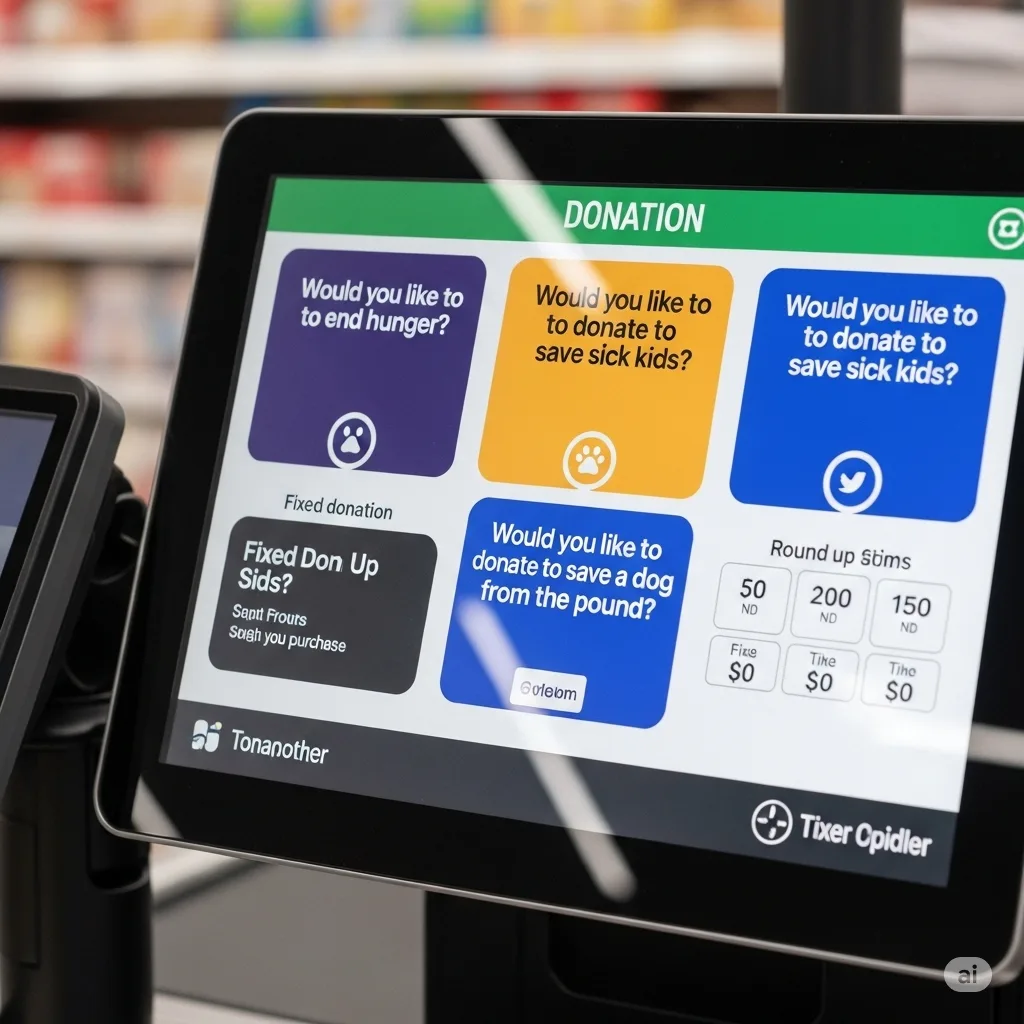
You’ve seen the little screen at the register:
“Would you like to round up your total to support sick kids?”
It flashes with pixelated virtue, asking for thirty-seven cents to save the world.
And sure, you round up. You’re not a monster.
But then you step outside, holding your overpriced groceries in a ten-cent plastic bag, thinking about the aluminum can you forgot to rinse out before tossing in the blue bin, and wondering—Am I doing enough?
Let me be clear:
This is not an accident.
This is the performance.
And you are being cast in the wrong role.
The Performance of Virtue
Somewhere along the line, corporations got very good at shifting moral responsibility from them to you. Not because it’s right—but because it’s profitable. Asking customers to “donate” at checkout lets them appear generous without spending a dime. In fact, they often write off your donations as part of their philanthropic tax strategy.
It’s not about charity.
It’s about optics.
And it works.
They pass the buck, literally and symbolically, and you—dutiful, exhausted, trying to be a “good person”—carry it.
The 10-Cent Bag and the 10-Million-Ton Lie
They charge you ten cents for a bag that costs them half a cent. They call it “environmental responsibility.” They call it “customer choice.” They build the illusion that you, the consumer, are at the heart of this system—that your decisions have the power to change the world.
But here’s the thing:
You taking your reusable bag to the store does not undo the environmental damage of international shipping.
You sorting your recycling does not offset the fact that most of it still ends up in landfills or shipped to developing nations.
You paying extra for organic produce doesn't stop the same parent corporation from clear-cutting forests elsewhere.
They want you to obsess over whether you rinsed your cans so you don’t ask why Nestlé owns half the bottled water market.
They want you to agonize over straws so you won’t ask why the oceans are full of discarded fishing nets and industrial runoff.
The Illusion of Control
This is about power.
Not just environmental power—but the psychological power of making you feel like the problem.
It’s gaslighting, weaponized at scale.
Because if you’re the problem, then they don’t have to change.
They’ve engineered a system where your participation in capitalism is framed as your fault.
You bought the cheap shirt? Shame on you.
You drove a car today? Bad citizen.
You used a plastic spoon at lunch? We hope you rot in eco-hell.
All the while, the companies behind it rake in billions, shift the blame, and sell you the solution.
Absurdity as Strategy
This isn’t just injustice. It’s absurd.
A cosmic joke where the people with the least systemic power are made to feel the most guilt.
And it’s deeply effective. Because most people want to do good.
They want to feel agency. They want to make ethical choices.
That desire for control—understandable, human—is exactly what’s being exploited.
Corporations have turned your conscience into a revenue stream.
The Real Rebellion (Now With Teeth)
So what do we do?
Let’s be clear: I’m not saying you should stop recycling. Or that using a reusable bag is meaningless. These are gestures of care—and care matters.
But we have to stop pretending they’re the solution.
Because the truth is: this manipulation works because we care. Because we want to feel some sense of agency in the face of ecological collapse or institutional cruelty. The desire to do good is exactly what’s being exploited.
They offer us moral clarity in digestible pieces:
Use this bin.
Pay this dime.
Say yes at checkout.
And it feels good—for a second. But it’s a distraction. A well-crafted theater designed to keep us busy instead of powerful.
What Real Action Looks Like
The real rebellion?
It looks like asking uncomfortable questions in public spaces, even when it’s awkward.
It looks like organizing, not just optimizing—putting pressure on companies, not just rinsing out cans.
It looks like teaching kids to notice systems, not just behaviors.
It looks like remembering that responsibility without power is just control in costume.
So sure—bring your own bag.
Wash the can.
But also:
Ask the store manager why they don’t donate.
Start a local initiative to hold businesses accountable for waste.
Support journalists and researchers who trace environmental damage to its corporate sources.
Use your humor, your voice, your presence.
You are not the villain in this story.
But if we keep playing along, we’ll never be the authors either.